‘Big Brother’ and the schools

24 Nov

Moi wrote about that Texas “Big Brother” in Texas digital school ID: ‘Big brother’ or the ‘mark of the beast’?

There was of course no way of knowing whether you were being watched at any given moment. How often, or on what system, the Thought Police plugged in on any individual wire was guesswork. It was even conceivable that they watched everybody all the time. But at any rate they could plug in your wire whenever they wanted to. You had to live—did live, from habit that became instinct—in the assumption that every sound you made was overheard, and, except in darkness, every movement scrutinized.”

George Orwell, 1984

Huffington Post is reporting in the article, Texas School District Reportedly Threatening Students Who Refuse Tracking ID, Can’t Vote For Homecoming:

Weeks after Northside Independent School District in San Antonio rolled out its new “smart” IDs that tracks students’ geographic locations, the community is still at odds with the program.

The “Student Locator Project,” which is slated to eventually reach 112 Texas schools and close to 100,000 students, is in trial stages in two Northside district schools. In an effort to reduce truancy, the district has issued new student IDs with an embedded radio-frequency identification (RFID) chip that tracks the location of a student at all times.

The program officially launched October 1 at John Jay High School and Anson Jones Middle School. Without the badges — required to be worn around the neck — students cannot access common areas like the cafeteria or library, and cannot purchase tickets to extracurricular activities. WND reports that the district has threatened to suspend, fine or involuntarily transfer students who fail to comply and officials have noted that “there will be consequences for refusal to wear an ID card as we begin to move forward with full implementation.”

Parents and students from the schools spoke out against the project last month. But now, WND is reporting that schools are taking the restrictions one step further.

John Jay High School sophomore Andrea Hernandez refuses to use the new IDs, citing religious beliefs and instead sticking with her old badge from previous years, calling the tracking devices the “mark of the beast.” She tells Salon that the new badges make her uncomfortable and are an invasion of her privacy.

But to add to her restricted school grounds access, the teen says she was barred from voting for homecoming king and queen.

I had a teacher tell me I would not be allowed to vote because I did not have the proper voter ID,” she told WND. “I had my old student ID card which they originally told us would be good for the entire four years we were in school. He said I needed the new ID with the chip in order to vote.”

If successful, the tracking program could save the district as much as $175,000 lost daily to low attendance figures, which in part determine school funding. Higher attendance could lead to more state funding in the neighborhood of $1.7 million. A statement on the school district’s website lays out the program’s goals: to increase student safety and security, increase attendance and offer a multi-purpose “smart” student ID card that streamlines grounds access and purchasing power.

While uncommon, RFID chips are not new to school IDs, according to Wired. Schools in Houston launched a monitoring program as early as 2004, and a federally funded preschool in California started placing RFID chips in children’s clothes two years ago. Numerous districts have also considered similar programs, but without making them mandatory. http://www.huffingtonpost.com/2012/10/08/texas-school-district-rep_n_1949415.html?utm_hp_ref=email_share

What one might ask would cause a school district to do that ‘big brother’ thing. It’s the money, stupid. According to the Texas Tribune’s Maurice Chammah and Nick Swartsell writing in the article, Student IDs That Track the Students which was published in the New York Times:

In Texas, school finance is a numbers game: schools receive money based on the number of students counted in their homeroom classes each morning. At Anson Jones, as at other schools, many students were in school but not in homeroom, so they were not counted and the district lost money, said Pascual Gonzalez, a spokesman for the district.

We were leaving money on the table,” he said, adding that the district expects a $2 million return on an initial investment of $261,000 in the technology at two pilot schools. [Emphasis Added] http://www.nytimes.com/2012/10/07/us/in-texas-schools-use-ids-to-track-students.html?emc=eta1&_r=0 http://drwildaoldfart.wordpress.com/2012/10/09/texas-digital-school-id-big-brother-or-the-mark-of-the-beast/

Students who refuse to be monitored are being expelled.

Aaron Dykes writes at Infowars.Com in the article, Student Expelled for Refusing Location Tracking RFID Badge:

After months of protesting a policy requiring high school students to wear an RFID-enabled ID badge around their necks at all times, Andrea Hernandez is being involuntarily withdrawn from John Jay High School in San Antonio effective November 26th, according to a letter sent by the district that has now been made public.

The letter, sent on November 13, informs her father that the Smart ID program, which was phased in with the new school year, is now in “full implementation” and requires all students to comply by wearing the location-tracking badges.

Since Andrea Hernandez has refused to wear the badge, she is being withdrawn from the magnet school and her program at the Science and Engineering Academy, and instead will have to attend William Howard Taft HS, which is not currently involved in the ID scheme, unless she changes her position.

Civil liberties lawyers at the Rutherford Institute told Infowars.com that they are in the process of filing a temporary restraining order petition to prevent the school from kicking Hernandez out until further appeals can be made to resolve the matter. Representatives for John Jay did not return calls for comment by the time of publishing.

Andrea, backed by her family, has claimed the policy violates her religious beliefs and unduly infringes on her privacy. The controversial ID badge includes the photo and name of each student, a barcode tied to the student’s social security number, as well as an RFID chip which pinpoints the exact location of the individual student, including after hours and when the student leaves campus.

The battle over the IDs has been an ongoing saga. The Hernandez family has previously attended several school board meetings, organized protests and filed formal grievances with the district over the matter, and has been backed by numerous civil rights advocates.

Infowars reporters covered a protest that took place in early October, following up with appearances by the Hernandez family on the Alex Jones Show and the Infowars Nightly News programs.
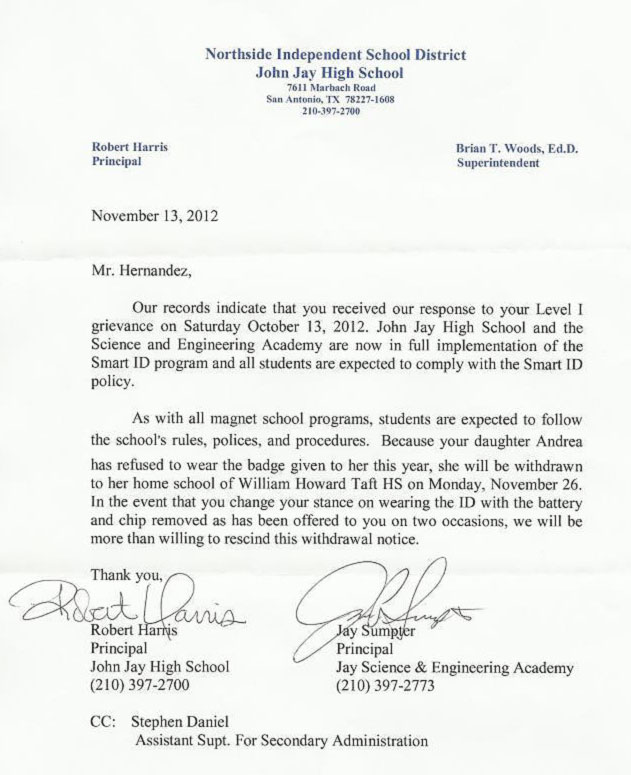
Letter from John Jay High School withdrawing Andrea Hernandez for not submitting to the RFID tracking ID badges.


http://www.infowars.com/student-expelled-for-refusing-location-tracking-rfid-badge/

For money, you would sell your soul.
 Sophocles

Resources:

Big Brother invades our classrooms                                     http://www.salon.com/2012/10/08/big_brother_invades_our_classrooms/

ACLU documents show increasing phone and internet surveillance by Department of Justice                                                       http://www.theverge.com/2012/9/27/3418420/department-of-justice-surveillance-increase-aclu

Related:

Who has access to student records?                               https://drwilda.com/tag/student-privacy-laws-complicate-schools-ability-to-prevent-attacks/

Dr. Wilda says this about that ©

Blogs by Dr. Wilda:

COMMENTS FROM AN OLD FART © http://drwildaoldfart.wordpress.com/

Dr. Wilda Reviews ©                           http://drwildareviews.wordpress.com/

Dr. Wilda ©                                                                                 https://drwilda.com/

Studies: Current testing may not adequately assess student abilities

22 Nov

Moi wrote about testing in More are questioning the value of one-size-fits-all testing:

Joy Resmovits has an excellent post at Huffington Post. In Standardized Tests’ Measures of Student Performance Vary Widely: Study Resmovits reports:

The report, written by the Education Department’s National Center for Education Statistics, found that the definition of proficiency on standardized tests varies widely among states, making it difficult to assess and compare student performance. The report looked at states’ standards on exams and found that some states set much higher bars for students proficiency in particular subjects.

The term “proficiency” is key because the federal No Child Left Behind law mandates that 100 percent of students must be “proficient” under state standards by 2014 — a goal that has been universally described as impossible to reach….

They found many states deemed students “proficient” by their own standards, but those same students would have been ranked as only “basic” — defined as “partial mastery of knowledge and skills fundamental for proficient work at each grade” — under NAEP.

The implication is that students of similar academic skills but residing in different states are being evaluated against different standards for proficiency in reading and mathematics,” the report concludes….

Here is the report citation:

Mapping State Proficiency Standards Onto NAEP Scales: Variation and Change in State Standards for Reading and Mathematics, 2005-2009

August 10, 2011

Author: Victor Bandeira de Mello

PDF Download the complete report in a PDF file for viewing and printing. (1959K PDF)

W.M. Chambers cautioned about testing in a 1964 Journal of General Education article, Testing And Its Relationship To Educational Objectives. He questioned whether testing supported the objectives of education rather than directing the objectives.

Here is the complete citation:

Penn State University Press Testing And Its Relationship To Educational Objectives

W. M. Chambers

The Journal of General Education
Vol. 16, No. 3 (October 1964), pp. 246-249
(article consists of 4 pages)

Published by:

Stable URL: http://www.jstor.org/stable/27795936

Sarah D. Sparks writes in the Education Week article, Today’s Tests Seen as Bar to Better Assessment:

The use of testing in school accountability systems may hamstring the development of tests that can actually transform teaching and learning, experts from a national assessment commission warn.

Members of the Gordon Commission on the Future of Assessment in Education, speaking at the annual meeting of the National Academy of Education here Nov. 1-3, said that technological innovations may soon allow much more in-depth data collection on students, but that current testing policy calls for the same test to fill too many different and often contradictory roles.

The nation’s drive to develop standards-based accountability for schools has led to tests that, “with only few exceptions, systematically overrepresent basic skills and knowledge and omit the complex knowledge and reasoning we are seeking for college and career readiness,” the commission writes in one of several interim reportsRequires Adobe Acrobat Reader discussed at the Academy of Education meeting.

“We strongly believe that assessment is a primary component of education, … [part of] the trifecta of teaching, learning, and testing,” said Edmund W. Gordon, the chairman of the commission and a professor emeritus of psychology at Yale University and Teachers College, Columbia University.

The two-year study group launched in 2011 with initial funding from the Princeton, N. J.-based Educational Testing Service and a membership that reads like a who’s who of education research and policy. Its 32 members include: author and education historian Diane Ravitch of New York University, former West Virginia Gov. Bob Wise of the Washington-based Alliance for Excellent Education, and cognitive psychologist Lauren Resnick of the University of Pittsburgh, among others.

The panel is developing recommendations for both research on new assessments—for the Common Core State Standards and others—and policy for educators on how to use tests appropriately. The final recommendations, expected at the end of the year, will be based on two dozen studies and analyses from experts in testing on issues of methods, student privacy, and other topics….

Related Stories

http://www.edweek.org/ew/articles/2012/11/14/12tests.h32.html?tkn=UMWFIAqhQGc%2Fi5o3iVfxpKJ7Mx2ZMahHFZ7L&cmp=clp-edweek&intc=es

There are education scholars on all sides of the testing issue.

Moi wrote in What, if anything, do education tests mean?

Every population of kids is different and they arrive at school at various points on the ready to learn continuum. Schools and teachers must be accountable, but there should be various measures of judging teacher effectiveness for a particular population of children. Perhaps, more time and effort should be spent in developing a strong principal corps and giving principals the training and assistance in evaluation and mentoring techniques. There should be evaluation measures which look at where children are on the learning continuum and design a program to address that child’s needs.               https://drwilda.com/2011/11/27/what-if-anything-do-education-tests-mean/

Dr. Wilda says this about that ©

Blogs by Dr. Wilda:

COMMENTS FROM AN OLD FART © http://drwildaoldfart.wordpress.com/

Dr. Wilda Reviews ©                           http://drwildareviews.wordpress.com/

Dr. Wilda ©                                                                                https://drwilda.com/

Study: too many kids are pumping up with steroids

20 Nov

Moi wrote in In Children, body image, bullying, and eating disorders, moi said:

The media presents an unrealistic image of perfection for women and girls. What they don’t disclose is for many of the “super” models their only job and requirement is the maintenance of their appearance. Their income depends on looks and what they are not able to enhance with plastic surgery and personal trainers, then that cellulite can be photoshopped or airbrushed away. That is the reality. Kid’s Health has some good information about Body Image https://drwilda.wordpress.com/2012/01/09/children-body-image-bullying-and-eating-disorders/

In an attempt to have a buff body many teens are using steroids.

Brian Toporek writes in the Education Week article, Study: Muscle-Enhancing Behaviors Increasingly Common Among Teens:

Both teenage boys and girls are engaging in muscle-enhancing behaviors far more than previously known, according to a study published online today in the journal Pediatrics.

As large, lean, muscular male body images have risen in popularity in Western culture, so too has teenage boys’ dissatisfaction with their own bodies, the study suggests. Some boys thus decide to engage in muscle-enhancing behaviors to shape their bodies like the ones being presented to them in the media.

For this study, three researchers from the University of Minnesota and Columbia University examined data from 2,793 youths (with a mean age of 14.4) at 20 urban middle and high schools taken during the 2009-10 school year. The researchers set out to determine the prevalence of five specific muscle-enhancing behaviors: changing eating habits to increase muscle size, increasing exercise, the use of protein powder, the use of steroids, and the use of other muscle-enhancing substances.

Nearly 70 percent of the boys in the study (897 of 1,307 total) reported having changed their eating habits in order to increase their muscle size or tone within the past 12 months, and more than 90 percent of boys increased their amount of exercise to achieve the same goal.

More than 40 percent of boys reported that they often exercised more to boost their muscle mass or tone, while 39.1 percent sometimes did, and 11.3 rarely did. Only 8.8 percent of boys never did, according to the study.

While changing eating habits and exercising more could each be considered healthy habits, many boys engaged in unhealthy behaviors, too. More than one-third of the boys in the study reported using protein powders or shakes, 5.9 percent reported using steroids, and 10.5 percent reported using some other muscle-enhancing substance.

On the female side, more than 60 percent of girls reported changing their eating habits to increase muscle size or tone, and more than 80 percent of girls exercised more for the same reason. More than 20 percent of girls reported using protein powders or shakes, 4.6 percent reported using steroids, and 5.5 percent reported using other muscle-enhancing substances…

The researchers suggest that pediatricians should ask their adolescent patients about muscle-enhancing behaviors, and say sports physicals could present a perfect opportunity to do so. http://blogs.edweek.org/edweek/schooled_in_sports/2012/11/muscle-enhancing_behaviors_increasingly_common_among_teens_study_finds.html?intc=es

Generva Pittman of Reuters writes about steroids in the article, One in 20 youth has used steroids to bulk up: study:

Anabolic steroids are synthetic versions of testosterone, the male sex hormone. Steroids are prescribed legally to treat conditions involving hormone deficiency or muscle loss, but when they’re used for non-medical purposes, it’s typically at much higher doses, according to the National Institute on Drug Abuse.

In those cases, steroids can cause mood swings – sometimes known as roid rage – and for adolescents, stunted growth and accelerated puberty.

Anabolic steroids have become pervasive in professional sports, including baseball, football and boxing. (Another example of performance-enhancing drug use is “blood doping” with erythropoietin or EPO, which is behind the Lance Armstrong cycling controversy that caused him to be stripped of his Tour de France titles last month.)

Experts have worried that the drive to get ahead of competitors at any cost could trickle down to college and high school athletes, as well.

Goldberg, co-developer of the ATLAS and ATHENA programs to prevent steroid and other substance use on high school teams, said it’s important to give teens healthier alternatives to build muscle. http://news.yahoo.com/one-20-youth-used-steroids-bulk-study-052014145.html

Citation:

Muscle-enhancing Behaviors Among Adolescent Girls and Boys

  1. Marla E. Eisenberg, ScD, MPHa,b,
  2. Melanie Wall, PhDc, and
  3. Dianne Neumark-Sztainer, PhD, MPH, RDb

+ Author Affiliations

  1. aDivision of Adolescent Health and Medicine, Department of Pediatrics, and
  2. bDivision of Epidemiology & Community Health, School of Public Health, University of Minnesota, Minneapolis, Minnesota; and
  3. cDepartments of Biostatistics and Psychiatry, Columbia University, New York, New York
    Abstract

OBJECTIVE: Media images of men and women have become increasingly muscular, and muscle-enhancing techniques are available to youth. Identifying populations at risk for unhealthy muscle-enhancingbehaviors is of considerable public health importance. The current study uses a large and diverse population-based sample of adolescents to examine the prevalence of muscle-enhancing behaviors and differences across demographic characteristics, weight status, and sports team involvement.

METHODS: Survey data from 2793 diverse adolescents (mean age = 14.4) were collected at 20 urban middle and high schools. Use of 5 muscle-enhancing behaviors was assessed (changing eating, exercising, protein powders, steroids and other muscle-enhancing substances), and a summary score reflecting use of 3 or more behaviors was created. Logistic regression was used to test for differences in each behavior across age group, race/ethnicity, socioeconomic status, BMI category, and sports team participation.

RESULTS: Muscle-enhancing behaviors were common in this sample for both boys and girls. For example, 34.7% used protein powders or shakes and 5.9% reported steroid use. Most behaviors were significantly more common among boys. In models mutually adjusted for all covariates, grade level, Asian race, BMI category, and sports team participation were significantly associated with the use of muscle-enhancing behaviors. For example, overweight (odds ratio = 1.45) and obese (odds ratio = 1.90) girls had significantly greater odds of using protein powders or shakes than girls of average BMI.

CONCLUSIONS: The use of muscle-enhancing behaviors is substantially higher than has been previously reported and is cause for concern. Pediatricians and other health care providers should ask their adolescent patients about muscle-enhancing behaviors. http://pediatrics.aappublications.org/content/early/2012/11/14/peds.2012-0095.abstract

Parents have more influence on their children’s values and beliefs than most are willing to exercise. You need to support your children’s dreams, not yours.

Because people have free will, even the best parents will have children who make mistakes. Some so identified “progressives” will attribute this lapse not to individual free will, but the fact that the message of morality is a failure. It is not. People learn lessons at different speeds, some sooner, some later. Remember the lesson of the Prodigal Son

Resources:

8 Reasons to Make Time for Family Dinner http://www.health.com/health/gallery/0,,20339151,00.html

The Family Dinner Deconstructed                                      http://www.npr.org/templates/story/story.php?storyId=18753715

The Magic of the Family Meal                                          http://www.time.com/time/magazine/article/0,9171,1200760,00.html

Related

Making time for family dinner                                             https://drwilda.com/2012/09/10/making-time-for-family-dinner/

Study: Girls as young as six think of themselves as sex objects https://drwilda.com/2012/07/18/study-girls-as-young-as-six-think-of-themselves-as-sex-objects/

Social media spreads eating disorder ‘Thinspiration’ https://drwilda.com/2012/06/19/social-media-spreads-eating-disorder-thinspiration/

Dr. Wilda says this about that ©

Blogs by Dr. Wilda:

COMMENTS FROM AN OLD FART © http://drwildaoldfart.wordpress.com/

Dr. Wilda Reviews ©                          http://drwildareviews.wordpress.com/

Dr. Wilda ©                                                                                    https://drwilda.com/


Studies: Lack of support and early parenthood cause kids to dropout

19 Nov

In Is mandating 18 as the dropout age the answer? Moi wrote:

The Alliance for Excellent Education has information about Graduation Rates at their site:

Yet every year, approximately 1.3 million students—that’s over 7,000 every school day—do not graduate from high school on time. Nationwide, only 69 percent of students earn their high school diplomas. Among minority students, only 56 percent of Hispanic, 54 percent of African American, and 51 percent of American Indian and Alaska Native students in the U.S. graduate with a regular diploma, compared to 77 percent of white students and 81 percent of Asian Americans….

High school dropouts face a lifetime of reduced earnings and a diminished quality of life. For example, a high school dropout’s lifetime earnings are, on average, about $260,000 less than a high school graduate’s. Local communities, states, and the American economy suffer from the dropout crisis as well – from lost wages, taxes, and productivity to higher costs for health care, welfare, and crime, as shown in the potential economic impacts nationally and by state.

Census projections show that the minority populations with the lowest graduation rates are poised to become half of the U.S. population by 2050. According to Demography as Destiny: How America Can Build a Better Future, an Alliance issue brief, if minority students continue to receive inferior educations and leave high school without diplomas and adequate preparation for the twenty-first-century economy, the nation’s graduation rate and economic strength will both decrease further.

To learn more, access the Alliance’s publications on high school graduation and dropout rates. http://www.all4ed.org/about_the_crisis/students/grad_rates

The question that educators, politicians, and business leaders are asking is how to decrease the dropout rates.

Passing a law is not going to be effective, but intervention for at-risk students and early childhood education are proven strategies. Those strategies cost money. The question is whether the political elite are paying lip service to dropout prevention while being penny wise and pound foolish. Rapoport is correct that raising the age to dropout must be accompanied by proven education strategies. https://drwilda.com/2012/01/26/is-mandating-18-as-the-dropout-age-the-answer/

Caralee Adams writes in the Education Week article, Why High School Students Drop Out and Efforts to Re-Engage:

Parenthood—either being a parent or missing out on parental support—is the leading reason cited by dropouts for leaving school, according to a new survey.

The 2012 High School Dropouts in America survey was released today by Harris/Decima, a division of Harris Interactive, on behalf of Everest College, a part of the for-profit Corinthian College Inc.

The poll was commissioned to help policymakers and educators understand why students drop out of high school and find effective ways to re-engage them in the hope of improving graduation rates.

The survey asked 513 adults, ages 19 to 35: “Which, if any, of the following reasons prevented you from finishing high school?” Here are the responses:

  1. Absence of parental support or encouragement (23 percent)
  2. Becoming a parent (21 percent)
  3. Lacking the credits needed to graduate (17 percent)
  4. Missing too many days of school (17 percent)
  5. Failing classes (15 percent)
  6. Uninteresting classes (15 percent)
  7. Experiencing a mental illness, such as depression (15 percent)
  8. Having to work to support by family (12 percent)
  9. Was bullied and didn’t want to return (12 percent)

In the survey, conducted online in October, 55 percent of the dropouts looked into, but had not started the process of getting their high school equivalency or GED. The likelihood of doing so is higher for those who are married (67 percent). The reasons for not getting a GED: “not having enough time” (34 percent) and “it costs too much” (26 percent).

One-third of high school dropouts say they are employed either full time, part time, or are self‐employed. Another 38 percent of the men and 26 percent of the women were unemployed.

Attracting young adults who have dropped out back for more education is a challenge.

Often students don’t want to return to the same school they left and are looking for flexible options. One approach that is showing promise is the Boston Public Re-Engagement Center. There, students can retake up to two courses they previously failed; try online credit recovery, or attend night school or summer school. Coming into the program, out-of-school youths are connected with an adult to discuss goals, finances, and enrollment options. http://blogs.edweek.org/edweek/college_bound/2012/11/examining_reasons_for_dropping_out_of_high_school_and_ways_to_re-engage_students.html

See, High School Dropouts Worsened By Lack Of Support, Becoming A Parent: Survey http://www.huffingtonpost.com/2012/11/15/lack-of-support-becoming-_n_2137961.html?utm_hp_ref=email_share

Here is the Executive Summary of Rennie Center’s report about Massachusetts:

Forgotten Youth: Re-Engaging Students Through Dropout Recovery [PDF]

Voices From the Field [PDF]

Executive Summary: Forgotten Youth: Re-Engaging Students Through Dropout Recovery [PDF]

PRESENTATIONS

Presentation: Forgotten Youth [PDF]

EVENTS

Recovering Out-of-School Youth: Using Re-Engagement as a Dropout Reduction Strategy [Web Page]  

Forgotten Youth

Re-Engaging Students Through Dropout Recovery Issue

Each year, thousands of Massachusetts students drop out of school. The path forward for these students is difficult, and failing to educate the next generation of workers and leaders has substantial long-term consequences for our shared economic and social well-being. Policymakers recently have devoted significant attention to dropout reduction; however, this agenda lacks focus on dropout recovery, the act of re-engaging and re-enrolling students who leave school before graduating. Without a more systemic approach to connect with these youth, educators will struggle to fulfill a commitment to educate all students.

Strategy

Boston’s Re-Engagement Center is a dropout recovery program that strives to re-enroll out-of-school youth through outreach, personal connections, and needs-based educational options.

Research

The Rennie Center conducted a case study of the Re-Engagement Center (REC) in Spring 2012, the findings of which are highlighted in the policy brief Forgotten Youth: Re-Engaging Students Through Dropout Recovery.

Findings

Promising practices A robust public-private partnership provides resources & support critical to the REC’s success. By pooling their assets, two partners pushed the work beyond what either could accomplish individually.
 The REC is a welcoming and supportive environment that encourages out-of-school youth to re-enroll in school. Staff encourage & assist youth who may not know what re-enrollment options are available.


Out-of-school youth who decide to return to school require appropriate educational options. A range of options, some immediately accessible, is essential for keeping these youth interested in education.


The REC is a driver of reform for serving students at-risk for leaving school. Information about out-of-school youth has pushed BPS to re-evaluate support provided to students at-risk for dropping out.

Continuing Challenges Information and data tracking is needed to demonstrate the impact of dropout recovery. There is no formal information tracking to explain the REC’s impact on graduation rates and district practices.
 

More systematic approaches are needed to evaluate out-of-school youth before re-enrollment. Re-engagement procedures would benefit from entry assessments to better address student needs.


There is limited capacity in the school district to re-enroll youth. Re-engaging youth often prefer to re-enroll in alternative education programs over traditional high schools, but seats are limited.


Formalization of the REC’s work is needed to strengthen organizational capacity and sustainability. Additional funding from diverse sources is needed to maintain and expand current operations.

 The inflexibility of some policies disengages many students who are close to graduation. Rigid credit hour requirements and MCAS administration dates create challenges to graduating with a diploma.
Considerations For school and district leaders Shape re-engagement around out-of-school youth needs by including multiple, flexible re-enrollment options. Develop partnerships with experienced organizations working to support at-risk youth. Create a supportive and welcoming environment for returning youth by finding the right staff and location.

Nurture open dialogue between re-engagement staff and district leadership to shape systematic change.


For community partners

Use an existing understanding of out-of-school youth to partner with districts to address unmet needs.

Address financial stability at the outset to ensure maintenance of the program.


For state policymakers

Support school districts in making re-engaging out-of-school youth a priority.

Encourage districts to develop or expand existing education options based on student needs.

Create opportunities for out-of-school youth to graduate by bein

Moi wrote about childcare in A baby changes everything: Helping parents finish school https://drwilda.com/tag/childcare-on-colleges/

Dr. Wilda says this about that ©

Blogs by Dr. Wilda:

COMMENTS FROM AN OLD FART © http://drwildaoldfart.wordpress.com/

Dr. Wilda Reviews ©                        http://drwildareviews.wordpress.com/

Dr. Wilda ©                                                                              https://drwilda.com/

Translating digital learning into K-12 education

18 Nov

Moi wrote in The digital divide in classrooms:

One of the major contributors to poverty in third world nations is limited access to education opportunities. The Asian Development Bank has the best concise synopsis of the link between Education and Poverty For a good article about education and poverty which has agood bibliography, go toPoverty and Education, Overview As technology becomes more prevalent in society and increasingly is used in schools, there is talk of a “digital divide” between the haves and have-nots. Laurence Wolff and Soledad MacKinnon define the “digital divide” in their article, What is the Digital Divide?

The “digital divide,” inequalities in access to and utilization of information and communication technologies (ICT), is immense.

http://info.worldbank.org/etools/docs/library/57449/digitaldivide.pdf

Access to information technology varies within societies and it varies between countries. The focus of this article is the digital divide in education. https://drwilda.com/2012/01/25/the-digital-divide-in-classrooms/

Huffington Post reports in the article, Education Technology, Digital Learning Not As Easy As It Seems: Alliance For Excellent Education Report:

A report from the Alliance for Excellent Education identifies four key challenges that public school district leaders must address in the next two years in order to successfully bring digital learning and education technology into K-12 classrooms.

The driving force behind the nationwide effort to adopt a comprehensive digital learning strategy is the move by all states to raise academic expectations by requiring students to graduate from high school college- and career-ready. Additionally, the Common Core State Standards adopted by 46 states and the District of Columbia necessitates using technology to prepare students for computer-administered assessments in the 2014-15 school year.

If you’re a school or district leader who is considering using education technology and digital learning in your schools, STOP — and go no further — until you have a comprehensive plan that addresses your district’s specific challenges and learning goals for all students,” Bob Wise, president of the Alliance for Excellent Education and former governor of West Virginia, said in a statement.

One challenge facing district leaders is ensuring that all students are adequately prepared for college and career following graduation. The report states that schools must adapt accordingly and provide students with learning opportunities that are more hands on, experiential, project-based and aligned with their interests. Doing so will enable students to produce content, analyze information and develop a deeper knowledge of complex topics.

Districts must also manage shrinking budgets and rethink how resources are allocated in support of teachers. The report recommends streamlining expenses, offering online professional development, elevating media specialists as instructional leaders and analyzing budget expenses.

When it comes to training and supporting teachers, the Alliance for Excellent Education encourages a transition from a teacher-centric culture to learner-centered instruction, so as to combat the widely uneven and inequitably distributed access to teachers. http://www.huffingtonpost.com/2012/11/15/alliance-for-excellent-ed_n_2140129.html?utm_hp_ref=email_share

The digital learning report is part of an initiative launched by the Alliance:

Alliance Launches Major Effort to Inform School District Leaders About Decisions Affecting the Future of Education

Every school, district, and state leader must make critical decisions in the next two years involving digital learning that will shape education for decades, according to a new report from the Alliance.

The report, The Nation’s Schools Are Stepping Up to Higher Standards, identifies four key challenges that public school district leaders must systemically address in the next two years and outlines the essential elements for developing a comprehensive digital strategy. (Click on the infographic to the left for a larger image).

The report, plus the Nov. 15 webinar and new digital learning web portal accompanying its release, are the first steps in a major effort by the Alliance to help district leaders make smart, far-reaching decisions about implementing education technology that support teachers and improve student outcomes in K–12 public schools.

If you’re a school or district leader who is considering using education technology and digital learning in your schools, STOP—and go no further—until you have a comprehensive plan that addresses your district’s specific challenges and learning goals for all students,” said Alliance President Bob Wise.

Read the press release , download the report, or access the digital learning portal.

All children have a right to a good basic education. See, Rural schools and the digital divide https://drwilda.com/2012/06/21/rural-schools-and-the-digital-divide/

Related:

Schools Must Bridge the Digital Divide                                          http://www.abpc21.org/digitaldivide.html

Dr. Wilda says this about that ©

Blogs by Dr. Wilda:

COMMENTS FROM AN OLD FART © http://drwildaoldfart.wordpress.com/

Dr. Wilda Reviews ©                            http://drwildareviews.wordpress.com/

Dr. Wilda ©                                                                                       https://drwilda.com/

Indiana University study: Homework doesn’t improve grades

17 Nov

Moi wrote about homework in Pros and cons of homework:

Vicki Abeles directed a very popular documentary, “The Race to Nowhere.” John Merrow, education correspondent for PBS writes in the Huffington Post article, ‘Race to Nowhere:’ It’s no ‘Waiting for ‘Superman’, ‘ but it’s Honest:

By now it seems we have all reviewed “Waiting for ‘Superman’,” but what’s surprising is that WFS is just one of four or five movies about education now out. A few weeks ago I reviewed WFS, and now I’ve decided to review the rest of them, beginning with “Race to Nowhere,” the 2009 film made by first-time director (and angry parent) Vicki Abeles.

Race to Nowhere” is a film about how schools and parental pressure are affecting students’ mental and emotional wellbeing. WFS portrays our schools as undemanding; “Race to Nowhere” says the opposite — that we are killing our kids, figuratively and sometimes literally….

Some moments in “Race to Nowhere” just jump off the screen. One that I found particularly compelling: a young woman speaking on a panel asks her audience to identify the worst question a parent can ask his or her child. Turns out, she says, it’s a one-word question. Just

And?” As in this circumstance:
Child: “I’m taking three honors courses.”
Parent: “And?”
Child: “Well, I have the lead in the school play.”
Parent: “And?”
Child: “I made the volleyball team.”
Parent: “And?”You get the picture. The parents are never satisfied, and the child can never relax. Life for these students is nothing but stress and unrealistic expectations. The world the film conjures up is all too familiar: students are expected to perform and produce but aren’t given time to play. http://www.huffingtonpost.com/john-merrow/race-to-nowhere-its-no-wa_b_751330.html

See, Why ‘Race to Nowhere’ documentary is wrong http://www.washingtonpost.com/blogs/class-struggle/post/why-race-to-nowhere-documentary-is-wrong/2011/04/03/AFBt27VC_blog.ht

Huffington Post reports about the value of homework in the article, Homework Doesn’t Improve Student Course Grades, But Could Boost Standardized Test Scores: Study:

There has been much debate surround the value of homework, and a recent study led by an Indiana University School of Education faculty member has found little correlation between time spent on homework and better course grades for math and science students. It did, however, did identify a positive relationship between homework time and performance on standardized tests.

The authors examined survey and transcript data of more than 18,000 10th grade students, focusing on individual classes. They suggest that factors like class participation and attendance may mitigate the association of homework to stronger grade performance, while the type of homework assigned may cater to standardized test preparation versus retaining knowledge of class material.

According to the report’s author, IU School of Education assistant professor Adam Maltese, “if students are spending more time on homework, they’re getting exposed to the types of questions and the procedures for answering questions that are not so different from standardized tests.”

The time spent on homework reported by most students represents the equivalent of 100-180 50-minute class periods of extra learning time each year, according to the report. http://www.huffingtonpost.com/2012/11/16/study-finds-little-correl_n_2145434.html?utm_hp_ref=education

Here is the Indiana University press release:

IU study: Homework doesn’t improve course grades but could boost standardized test scores

FOR IMMEDIATE RELEASE
Nov. 15, 2012

BLOOMINGTON, Ind. — A study led by an Indiana University School of Education faculty member finds little correlation between time spent on homework and better course grades for math and science students, but a positive relationship between homework time and performance on standardized tests.

“When Is Homework Worth the Time?” is a recently published work of Adam Maltese, assistant professor of science education in the IU School of Education, along with co-authors Robert H. Tai, associate professor of science education at the Curry School of Education at the University of Virginia, and Xitao Fan, dean of education at the University of Macau.

The authors examined survey and transcript data of more than 18,000 10th-grade students to uncover explanations for academic performance. The data focused on individual classes for students, examining the outcomes through the transcripts for students from two nationwide samples collected in 1990 and 2002 by the National Center for Education Statistics. Contrary to much of the published research, a regression analysis of time spent on homework and the final class grade found no substantive difference in grades between students who complete homework and those who do not. But the analysis found a positive association between student performance on standardized tests and the time they spent on homework.

“Our results hint that maybe homework is not being used as well as it could be,” Maltese said.

The authors suggest in their conclusions that other factors such as class participation and attendance may mitigate the association of homework to stronger grade performance. They also indicate that the types of homework assignments typically given may work better toward standardized test preparation than for retaining knowledge of class material. Maltese puts forward the idea that “if students are spending more time on homework, they’re getting exposed to the types of questions and the procedures for answering questions that are not so different from standardized tests.”

Maltese said the genesis for the study was a concern about whether a traditional and ubiquitous educational practice, such as homework, is associated with students achieving at a higher level in math and science. Many media reports about education compare U.S. students unfavorably to high-achieving math and science students from across the world. The 2007 documentary film “Two Million Minutes” compared two Indiana students to students in India and China, taking particular note of how much more time the Indian and Chinese students spent on studying or completing homework.

“We’re not trying to say that all homework is bad,” Maltese said. “It’s expected that students are going to do homework. This is more of an argument that it should be quality over quantity. So in math, rather than doing the same types of problems over and over again, maybe it should involve having students analyze new types of problems or data. In science, maybe the students should write concept summaries instead of just reading a chapter and answering the questions at the end.”

This issue is particularly relevant given that the time spent on homework reported by most students translates into the equivalent of 100 to 180 50-minute class periods of extra learning time each year.

“The results from this study imply that homework should be purposeful,” Tai said, “and that the purpose must be understood by both the teacher and the students.”

The authors conclude that given current policy initiatives of the U.S. Department of Education, states and school districts to improve science, technology, engineering and math education, more evaluation should be done about how to use homework time more effectively. They suggest more research be done on the form and function of homework assignments.

“In today’s current educational environment, with all the activities taking up children’s time both in school and out of school, the purpose of each homework assignment must be clear and targeted,” Tai said. “With homework, more is not better.”

“If homework is going to be such an important component of learning in American schools, it should be used in some way that’s more beneficial,” Maltese said. “More thought needs to be given to this, rather than just repeating problems already done in class.”

The full article is published in The High School Journal.

Citation:

When is Homework Worth the Time?: Evaluating the Association Between Homework and Achievement in High School Science and Math

Adam V. Maltese, Robert H. Tai, Xitao Fan

From: The High School Journal
Volume 96, Number 1, Fall 2012
pp. 52-72 | 10.1353/hsj.2012.0015

Abstract

Abstract:

Even with the history of debate over the merits of homework, there are significant gaps in the research record regarding its benefit to students. The focus of this study is on the association between time spent on homework and academic performance in science and math by assessing survey and transcript data from two nationally representative samples of high school students collected in 1990 and 2002. Using multiple linear regressions and controlling for students’ background, motivation, and prior achievement, we investigated how much variance in science and math course grades and achievement test scores could be explained by time spent on homework in those classes. The results indicate that there is no consistent significant relationship between time spent on homework and grades, but a consistently positive significant relationship between homework and performance on standardized exams.

There are certain populations of children who will benefit from homework assignments.

Education is quite often a one-size-fits-all approach. Each population of children is different and education strategies MUST be designed to address the needs of the child. For some children whose backgrounds are not as enriched as others; it may mean homework is necessary to bring them up to grade level. Education programs must be tailored to the needs of each child.

Resources:

Homework Help                                                                              http://kidshealth.org/kid/feeling/school/homework_help.html

Homework Tips for Parents                                              http://www2.ed.gov/parents/academic/involve/homework/homeworktips.pdf

Related:

Pros and cons of homework                                                                      https://drwilda.com/2012/06/03/pros-and-cons-of-homework/

Is homework a necessary evil?                                          https://drwilda.com/2012/04/07/is-homework-a-necessary-evil/

Dr. Wilda says this about that ©

Blogs by Dr. Wilda:

COMMENTS FROM AN OLD FART © http://drwildaoldfart.wordpress.com/

Dr. Wilda Reviews ©                         http://drwildareviews.wordpress.com/

Dr. Wilda ©                                                                                https://drwilda.com/

University of Missouri study: Counting ability predicts future math ability of preschoolers

15 Nov

Jacob Vigdor wrote the interesting Education Next article, Solving America’s Math Problem:

American public schools have made a clear trade-off over the past few decades. With the twin goals of improving the math performance of the average student and promoting equality, it has made the curriculum more accessible. The drawback to exclusive use of this more accessible curriculum can be observed among the nation’s top-performing students, who are either less willing or less able than their predecessors or their high-achieving global peers to follow the career paths in math, science, and engineering that are the key to innovation and job creation. In the name of preparing more of the workforce to take those jobs, we have harmed the skills of those who might have created them. Although there is some evidence of a payoff from this sacrifice, in the form of marginally better performance among average students, some of the strategies used to help these students have in fact backfired…

Not all children are equally prepared to embark on a rigorous math curriculum on the first day of kindergarten, and there are no realistic policy alternatives to change this simple fact. Rather than wish differences among students away, a rational policy for the 21st century will respond to those variations, tailoring lessons to children’s needs. This strategy promises to provide the next generation of prospective scientists and engineers with the training they need to create jobs, and the next generation of workers with the skills they need to qualify for them. http://educationnext.org/solving-america%E2%80%99s-math-problem/#.UG25FCk_6rE.email

One way of looking at Vigdor’s conclusions is to ask whether high performance preschool programs and early intervention can affect student achievement?

Science Daily reports about a University of Missouri study about the effect of counting ability in preschoolers in the article, Preschoolers’ Counting Abilities Relate to Future Math Performance, Researcher Says:

Along with reciting the days of the week and the alphabet, adults often practice reciting numbers with young children. Now, new research from the University of Missouri suggests reciting numbers is not enough to prepare children for math success in elementary school. The research indicates that counting, which requires assigning numerical values to objects in chronological order, is more important for helping preschoolers acquire math skills.

“Reciting means saying the numbers from memory in chronological order, whereas counting involves understanding that each item in the set is counted once and that the last number stated is the amount for the entire set,” said Louis Manfra, an assistant professor in MU’s Department of Human Development and Family Studies. “When children are just reciting, they’re basically repeating what seems like a memorized sentence. When they’re counting, they’re performing a more cognitive activity in which they’re associating a one-to-one correspondence with the object and the number to represent a quantity.”

Manfra analyzed data from more than 3,000 children from low-income households in order to determine if the children’s reciting and counting abilities in preschool affected their first-grade math scores. He found that students who could recite and count to 20 in preschool had the highest math scores in first grade; however, less than 10 percent of the children in the study could count and recite to 20.

“Counting gives children stronger foundations when they start school,” Manfra said. “The skills children have when they start kindergarten affect their trajectories through early elementary school; therefore, it’s important that children start with as many skills as possible.” http://www.sciencedaily.com/releases/2012/11/121108142808.htm

Here is the press release from the University of Missouri:

News Bureau

University of Missouri

Preschoolers’ Counting Abilities Relate to Future Math Performance, MU Researcher Says

Counting, in addition to reciting, should be emphasized in early childhood education to establish foundation for future academic success

Nov. 08, 2012

Story Contact(s):
Jesslyn Chew, ChewJ@missouri.edu, (573) 882-8353

COLUMBIA, Mo. – Along with reciting the days of the week and the alphabet, adults often practice reciting numbers with young children. Now, new research from the University of Missouri suggests reciting numbers is not enough to prepare children for math success in elementary school. The research indicates that counting, which requires assigning numerical values to objects in chronological order, is more important for helping preschoolers acquire math skills.

Reciting means saying the numbers from memory in chronological order, whereas counting involves understanding that each item in the set is counted once and that the last number stated is the amount for the entire set,” said Louis Manfra, an assistant professor in MU’s Department of Human Development and Family Studies. “When children are just reciting, they’re basically repeating what seems like a memorized sentence. When they’re counting, they’re performing a more cognitive activity in which they’re associating a one-to-one correspondence with the object and the number to represent a quantity.”

Manfra analyzed data from more than 3,000 children from low-income households in order to determine if the children’s reciting and counting abilities in preschool affected their first-grade math scores. He found that students who could recite and count to 20 in preschool had the highest math scores in first grade; however, less than 10 percent of the children in the study could count and recite to 20.

Counting gives children stronger foundations when they start school,” Manfra said. “The skills children have when they start kindergarten affect their trajectories through early elementary school; therefore, it’s important that children start with as many skills as possible.”

Previous research has shown that, in low-income families, parents often think children’s educations are the responsibility of teachers, while teachers expect parents to teach some essential skills at home, Manfra said.

These low-income children aren’t learning math skills anywhere because parents think the children are learning them at school, and teachers think they’re learning them at home,” Manfra said. “This is a problem because it gives parents and teachers the idea that it’s not their responsibility to educate the children, when it’s everyone’s responsibility. This is problematic because, when the children enter kindergarten and are at lower math levels, they don’t have the foundational skills needed to set them on paths for future success.”

Parents and teachers should integrate counting into all aspects of children’s daily activities so they can master the skill, Manfra said.

You can learn anything anywhere, and this is very true for counting,” Manfra said. “When adults read books with children, they can count the ducks on the page. They might count the leaves that fall to the ground outside or the number of carrots at lunchtime.”

The Department of Human Development and Family Studies is part of the MU College of Human Environmental Sciences. The study, “Associations between Counting Ability in Preschool and Mathematic Performance in First Grade among a Sample of Ethnically Diverse, Low-Income Children,” will be published in an upcoming issue of the Journal of Research in Childhood Education.

There will continue to be battles between those who favor a more traditional education and those who are open to the latest education fad. These battles will be fought out in school board meetings, PTSAs, and the courts.

There is one way to, as Susan Powder says, “Stop the Insanity.” Genuine school choice allows parents or guardians to select the best educational setting for their child. Many policy wonks would like to believe that only one type of family seeks genuine school choice, the right wing wacko who makes regular visits on the “tea party” circuit. That is not true. Many parents favor a back-to-the basics traditional approach to education.

A one-size-fits-all approach does not work in education

Related:

Study: Early mastery of fractions is a predictor of math success                                                                                  https://drwilda.com/tag/formula-written-for-math-success/

Dr. Wilda says this about that ©

Blogs by Dr. Wilda:

COMMENTS FROM AN OLD FART © http://drwildaoldfart.wordpress.com/

Dr. Wilda Reviews ©                                 http://drwildareviews.wordpress.com/

Dr. Wilda ©                                                                                   https://drwilda.com/

College readiness: What are ‘soft skills’

14 Nov

Whether or not students choose college or vocational training at the end of their high school career, our goal as a society should be that children should be “college ready.” David T. Conley writes in the ASCD article, What Makes a Student College Ready? http://www.ascd.org/publications/educational-leadership/oct08/vol66/num02/What-Makes-a-Student-College-Ready%C2%A2.aspxhttps://drwilda.com/2012/10/06/many-not-ready-for-higher-education/

Caralee J. Adams reports in the Education Week article, ‘Soft Skills’ Pushed as Part of College Readiness:

To make it in college, students need to be up for the academic rigor. But that’s not all. They also must be able to manage their own time, get along with roommates, and deal with setbacks. Resiliency and grit, along with the ability to communicate and advocate, are all crucial life skills. Yet, experts say, many teenagers lack them, and that’s hurting college-completion rates.

“Millennials have had helicopter parents who have protected them,” said Dan Jones, the president of the Association for University and College Counseling Center Directors and the director of counseling and psychological services at Appalachian State University in Boone, N.C. “They haven’t had the opportunity to struggle. When they come to college and bad things happen, they haven’t developed resiliency and self-soothing skills.”

College enrollment is growing, but graduation rates remain flat. Among industrialized nations, the United States ranks ninth in the world in enrollment but last in completion rates, according to an analysis of 18 countriesRequires Adobe Acrobat Reader by the Organization for Economic Cooperation and Development.

As educators look for ways to turn that showing around, many schools are incorporating the softer, noncognitive skills into college-readiness efforts. The ability to solve problems and be resourceful are viewed by some experts as being as important as mastering mathematics and reading. Helping teenagers develop those skills is being addressed in high schools, college-freshman orientation, youth-development organizations, and parenting programs….

“The expectations are not in alignment with reality,” said Harlan Cohen, the author of The Naked Roommate and 107 Other Issues You Might Run Into In College, published last year. “Students do not have the communication skills to navigate through adversity that is part of the normal transition to college.”

Colleges sell the best moments in brochures. “The uncomfortable parts aren’t illustrated. You don’t see people crying, struggling, vomiting, dealing with roommate conflict or heartache,” Mr. Cohen said.

To emotionally prepare students for campus life, he has helped craft a curriculum for high school seniors. “High schools are starting to realize that we desperately need to be responding, not just getting them into college, but getting them through,” he said….

The work of promoting life skills is bigger than high school counselors can handle alone, especially since many have caseloads far into the hundreds. College counselors try to help incoming freshmen, but their resources are stretched and their priority is serving the most-troubled students. And many experts believe those soft skills need to be taught before students get to campus.

A holistic approach to college readiness that integrates academic content, college knowledge, and psychology may be what’s needed to help more students complete college, said Andrea Venezia, a project director at WestEd, a research organization based in San Francisco. Rather than compartmentalization of college-readiness efforts, she advocates early training that includes noncognitive strategies and habits of mind that give students internal strength to persist….http://www.edweek.org/ew/articles/2012/11/14/12softskills_ep.h32.html?tkn=WQRFgl%2Bkfw2CUbzDpa48iaX0xbRF0HCUXIpI&cmp=clp-edweek&intc=es

Soft skills are skills associated with “emotional intelligence.”

Jeanne Segal, Ph.D., and Melinda Smith, M.A. have written the excellent article, Emotional Intelligence (EQ) for HELPGUIDE.Org.

What is emotional intelligence?

Emotional intelligence (EQ) is the ability to identify, use, understand, and manage emotions in positive ways to relieve stress, communicate effectively, empathize with others, overcome challenges, and diffuse conflict. Emotional intelligence impacts many different aspects of your daily life, such as the way you behave and the way you interact with others.

If you have a high emotional intelligence you are able to recognize your own emotional state and the emotional states of others and engage with people in a way that draws them to you. You can use this understanding of emotions to relate better to other people, form healthier relationships, achieve greater success at work, and lead a more fulfilling life.

Emotional intelligence consists of four attributes:

  • Self-awareness – You recognize your own emotions and how they affect your thoughts and behavior, know your strengths and weaknesses, and have self-confidence.

  • Self-management – You’re able to control impulsive feelings and behaviors, manage your emotions in healthy ways, take initiative, follow through on commitments, and adapt to changing circumstances.

  • Social awareness – You can understand the emotions, needs, and concerns of other people, pick up on emotional cues, feel comfortable socially, and recognize the power dynamics in a group or organization.

  • Relationship management – You know how to develop and maintain good relationships, communicate clearly, inspire and influence others, work well in a team, and manage conflict.

Why is emotional intelligence (EQ) so important?

As we know, it’s not the smartest people that are the most successful or the most fulfilled in life. You probably know people who are academically brilliant and yet are socially inept and unsuccessful at work or in their personal relationships. Intellectual intelligence or IQ isn’t enough on its own to be successful in life. IQ can help you get into college but it’s EQ that will help you manage the stress and emotions of sitting your final exams.

Emotional intelligence affects:

  • Your performance at work. Emotional intelligence can help you navigate the social complexities of the workplace, lead and motivate others, and excel in your career. In fact, when it comes to gauging job candidates, many companies now view emotional intelligence as being as important as technical ability and require EQ testing before hiring.

  • Your physical health. If you’re unable to manage your stress levels, it can lead to serious health problems. Uncontrolled stress can raise blood pressure, suppress the immune system, increase the risk of heart attack and stroke, contribute to infertility, and speed up the aging process. The first step to improving emotional intelligence is to learn how to relieve stress.

  • Your mental health. Uncontrolled stress can also impact your mental health, making you vulnerable to anxiety and depression. If you are unable to understand and manage your emotions, you’ll also be open to mood swings, while an inability to form strong relationships can leave you feeling lonely and isolated.

  • Your relationships. By understanding your emotions and how to control them, you’re better able to express how you feel and understand how others are feeling. This allows you to communicate more effectively and forge stronger relationships, both at work and in your personal life. http://www.helpguide.org/mental/eq5_raising_emotional_intelligence.htm

Whether one calls success traits “emotional intelligence” or “soft skills” is really not important. The traits associated are those more likely to result in a successful outcome for the student.

Margaret Rouse defines “soft skills” in the post, Soft Skills:

Soft skills are personal attributes that enhance an individual’s interactions, job performance and career prospects. Unlike hard skills, which are about a person’s skill set and ability to perform a certain type of task or activity, soft skills are interpersonal and broadly applicable.

Soft skills are often described by using terms often associated with personality traits, such as:

  • optimism
  • common sense
  • responsibility
  • a sense of humor
  • integrity

and abilities that can be practiced (but require the individual to genuinely like other people) such as:

  • empathy
  • teamwork
  • leadership
  • communication
  • good manners
  • negotiation
  • sociability
  • the ability to teach.

It’s often said that hard skills will get you an interview but you need soft skills to get (and keep) the job. http://searchcio.techtarget.com/definition/soft-skills

K-12 education must not only prepare students by teaching basic skills, but they must prepare students for training after high school, either college or vocational. There should not only be a solid education foundation established in K-12, but there must be more accurate evaluation of whether individual students are “college ready.”

Related:

Many NOT ready for higher education                                    https://drwilda.com/2012/10/06/many-not-ready-for-higher-education/

What the ACT college readiness assessment means               https://drwilda.com/2012/08/25/what-the-act-college-readiness-assessment-means/

Study: What skills are needed for ’21st-century learning?’                       https://drwilda.com/2012/07/11/study-what-skills-are-needed-for-21st-century-learning/

ACT to assess college readiness for 3rd-10th Grades                           https://drwilda.com/2012/07/04/act-to-assess-college-readiness-for-3rd-10th-grades/

Dr. Wilda says this about that ©

Blogs by Dr. Wilda:

COMMENTS FROM AN OLD FART © http://drwildaoldfart.wordpress.com/

Dr. Wilda Reviews ©                                http://drwildareviews.wordpress.com/

Dr. Wilda ©                                                                                   https://drwilda.com/

Will ‘massive open online courses’ (MOOCS) begin to offer credit?

14 Nov

Moi discussed online college courses in Do online badges give a more realistic appraisal than grades?

The New York Times reported about the online education trend in the article, Online Enterprises Gain Foothold as Path to a College Degree http://www.nytimes.com/2011/08/25/education/25future.html?_r=1&emc=eta1

Often these online ventures will offer a certificate or badge to show completion of a course of study. Education Portal defines the difference between a certificate and diploma:

Certificate Overview

A certificate is earned by a student after taking a series of courses relating to a subject. Students often earn certificates to get a step ahead in the professional field of their interest and certificates may be offered in similar programs as degrees. For instance, there are certificates in business, literature and technical programs. In some technical programs, a certificate may be required.

There are also graduate certificates, often taken either alone or alongside a graduate degree program. In some programs, the student may use his or her electives to fulfill a certificate in order to make him or herself more desirable to a potential employer.

Certificate programs taken alone are similar to associate’s degree programs. However, they take less time because core academic programs are not required.

Diploma Overview

Diplomas are similar to certificates but often earned at clinical schools. For instance, a diploma of nursing is offered as an option besides an associate’s degree or bachelor’s degree. This diploma program is only offered at hospitals with specialty programs that provide training. A diploma often takes two years and involves as much clinical work as classroom.

Degree Overview

An academic degree can be earned at many levels, including associate’s, which takes two years, bachelor’s, which takes four years, master’s, which is two years beyond a bachelor’s degree, and doctoral, which is several years beyond a master’s degree.

A degree program differs from certificates and diploma programs in that it often requires the student to take core courses to support a more rounded education. For instance, at many universities, those earning their bachelor’s degree are required to take English, math, science, philosophy and history. Earning a degree also opens up many more potential doors to the student than would a certificate or diploma. Many careers require that the student has earned at least a bachelor’s degree; several career options require more than this. http://education-portal.com/articles/What_is_the_Difference_Between_a_Certificate_Diploma_and_Degree.html

Some online universities are awarding badges. Lynn O’Shaughnessy reports in the U.S. News article, Digital Badges Could Significantly Impact Higher Education. http://www.usnews.com/education/blogs/the-college-solution/2011/10/04/digital-badges-could-significantly-impact-higher-education https://drwilda.com/2012/01/23/can-free-online-universities-change-the-higher-education-model/

https://drwilda.com/2012/10/21/do-online-badges-give-a-more-realistic-appraisal-than-grades/

Nick Anderson reports in the Washington Post article, Exploring credits for free online courses:

The American Council on Education, which represents university presidents, said Tuesday it is teaming with the Bill & Melinda Gates Foundation and the free online education provider Coursera on an initiative to seek answers to those questions.

The announcement is the latest sign of the emerging influence of what are known as mass­ive open online courses, or MOOCs. Millions of people this year have tried out MOOCs on Web sites such as Coursera, edX, Udacity and others.

MOOCs are an intriguing, innovative new approach that hold much promise for engaging students across the country and around the world, as well as for helping colleges and universities broaden their reach,” Molly Corbett Broad, president of the council, said in a statement. She said the council is eager to help answer questions such as whether the free online courses can “increase learning productivity.”

Under the initiative, Coursera will pay the council a to-be-determined fee to evaluate the credit-worthiness of a selection of its courses. Coursera, a for-profit company, hosts about 200 courses from 33 prominent institutions. Among local participants are the universities of Virginia and Maryland and Johns Hopkins University.

Broad said the council also is in discussions with edX, a nonprofit MOOC venture led by MIT and Harvard University, about possible analysis of its courses.

The universities that offer MOOCs have not said that they intend to award credits for them. But a recommendation from the council that the courses are worthy of credit would be a key step toward helping students obtain transfer credit from other schools. Another key step would be to arrange proctored exams to verify student work….

Some university presidents are skeptical.

C.L. Max Nikias, president of the University of Southern California, said his school will not offer free online courses. He said he worries about how much students learn through MOOCs and whether their achievement can be verified. http://www.washingtonpost.com/local/education/exploring-credits-for-free-online-courses/2012/11/13/ccdcbac8-2d8f-11e2-89d4-040c9330702a_story.html?wpisrc=emailtoafriend

See, College Credit Eyed for Online Courses http://www.nytimes.com/2012/11/14/education/moocs-to-be-evaluated-for-possible-college-credit.html?emc=eta1&_r=0

Jeffrey R. Young reports in the Chronicle of Higher Education article, American Council on Education May Recommend Some Coursera Offerings for College Credit:

ACE also announced on Tuesday that it will set up a Presidential Innovation Lab that will bring together college leaders to discuss the potential of MOOC’s and new business models for higher education. The lab is supported by an $895,453 grant from the Bill & Melinda Gates Foundation, as part of about $3-million in new MOOC-related grants announced Tuesday.

The review process by the council will be “similar to the way regional accreditation works,” said Molly Corbett Broad, president of ACE. Professors will look at the content, teaching methods, “evidence of student engagement,” and other elements of MOOC’s to see if they appear equivalent to that taught by an accredited college, she added.

To pass the council’s test, Coursera will make a few changes in the courses for which it seeks certification. For instance, ACE requires an “authentication of identity,” said Ms. Broad, meaning that Coursera must have some kind of proctored examination or other way to prove that students are who they say they are.

For the courses in the pilot project, Coursera will form partnerships with online proctoring companies that use Webcams and special software to monitor tests remotely, said Daphne Koller, co-founder of Coursera. Students hold up their ID’s to a Webcam during an appointed exam time, and an employee from the proctoring company checks them to verify identity, and then watches students take the test to make sure they aren’t cheating.

Meanwhile, the proctoring company uses software to monitor the students’ activity to make sure they aren’t just Googling the answers. Ms. Koller expects the cost of the proctoring to be less than $30 per exam.

The remote-proctoring strategy differs from an identity-verification system used by other providers of MOOC’s, including edX, a nonprofit started by Harvard University and the Massachusetts Institute of Technology, and Udacity, a start-up company competing with Coursera. Both of those organizations say they will use a series of testing centers run by Pearson, which will require students to travel to a test center to take final exams in person, if they want a certificate of completion.

Related Content

http://chronicle.com/article/American-Council-on-Education/135750/?cid=pm&utm_source=pm&utm_medium=en

With any education opportunity the prospective student and their family must do their homework and weigh the pros and cons of the institution with with the student’s goals and objectives. In answer to the question of whether online college is a threat to traditional bricks and mortar universities, it depends. The market will answer that question because many students do not attend college to receive a liberal arts education, but to increase employment opportunities. If the market accepts badges and certificates, then colleges may be forced to look at the costs associated with a traditional college degree.

Related:

Verifying identity for online courses                                            https://drwilda.com/2012/04/15/verifying-identity-for-online-courses/

Is online higher ed a threat to bricks and mortar colleges? https://drwilda.com/2012/09/17/is-online-higher-ed-a-threat-to-bricks-and-mortar-colleges/

Dr. Wilda says this about that ©

Blogs by Dr. Wilda:

COMMENTS FROM AN OLD FART © http://drwildaoldfart.wordpress.com/

Dr. Wilda Reviews ©                            http://drwildareviews.wordpress.com/

Dr. Wilda ©                                                                                https://drwilda.com/

Study: Early stress in girls may be the source of later anxiety

13 Nov

Prolonged stress can have adverse effects on humans. Moi wrote about the Adverse Childhood Experiences Study in Study: Some of the effects of adverse stress do not go away:

Sarah D. Sparks writes in the Education Week article, Research Traces Impacts of Childhood Adversity:

Research from Dr. Shonkoff’s center and from other experts finds that positive stress—the kind that comes from telling a toddler he can’t have a cookie or a teenager that she’s about to take a pop quiz—causes a brief rise in heart rate and stress hormones. A jolt can focus a student’s attention and is generally considered healthy.

Similarly, a child can tolerate stress that is severe but may be relatively short-term—from the death of a loved one, for example—as long as he or she has support….

Toxic’ Recipe

By contrast, so-called “toxic stress” is severe, sustained, and not buffered by supportive relationships.

The same brain flexibility, called plasticity, that makes children open to learning in their early years also makes them particularly vulnerable to damage from the toxic stressors that often accompany poverty: high mobility and homelessness; hunger and food instability; parents who are in jail or absent; domestic violence; drug abuse; and other problems, according to Pat Levitt, a developmental neuroscientist at the University of Southern California and the director of the Keck School of Medicine Center on the Developing Child in Los Angeles…. http://www.edweek.org/ew/articles/2012/11/07/11poverty_ep.h32.html?tkn=QLYF5qldyT3U0BI0xqtD5885mihZIxwbX4qZ&cmp=clp-edweek

Here is information about the Adverse Child Experiences Study. The Centers for Disease Control and Prevention provides access to the peer-reviewed publications resulting from The ACE Study. http://acestudy.org/

https://drwilda.com/2012/11/09/study-some-of-the-effects-of-adverse-stress-do-not-go-away/

Waisman Laboratory for Brain Imaging and Behavior published a study which looks at the effects of stress on girls.

Science Daily is reporting in the article, Early Stress May Sensitize Girls’ Brains for Later Anxiety:

High levels of family stress in infancy are linked to differences in everyday brain function and anxiety in teenage girls, according to new results of a long-running population study by University of Wisconsin-Madison scientists.

The study highlights evidence for a developmental pathway through which early life stress may drive these changes. Here, babies who lived in homes with stressed mothers were more likely to grow into preschoolers with higher levels of cortisol, a stress hormone. In addition, these girls with higher cortisol also showed less communication between brain areas associated with emotion regulation 14 years later. Last, both high cortisol and differences in brain activity predicted higher levels of adolescent anxiety at age 18.

The young men in the study did not show any of these patterns.

“We wanted to understand how stress early in life impacts patterns of brain development which might lead to anxiety and depression,” says first author Dr. Cory Burghy of the Waisman Laboratory for Brain Imaging and Behavior. “Young girls who, as preschoolers, had heightened cortisol levels, go on to show lower brain connectivity in important neural pathways for emotion regulation — and that predicts symptoms of anxiety during adolescence….”

The current paper has its roots back in 1990 and 1991, when 570 children and their families enrolled in the Wisconsin Study of Families and Work (WSFW). All of the children were born in either Madison or Milwaukee. Dr. Marilyn Essex, a UW professor of psychiatry and co-director of the WSFW, said the initial goal was to study the effects of maternity leave, day care and other factors on family stress. Over the years, the study has resulted in important findings on the social, psychological, and biological risk factors for child and adolescent mental health problems. Subjects are now 21 and 22 years old, and many continue to participate.

For the current study, Burghy and Birn used fcMRI to scan the brains of 57 subjects — 28 female and 29 male — to map the strength of connections between the amygdala, an area of the brain known for its sensitivity to negative emotion and threat, and the prefrontal cortex, often associated with helping to process and regulate negative emotion. Then, they looked back at earlier results and found that girls with weaker connections had, as infants, lived in homes where their mothers had reported higher general levels of stress — which could include symptoms of depression, parenting frustration, marital conflict, feeling overwhelmed in their role as a parent, and/or financial stress. As four-year-olds, these girls also showed higher levels of cortisol late in the day, measured in saliva, which is thought to demonstrate the stress the children experienced over the course of that day. http://www.sciencedaily.com/releases/2012/11/121111152930.htm#.UKEogDfvMTo.email

Citation:

Nature Neuroscience | Article

Developmental pathways to amygdala-prefrontal function and internalizing symptoms in adolescence

Nature Neuroscience
(2012)
doi:10.1038/nn.3257
Received
23 July 2012
Accepted
11 October 2012
Published online
11 November 2012
Abstract

Early life stress (ELS) and function of the hypothalamic-pituitary-adrenal axis predict later psychopathology. Animal studies and cross-sectional human studies suggest that this process might operate through amygdala–ventromedial prefrontal cortex (vmPFC) circuitry implicated in the regulation of emotion. Here we prospectively investigated the roles of ELS and childhood basal cortisol amounts in the development of adolescent resting-state functional connectivity (rs-FC), assessed by functional connectivity magnetic resonance imaging (fcMRI), in the amygdala-PFC circuit. In females only, greater ELS predicted increased childhood cortisol levels, which predicted decreased amygdala-vmPFC rs-FC 14 years later. For females, adolescent amygdala-vmPFC functional connectivity was inversely correlated with concurrent anxiety symptoms but positively associated with depressive symptoms, suggesting differing pathways from childhood cortisol levels function through adolescent amygdala-vmPFC functional connectivity to anxiety and depression. These data highlight that, for females, the effects of ELS and early HPA-axis function may be detected much later in the intrinsic processing of emotion-related brain circuits.

Stress has negative effects on the body.

According to the Mayo Clinic article, Stress symptoms: Effects on your body, feelings and behavior:

Common effects of stress …
… On your body … On your mood … On your behavior
  • Headache
  • Muscle tension or pain
  • Chest pain
  • Fatigue
  • Change in sex drive
  • Stomach upset
  • Sleep problems
  • Anxiety
  • Restlessness
  • Lack of motivation or focus
  • Irritability or anger
  • Sadness or depression
  • Overeating or undereating
  • Angry outbursts
  • Drug or alcohol abuse
  • Tobacco use
  • Social withdrawal

Source: American Psychological Association’s “Stress in America” report, 2010

http://www.mayoclinic.com/health/stress-symptoms/SR00008_D

This study points to the need for quality prenatal care.

The March of Dimes discusses stress during pregnancy in the article, Emotional and life changes:

What types of stress can cause pregnancy problems?

Stress is not all bad. When you handle it right, a little stress can help you take on new challenges. Regular stress during pregnancy, such as work deadlines and sitting in traffic, probably don’t add to pregnancy problems.

However, serious types of stress during pregnancy may increase your chances of certain problems, like premature birth. Most women who have serious stress during pregnancy can have healthy babies. But be careful if you experience serious kinds of stress, like:

  • Negative life events. These are things like divorce, serious illness or death in the family, or losing a job or home. 
  • Catastrophic events. These are things like earthquakes, hurricanes or terrorist attacks. 
  • Long-lasting stress. This type of stress can be caused by having financial problems, being abused, having serious health problems or being depressed. Depression is medical condition where strong feelings of sadness last for long periods of time and prevent a person from leading a normal life. 
  • Racism. Some women may face stress from racism during their lives. This may help explain why African-American women in the United States are more likely to have premature and low-birthweight babies than women from other racial or ethnic groups. 
  • Pregnancy-related stress. Some women may feel serious stress about pregnancy. They may be worried about miscarriage, the health of their baby or about how they’ll cope with labor and birth or becoming a parent. If you feel this way, talk to your health care provider.

Does post-traumatic stress disorder affect pregnancy?
Post-traumatic stress disorder (PTSD) is when you have problems after seeing or experiencing a terrible event, such as rape, abuse, a natural disaster, a terrorist attack or the death of a loved one. People with PTSD may have:

  • Serious anxiety 
  • Flashbacks of the event 
  • Nightmares 
  • Physical responses (like a racing heartbeat or sweating) when reminded of the event

As many as 8 in 100 women (8 percent) may have PTSD during pregnancy. Women who have PTSD may be more likely than women without it to have a premature or low-birthweight baby. They also are more likely than other women to have risky health behaviors, such as smoking cigarettes, drinking alcohol or taking street drugs. Doing these things can increase the chances of having pregnancy problems. If you think you may have PTSD, talk to your provider or a mental health professional.

How does stress cause pregnancy problems?
We don’t completely understand the effects of stress on pregnancy. But certain stress-related hormones may play a role in causing certain pregnancy complications. Serious or long-lasting stress may affect your immune system, which protects you from infection. This can increase the chances of getting an infection of the uterus. This type of infection can cause premature birth.

Stress also may affect how you respond to certain situations. Some women deal with stress by smoking cigarettes, drinking alcohol or taking street drugs, which can lead to pregnancy problems.

Can high levels of stress in pregnancy hurt your baby later in life?
Some studies show that high levels of stress in pregnancy may cause certain problems during childhood, like having trouble paying attention or being afraid. It’s possible that stress may also affect your baby’s brain development or immune system.

How can you reduce stress during pregnancy?
Here are some ways to reduce stress:

  • Figure out what’s making you stressed and talk to your partner, a friend or your health care provider about it. 
  • Know that the discomforts of pregnancy are only temporary. Ask your provider how to handle these discomforts. 
  • Stay healthy and fit. Eat healthy foods, get plenty of sleep and exercise (with your provider’s OK).
  • Exercise can help reduce stress and also helps prevent common pregnancy discomforts. 
  • Cut back on activities you don’t need to do. 
  • Have a good support network, including your partner, family and friends. Ask your provider about resources in the community that may be able to help. 
  • Ask for help from people you trust. Accept help when they offer. For example, you may need help cleaning the house, or you may want someone to go with you to your prenatal visits. 
  • Try relaxation activities, like prenatal yoga or meditation. 
  • Take a childbirth education class so you know what to expect during pregnancy and when your baby arrives. Practice the breathing and relaxation techniques you learn in your class. 
  • If you’re working, plan ahead to help you and your employer get ready for your time away from work. 
  • If you think you may be depressed, talk to your provider right away. There are many ways to deal with depression. Getting treatment and counseling early may help.

Last reviewed January 2012 http://www.marchofdimes.com/pregnancy/lifechanges_indepth.html

See, The Importance of Quality Prenatal Care http://www.mdnews.com/news/2010_07/national_jul10_the-importance-of-quality-prenatal-care

Our goal as a society should be:

A healthy child in a healthy family who attends a healthy school in a healthy neighborhood ©

Resources:

The Effects of Stress on Your Body                                           http://www.webmd.com/mental-health/effects-of-stress-on-your-body

The Physical Effects of Long-Term Stress                              http://psychcentral.com/lib/2007/the-physical-effects-of-long-term-stress/all/1/

Chronic Stress: The Body Connection                            http://www.medicinenet.com/script/main/art.asp?articlekey=53737

Understanding Stress Symptoms, Signs, Causes, and Effects http://www.helpguide.org/mental/stress_signs.htm

Dr. Wilda says this about that ©

Blogs by Dr. Wilda:

COMMENTS FROM AN OLD FART © http://drwildaoldfart.wordpress.com/

Dr. Wilda Reviews ©                                         http://drwildareviews.wordpress.com/

Dr. Wilda ©                                                                                  https://drwilda.com/