Archive | October, 2012

Ohio study: Deregulation in college education equals less access to modest and lower-income students

19 Oct

Moi really doesn’t know what to make of the idea of privatizing state universities. In the recent past, government had the goal of raising the standard of living and producing the economic conditions that fostered livable wage jobs. The goal of most politicians was to create the conditions that promoted and fostered a strong middle class. Particularly, after WWII and the Korean War, with the G.I Bill, one part of that equation was the wide availability of a college education. This push produced an educated workforce and a college education was within reach, no matter one’s class or social status. This educated workforce helped drive this country’s prosperity. Now, have we lost the goal of providing educational opportunity the widest number of people possible, no matter their class or social status? This question causes moi to wonder about privatizing state universities.

A couple of questions. First, has anyone ever looked at how efficient the academic world is in spending current resources? Second, is the current institutional model one that works? Should there be changes in the institutional model? Finally, is this proposal the first step toward privatization of universities?  Sam Dillion was writing about the prospect of privatizing public universities in the New York Times in 2005. See, At Public Universities, Warnings of Privatization In 2004, William Symonds wrote an opinion piece in Business Week about the role of public universities

Tamar Lewin wrote an excellent 2011 article in the New York Times about the greater percentage that tuition is making up of must public university budgets. In, Public Universities Relying More on Tuition Than State Money Lewin writes:

According to the Delta Cost Project, most of the nation’s public research universities had more than half their costs paid by tuition in 2008, and other four-year public institutions were hovering near the 50 percent mark. With three more years of tuition increases, they, too, have probably passed it, said Jane V. Wellman, executive director of the project, leaving only community colleges as mostly state-financed.

And the increasing dependence on tuition has disturbing implications for access to higher education, she said.

In the next three or four years, we’re going to have more students who are spilling out the bottom, priced out of the expensive institutions,” Ms. Wellman said. “We’re going to be rationing opportunity. We’re moving in that direction fairly rapidly.”

Given that states still provide some $80 billion for higher education, some education policy experts say it is wrong to think of public universities as privatized. But they acknowledge that a fundamental reordering is under way — and that the era of affordable four-year public universities, heavily subsidized by the state, may be over.

Something important is happening here,” said Pat Callan, president of the National Center for Public Policy and Higher Education. “I wouldn’t call it privatization, a word often used by presidents of public institutions who want a blank check on raising tuition. But with the shift toward more student funding, you have to wonder who owns these places — the students, because they’re paying the majority, or the state, which has invested hundreds of years in the physical plant and the brand?”

The burden on students is likely to keep growing. According to the Center on Budget and Policy Priorities, 30 states face shortfalls of at least 10 percent of their budgets next year. And given the difficulties of cutting costs for Medicaid or K-12 schools, which get the biggest chunk of state budgets, appropriations for higher education are likely to shrivel further, leaving public universities ever more dependent on tuition money.

The University of South Carolina has lost almost half of its state appropriations in the last three years, gets only about a quarter of its education budget from the state and is expecting another round of deep cuts next year.

We still have our public mission, but at this point, we have more of a private funding model,” said Michael Amiridis, the provost.

More states may soon find themselves in a similar position. In California, where tuition has been raised by 30 percent in the last two years — and where out-of-state tuition now tops $50,000, about the same as an elite private university — the governor has proposed cutting state support for the University of California by $500 million for the next fiscal year.

If approved, this budget will mean that for the first time in our long history, tuition paid by University of California students and their families will exceed the state’s contribution to the core fund,” Mark Yudof, the president of the University of California system, told the Board of Regents. “For those who believe what we provide is a public good, not a private one, this is a sad threshold to cross.”

In Texas, legislators have proposed closing four community colleges and ending financial aid for freshmen. In Georgia, the popular Hope scholarships are likely to be slashed. In Arizona, the governor has proposed cutting financing for community colleges by half, and for four-year universities by 20 percent.

In state after state, tuition and class size are rising, jobs are being eliminated, maintenance is being deferred and the number of nonresident students, who pay higher tuition, is increasing.

Policy Matters Ohio studied deregulation efforts in the Ohio higher education system. See, Lack of Success in Experiments Deregulating Public Higher Ed http://www.educationnews.org/higher-education/lack-of-success-in-experiments-deregulating-public-higher-ed/

Here is the press release from Policy Matters Ohio:

Deregulated higher education shows troubling results

by Policy Matters Ohio on October 17th, 2012

October 17th, 2012     
   
For immediate release
Contact: Wendy Patton, 614.221.4505
Download press release
Go to full report

Higher tuition, less access for modest-income students at systems with less public control, study finds

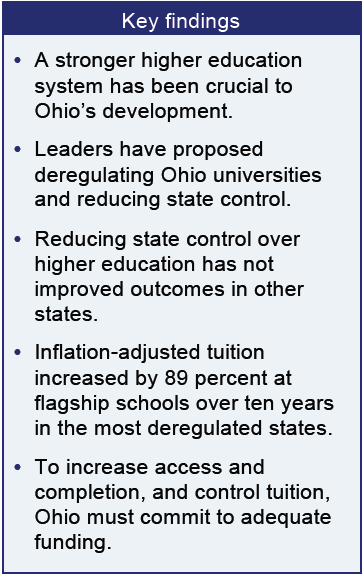
The most deregulated public college and university systems in the U.S. saw a staggering 89 percent tuition growth in flagship schools over the past decade (inflation adjusted), enrolled the lowest percentage of lower-income students, and devoted the lowest amount of state per capita income to higher education when compared to more regulated public education systems, according to a new report from Policy Matters Ohio.

The study, Deregulation and higher education: Potential impact on access, affordability and achievement in Ohio, reviews higher education management structures around the country.

In August 2011, the Kasich administration proposed the Enterprise University Plan,an approach that is likely to form the basis for changes to university management in Ohio. The proposal provides broad exemption from state fiscal and administrative statutes; diminished state oversight of real estate, construction, procurement, and legal settlements; elimination of student enrollment caps; and authority to set differential tuition.

Deregulation in other states has not made tuition more affordable, increased access for low-income students, or increased graduation rates,” said Wendy Patton, senior project director at Policy Matters and report co-author. “Public support for universities and funding for need-based aid, not management structure, are the key factors that lead to lower tuition and more access.”

In the past 20 years, many states have loosened control over aspects of public higher education. Ohio’s proposal goes further than most – it lacks state-mandated performance targets on retention, graduation, affordability and other mechanisms included in the deregulation of other systems.

Policy Matters compared enrollment, graduation, affordability, and low-income student access for the nation as a whole with three smaller groups of states: highly deregulated states like Colorado and Virginia; partially regulated approaches like in Illinois, New Jersey and Texas and coordinated systems as in Kentucky, Maryland and Minnesota.

Ohio’s Enterprise University Plan is most like the highly deregulated model. The most deregulated systems in our study have seen the highest inflation-adjusted tuition growth at flagship schools since deregulation, an 89 percent jump. At non-flagship four-year universities, tuition has spiked most in the partially regulated schools, the second most deregulated category.

Public investment has plunged across all management structures, with highly deregulated systems investing the least by 2011, a paltry $3.79 for every $1,000 in state income, down from $7.55 in 1991. Ohio’s investment also plunged, from $7.03 for every $1,000 in state income in 1991 to just $4.57 in 2011. Low-income enrollment for the highly deregulated group was far behind the control group, just 26.1 percent compared to 37.8 percent.

Public universities and colleges in Ohio helped to dramatically increase higher education levels over the past fifty years. They have given employers skilled professionals, provided a pathway to the middle class, and provided businesses with cutting edge research. However, Ohio college completion levels lag the nation (we rank 34th), tuition is higher than average (tied for third most costly relative to median family income), the state has slashed support for higher education and for need-based aid, and it is difficult in Ohio, as elsewhere, for students from middle-class and low-income families to afford college. Federal aid helps: Ohio enrolls more students who are eligible for and get federal assistance in the form of Pell grants (38.9 percent).

The report concludes that reducing public control over Ohio’s university system could result in higher tuition and lower access for students from middle- and low-income families. The report recommends that, instead of deregulating, Ohio adequately fund higher education, commit to need-based aid, and establish strong performance targets.

Ohio’s future depends on an excellent higher education system capable of preparing Ohioans to participate in the economy and community,” said Michelle Camou, report co-author. “The enterprise plan lost sight of Ohio’s own goals, labor force needs, and understanding of higher education as a pathway to the middle class. Outcomes are likely to be better if citizens maintain control over Ohio’s public university system.”

###

 Policy Matters is a non-profit, non-partisan policy research institute. Michelle Camou, who has a Ph.D. in political science from University of Colorado at Boulder, is a public policy consultant, specializing in urban development, labor, immigration, and higher education policies.

Here are some key findings:
Download report
Download executive summary

The public policy wonks well tell you that it is bad public policy to have tightly dedicated funds for one particular public purpose. But, we are at the time in this society where a dedicated source of funding for K-16 education should be examined. Otherwise, the seeds of growth for the economic future of this state and this country will die before they have a chance to germinate.

Dr. Wilda says this about that ©

Blogs by Dr. Wilda:

COMMENTS FROM AN OLD FART © http://drwildaoldfart.wordpress.com/

Dr. Wilda Reviews ©                        http://drwildareviews.wordpress.com/

Dr. Wilda ©                                                                                    https://drwilda.com/

Study: High school students enrolled in college courses more likely to complete college

18 Oct

Moi said in Motivation is increasingly researched as a key ingredient in student achievement:

Moi often says education is a partnership between the student, the teacher(s) and parent(s). All parties in the partnership must share the load. The student has to arrive at school ready to learn. The parent has to set boundaries, encourage, and provide support. Teachers must be knowledgeable in their subject area and proficient in transmitting that knowledge to students. All must participate and fulfill their role in the education process. https://drwilda.com/tag/student-achievement/

Huffington Post is reporting in the article, College Courses In High School Yield Students More Likely To Attend, Graduate From College: Study:

Results showed that high school students who completed a college course before graduation were nearly 50 percent more likely to earn a college degree from a Texas two- or four-year college within six years than students who had not participated in dual enrollment.

According to the report’s findings, 54.2 percent of dual enrollment students earned some form of college degree, compared to 36.9 percent of non-dual enrollment high school graduates. Branching off that, 47.2 percent of high school graduates who had taken college courses while still in high school went on to earn a Bachelor’s degree, compared to 30.2 percent of non-dual enrollees.

The study tracked 32,908 Texas students for six years, beginning when they graduated from high school in 2004. Half were “dual enrollment” students, meaning they completed college courses while in high school that awarded both high school and college credit, and half were not. According to the report, both groups were otherwise similar in academic and social background.

These finding held true for all racial groups and for students from low-income households. In fact, dual enrollment students from low-income families were especially more likely to attend a four-year college in Texas after high school….http://www.huffingtonpost.com/2012/10/17/study-finds-that-students_n_1974063.html?utm_hp_ref=education

Here is the press release from Jobs for the Future:

MEDIA CONTACT

Jayme Rubenstein 617.728.4446 x152
jrubenstein@jff.org

Study: “Dual enrollment” students more likely to attend, graduate from college

BOSTON, MA (October 17, 2012) — High school students who take college courses are significantly more likely to attend and graduate from college than peers who do not, according to a study of more than 30,000 Texas high school graduates by Boston-based education nonprofit Jobs for the Future (JFF).

JFF’s study, Taking College Courses in High School: A Strategy for College Readiness, tracked 32,908 students who graduated from Texas high schools in 2004. Half were “dual enrollment” students—completing college courses that typically award both high school and college credit—and half were not, though the two groups were otherwise similar in academic and social background. The study found: 

  • Dual enrollment students were more than twice as likely to enroll in a Texas two- or four-year college, and nearly twice as likely to earn a degree.
  • 54.2% of dual enrollment graduates earned a college degree, compared to 36.9% of non-DE grads.
  • 47.2% of DE graduates earned a Bachelor’s degree, compared to 30.2% of non-DE grads.

These benefits held for all racial groups and for students from low-income families.

We’re excited to add to a growing body of research evidence strongly suggesting that dual enrollment improved education outcomes for all populations, including those currently underrepresented in higher education,” said Ben Struhl, lead author of the report and senior project manager at JFF. 

A big question in education reform has been: ‘How do we increase the college readiness of those most likely not to go?’” said Joel Vargas, report coauthor and vice president of JFF’s High School Through College team. “Dual enrollment is a strategy states can use to help answer that question.”

Dual enrollment is not a new concept. Most states have dual enrollment policies and programs. However, this report urges policymakers to expand college course taking for high school students through dual enrollment as a strategy to increase college readiness and success. The report also encourages policymakers to support efforts that promote the preparation of more students for dual enrollment to get on a path toward completing college, such as early college high schools that target minorities and low-income students—populations that are underrepresented in higher education. Texas has 49 early colleges, serving over 10,000 students statewide.

Texas’ results are particularly notable because the state has one of the nation’s largest and fastest-growing public school populations, and has seen a spike in dual enrollment participation. Texas’ DE student body has grown from 17,784 in 2000 to 90,364 in 2010 (a 408 percent increase), according to the Texas Higher Education Coordinating Board.

We look forward to studying how Texas dual enrollees have fared since 2004,” Vargas said. “And we encourage other states to offer the same opportunities to all students—especially those with traditionally lower college enrollment and completion rates.”

To download Taking College Courses in High School: A Strategy for College Readiness, go to http://bit.ly/S22VEB

About Jobs for the Future

Jobs for the Future aligns education with today’s high-demand careers. With its partners, JFF develops policy solutions and new pathways leading from college readiness to career advancement for struggling and low-income populations in America.

www.jff.org

Twitter: @JFFtweets

Moi said in College Board’s ‘Big Future’: Helping low-income kids apply to college:                                                                                                       In 3rd world America: The economy affects the society of the future, moi said:

One of the major contributors to poverty in third world nations is limited access to education opportunities. Without continued sustained investment in education in this country, we are the next third world country. All over the country plans are being floated to cut back the school year or eliminate programs which help the most disadvantaged….The best way to eliminate poverty is job creation, job growth, and job retention. The Asian Development Bank has the best concise synopsis of the link between Education and Poverty For a good article about education and poverty which has a good bibliography, go to Poverty and Education, Overview  There will not be a good quality of life for most citizens without a strong education system. One of the major contributors to poverty in third world nations is limited access to education opportunities. Without continued sustained investment in education, we are the next third world country. https://drwilda.com/2012/04/19/college-boards-big-future-helping-low-income-kids-apply-to-college/

Related:

Closing the achievement gap: What is AVID college preparation? https://drwilda.com/2012/10/16/closing-the-achievement-gap-what-is-avid-college-preparation/

Many NOT ready for higher education                                         https://drwilda.com/2012/10/06/many-not-ready-for-higher-education/

Who should take AP classes?                                              https://drwilda.com/2012/02/14/who-should-take-ap-classes

Dr. Wilda says this about that ©

COMMENTS FROM AN OLD FART © http://drwildaoldfart.wordpress.com/

Dr. Wilda Reviews ©                          http://drwildareviews.wordpress.com/

Dr. Wilda ©                                                                                   https://drwilda.com/

For-profit colleges: It’s all about the $$$

16 Oct

Moi wrote in Report: For-profit colleges more concerned with executive pay than student achievement:

Michael Stratford reports on the Harkin report in the Chronicle of Higher Education article, Senate Report Paints a Damning Portrait of For-Profit Higher Education:

For-profit colleges can play an important role in educating nontraditional students, but the colleges often operate as aggressive recruiting machines focused on generating shareholder profits at the expense of a quality education for their students.

That’s the unflattering portrait of the for-profit higher-education industry detailed in a voluminous report officially released on Monday by the Senate Health, Education, Labor, and Pensions Committee. The report, which also criticizes the accrediting agencies that evaluate the colleges, concludes a two-year investigation into the operations of 30 for-profit higher-education companies from 2006 to 2010….

Profits Over Students

The report says that more than half of the 1.1 million students who enrolled in the colleges under scrutiny in 2008-9 had withdrawn by mid-2010. Those retention rates varied between publicly traded and privately held for-profit colleges. At the 15 publicly traded companies 55 percent of students withdrew, compared with 46 percent at the 15 privately held companies, many of which are owned by private-equity firms.

While community colleges and two-year for-profit programs have similarly low retention rates, the cost of the for-profit programs makes those programs more risky for students and federal taxpayers,” the report says. Nearly all students attending a for-profit college take out loans to attend, the report says, compared with just 13 percent of community-college students.

Internal company documents examined by the investigation reveal that decisions to increase tuition at for-profit colleges were driven by profit goals rather than increasing costs of instruction. The educational interests of students rarely, if at all, figured into that decision making, the report says. https://drwilda.com/2012/07/31/report-for-profit-colleges-more-concerned-with-executive-pay-than-student-achievement/

For-profit education exists at both higher education and K-12.

Moi wrote in Online K-12 education as a cash cow for ‘Wall Street’: There should be a variety of options and approaches in education. Still, School choice does not mean education on the cheap! K-12 education should not be the next sub-prime mortgage or derivative gambit for large for-profit companies. Lee Fang has written the alarming Nation article, How Online Learning Companies Bought America’s Schools.

While most education reform advocates cloak their goals in the rhetoric of “putting children first,” the conceit was less evident at a conference in Scottsdale, Arizona, earlier this year.

Standing at the lectern of Arizona State University’s SkySong conference center in April, investment banker Michael Moe exuded confidence as he kicked off his second annual confab of education startup companies and venture capitalists. A press packet cited reports that rapid changes in education could unlock “immense potential for entrepreneurs.” “This education issue,” Moe declared, “there’s not a bigger problem or bigger opportunity in my estimation.”

Moe has worked for almost fifteen years at converting the K-12 education system into a cash cow for Wall Street. A veteran of Lehman Brothers and Merrill Lynch, he now leads an investment group that specializes in raising money for businesses looking to tap into more than $1 trillion in taxpayer money spent annually on primary education. His consortium of wealth management and consulting firms, called Global Silicon Valley Partners, helped K12 Inc. go public and has advised a number of other education companies in finding capital.

Moe’s conference marked a watershed moment in school privatization. His first “Education Innovation Summit,” held last year, attracted about 370 people and fifty-five presenting companies. This year, his conference hosted more than 560 people and 100 companies, and featured luminaries like former DC Mayor Adrian Fenty and former New York City schools chancellor Joel Klein, now an education executive at News Corporation, a recent high-powered entrant into the for-profit education field. Klein is just one of many former school officials to cash out. Fenty now consults for Rosetta Stone, a language company seeking to expand into the growing K-12 market.

As Moe ticked through the various reasons education is the next big “undercapitalized” sector of the economy, like healthcare in the 1990s, he also read through a list of notable venture investment firms that recently completed deals relating to the education-technology sector, including Sequoia and Benchmark Capital. Kleiner Perkins, a major venture capital firm and one of the first to back Amazon.com and Google, is now investing in education technology, Moe noted. http://www.thenation.com/article/164651/how-online-learning-companies-bought-americas-schools

Henry M. Levin of Columbia University had some cautionary notes about for-profit K-12 education in 2001.

In the 2001 paper, Thoughts on For-profit Schools, Levin wrote:

The fact is that we know little about how for-profit schools will operate and how they will affect students and other schools. At least three major questions have yet to be answered satisfyingly:

If schools are a potentially profitable endeavor, then why did entrepreneurs wait so long to enter the market? Is there something unique about schooling that makes it difficult to earn a profit?

Now that we do have for-profit schools, how will they achieve cost savings? Will they bring fundamentally different approaches to education through curricular and technological innovations that will “break the mold”?

Even if they are more effective or less costly, or both, will they earn profits that are comparable to the returns on other investments? http://www.ncspe.org/publications_files/7_OP14.pdfhttps://drwilda.com/2011/11/21/online-k-12-education-as-a-cash-cow-for-wall-street/

AP and Seattle Times staff are reporting in the article, University of Phoenix closing some Puget Sound-area learning centers:

Apollo Group, the for-profit education company that operates the University of Phoenix, said it would close 115 of the university’s locations, including several in the Puget Sound region…

Apollo said the closures will affect 13,000 students nationwide, or about 4 percent of the university’s students. The move was spurred by a 60 percent decline in Apollo’s fiscal fourth-quarter profit, which was hurt by higher costs and declining University of Phoenix enrollment.

Shares in the Phoenix-based company tumbled nearly 8 percent in after-hours trading Tuesday.

The closings nationwide include 25 main campuses and 90 smaller satellite learning centers. At least one location in 30 states is slated to be shuttered.

Students affected by the closures will be given the option of transferring to online programs or moving their course work to other sites, said University of Phoenix President Bill Pepicello.

If no other center is nearby, the company will continue courses at other space near the closed facility until students complete their degrees, he added.

The university, which also recently announced a tuition freeze, is in the process of notifying students.

The University of Phoenix currently has about 328,000 students, down from a peak of more than 400,000. Following the closures, it will be left with 112 locations in 36 states, the District of Columbia and Puerto Rico.

The announcement comes as enrollments overall in the for-profit sector are declining after years of rapid growth, even as enrollment in other sectors of higher education rises. Recent federal figures showed enrollment in for-profits fell 2.9 percent in 2011. The sector has faced tighter regulations and more pressure to enroll students who have a better chance of graduating.

Another factor in the closures: students increasingly favor online courses. Others are put off by the shaky economy.

People are simply holding off investing money in education at a time when the costs are escalating and the outcomes are uncertain,” Pepicello said.

In the June-to-August quarter, the number of students enrolled in degreed programs at University of Phoenix fell on an annual basis by 13.8 percent to 328,400. While enrollment of new students in degreed programs declined 13.7 percent.

That decline led to an 11 percent drop in fiscal fourth-quarter revenue for the university’s parent company, which helped weigh down earnings despite some changes in tuition prices and other fees.

Apollo reported net income of $75.4 million, or 66 cents per share, for the three months ended Aug. 31. That compares with net income of $188.6 million, or $1.37 per share, a year earlier.

The latest results included $9.4 million in restructuring costs and other charges. Excluding the special items, Apollo’s earnings amounted to 52 cents per share.

Revenue fell to $996.5 million from $1.12 billion. http://seattletimes.com/html/businesstechnology/2019448516_universityphoenixxml.html

Many critics put the emphasis on “for-profit” and will adamantly argue that any entity which is for-profit is inherently bad for education. Moi would put the emphasis on neighborhood choice and argue that entities without strong ties to the neighborhood they intend to operate in, do not have the loyalty to succeeding in that particular neighborhood and will probably not be successful. Let’s be honest, corporations intend to generate a profit from their education activities as their primary goal. The secondary goal is probably the education of children. Moi is skeptical that a for-profit entity really has the commitment to a neighborhood and thus to a neighborhood’s schools. Still, moi is not like some so called “anti-reform” types who foam at the mouth at the words charter and for-profit. There is no magic bullet or “Holy Grail” in education. There is only what works to produce academic achievement in each population of children. That is why school choice is so important. Still, the welfare of the student must be paramount.

Children are not the new sub-prime mortgage business or the new derivative gambit.People must be afraid, very afraid of the vultures who are now hovering around the education sector. If folks don’t watch them, the results will not be pretty.

Resources:

College accreditation – U.S. Department of Education

http://ope.ed.gov/accreditation/

College Accreditation: Frequently Asked Questions

http://www.back2college.com/library/accreditfaq.htm

Ask questions before deciding on a for-profit college [Video]

http://latimesblogs.latimes.com/money_co/2011/02/questions-deciding-for-profit-college-video.html

For Profit Colleges: Get the Facts

http://www.education.com/magazine/article/for-profit-colleges/

Related:

For-profit colleges: Money buys government, not quality for students                                                                                https://drwilda.com/2011/12/12/for-profit-colleges-money-buys-government-not-quality-for-students/

Dr. Wilda says this about that ©

Blogs by Dr. Wilda:

COMMENTS FROM AN OLD FART © http://drwildaoldfart.wordpress.com/

Dr. Wilda Reviews ©                                      http://drwildareviews.wordpress.com/

Dr. Wilda ©                                                                                   https://drwilda.com/

Closing the achievement gap: What is AVID college preparation?

16 Oct

Moi wrote in Many NOT ready for higher education:

Whether or not students choose college or vocational training at the end of their high school career, our goal as a society should be that children should be “college ready.” David T. Conley writes in the ASCD article, What Makes a Student College Ready? http://www.ascd.org/publications/educational-leadership/oct08/vol66/num02/What-Makes-a-Student-College-Ready%C2%A2.aspxhttps://drwilda.com/2012/10/06/many-not-ready-for-higher-education/

One program which is helping many students overcome the achievement gap is Advancement Via Individual Determination (AVID).

Jay Mathews reports in the Washington Post article, Reforming a nation of bad note-takers:

But I didn’t know what I was doing. No one ever showed me how best to break down a lecture or book. This is common. Most high school and college students write what seems important but are rarely satisfied with the result.

It never occurred to me what I had missed until I encountered a college readiness program called Advancement Via Individual Determination (AVID) that is getting rave reviews from teachers. One of its most radical and effective tactics is teaching students the neglected skill of taking notes.

Visiting an AVID class, I realized how much time and energy I had wasted not learning to do this right. Teachers new to AVID have a similar reaction, because our education system and our education schools have not made note-taking a priority.

Fairfax County social studies teacher Eric Welch first tasted the power of thoughtful summarizing at a 2005 AVID summer training on teaching what are called Cornell notes. “I saw that this fed into so many different aspects of learning,” he said. Seven years later, he is the AVID coordinator for J.E.B. Stuart High School, which has become one of the highest-achieving schools in the country with a majority of students from low-income families.

AVID began in 1980 with an English teacher, Mary Catherine Swanson, who was upset that her suburban San Diego school was doing so little to help low-performing students bused in from poor neighborhoods. Her mix of multi-subject tutoring and instruction in note-taking, time management and critical thinking began with 32 students. AVID now has 425,000 students in 48 states, the District and 16 territories and foreign countries. There are AVID programs in Alexandria and in Montgomery, Prince George’s, Fairfax, Loudoun, Anne Arundel and Charles counties.

The note-taking system taught by AVID was developed by Cornell University education professor Walter Pauk in 1949. The student divides a sheet of note paper into two columns, the one on the right twice as wide as the one on the left. The student adds a horizontal line about two inches from the bottom of the page.

The student take notes in the right column, using a number of symbols and abbreviations. Questions and key words go in the left column. Afterward, the student reviews the notes, revises and adds questions and a brief summary at the bottom of the page.

The process deepens learning and augments review, but it takes practice and perseverance, qualities not common among the middle school and younger high school students in introductory AVID classes. AVID students have just one class a day with their AVID teacher. The rigor of the rest of the day depends on how much their other teachers — not all of them AVID-trained — reinforce AVID values. http://www.washingtonpost.com/blogs/class-struggle/post/reforming-a-nation-of-bad-note-takers/2012/10/14/13327bfc-1427-11e2-ba83-a7a396e6b2a7_blog.html

The What Works Clearinghouse defines AVID:

According to What Works Clearinghouse, AVID is:

Program Description1

AVID2 is a college-readiness program whose primary goal is to prepare middle and high school students for enrollment in four-year colleges through increased access to and support in advanced courses. The program, which focuses on underserved, middle-achieving students (defined as students earning B, C, and even D grades), places students in college preparatory classes (e.g., honors and Advancement Placement classes) while providing academic support through a daily elective period and ongoing tutorials. http://ies.ed.gov/ncee/wwc/reports/adolescent_literacy/avid/index.asp

Here is a summary of the research about AVID:

Research

Since 1980, AVID has been closely studied by numerous research teams and individuals. In addition to our own data collection (see the Data & Results page), AVID’s success has been demonstrated by numerous third-party studies. In fact, the quality of our proof is so high, that AVID was one of eleven organizations to receive the highest praise for outstanding rigorous research by Building Engineering and Science Talent in an April 2004 report to Congress. If you know of a research article in the print media or on the web that you would like to share, please contact us. If you have questions or comments about our research, please contact Director of Research & Evaluation, Dr. Dennis Johnston at djohnston@avidcenter.org.

The AVID Center has organized the research section of our website so that is useful for clients, the media, and the public. We recommend that you begin your tour by viewing two research documents that summarize key findings:

AVID Research Overview A summary presentation of AVID’s research.
Review of AVID Research A summary and key findings of representative research articles on AVID.

For additional research, view the:

AVID and GEAR UP page
Schoolwide/Districtwide page
AVID’s Electronic Archival Guide

Quick links for this page:

Highlights from AVID Graduate Research:

  • AVID sends one third more students to 4-year colleges than the local and national average.
  • African American AVID students, whether they participate in AVID for one or three years, are enrolling in college at rates which are considerably higher than the local and national average.
  • Students who participate in AVID enroll more often than students who don’t participate, and the longer students enroll in AVID, the better is their college enrollment record.
  • AVID students are staying in college once they enroll; 89% of those who started are in college two years later.
  • In short, the capital that students bring with them into the program does not seem to be as important as the capital that the students accrue while they are in the program.
  • More than twice the percentage of students with two years of middle school AVID took three or more AP classes than those with only one year or no AVID experience in middle school.


Full Studies:

“The Impact of Advancement Via Individual Determination (AVID) on Mexican American Students Enrolled in a Four-year University.” Mendiola, I.D., Watt, K. M., Huerta, J. Journal of Hispanics in Higher Education. (In Press.) The purpose of this study was to investigate the higher educational progress of Mexican American students who participated in AVID

“The Magnificent Eight: AVID Best Practices Study.” Larry F. Guthrie, Grace Pung Guthrie. Center for Research, Evaluation and Training in Education. February 2002. This study investigates how closely eight California AVID Demonstration schools, generally considered to be representative of mature AVID programs, follow the AVID implementation model. The researchers also discuss whether or not all of the eleven AVID essentials are requisite, and propose several additional essentials.

“Constructing School Success: The Consequences of Untracking Low-Achieving Students.” Hugh Mehan, I. Villanueva, L. Hubbard, A. Lintz. Cambridge: Cambridge University Press, 1996. This book presents an in-depth picture of AVID within the context of tracking and “untracking” students based on perceived academic ability. It shows that AVID succeeds in placing previously low-track students on the college track. Mehan, et al., also published a follow-up piece on AVID, in 1998: “Scaling up an Untracking Program: A Co-Constructed Process.” L. Hubbard and H. Mehan. JESPAR 4(1), 83-100.

Impact at the High School Level

Highlights from AVID High School Studies:

  • The AVID, AVID/GEAR UP, and GEAR UP groups raised their anticipations level by increasing their level of satisfaction from Associate’s to Bachelor’s over the 2-year period.
  • Students who felt nurtured stayed in AVID; personal bonds with the AVID teachers were key to continuing in the program for four years.
  • The family-like atmosphere of AVID was important to students’ morale, self-esteem and determination.
  • While not statistically significant, higher aspirations and college knowledge were found among AVID and GEAR UP students.
  • AVID high schools improved their accountability ratings as measured by the Texas Assessment of Academic Skills and dropout rates, over the 4-year study period.

There are links to more research at http://www.avid.org/abo_research.html

K-12 education must not only prepare students by teaching basic skills, but they must prepare students for training after high school, either college or vocational. There should not only be a solid education foundation established in K-12, but there must be more accurate evaluation of whether individual students are “college ready.”

Related:

What the ACT college readiness assessment means                             https://drwilda.com/2012/08/25/what-the-act-college-readiness-assessment-means/

Study: What skills are needed for ’21st-century learning?’                       https://drwilda.com/2012/07/11/study-what-skills-are-needed-for-21st-century-learning/

ACT to assess college readiness for 3rd-10th Grades                               https://drwilda.com/2012/07/04/act-to-assess-college-readiness-for-3rd-10th-grades/

Dr. Wilda says this about that ©

Blogs by Dr. Wilda:

COMMENTS FROM AN OLD FART © http://drwildaoldfart.wordpress.com/

Dr. Wilda Reviews ©                             http://drwildareviews.wordpress.com/

Dr. Wilda ©                                                                                  https://drwilda.com/

Study: Bored students may be stressed rather than bored

14 Oct

Moi wrote in Motivation is increasingly researched as a key ingredient in student achievement

Moi wrote in It’s the culture and the values, stupid:

Every week in the Seattle Stranger there is a column I, Anonymous , which gives one reader the chance to rant anonymously about any topic or person that has provoked such a reaction that venting and a good old fashion rant is necessary. Sometimes, the rants are poetic or touching. Most of the time, they are just plain hilarious. This is a recent rant, which is from a teacher, not an educator

I say hello with a big smile every morning as you shuffle in the door, but I secretly seethe with hatred for almost each and every one of you. Your stupidity and willful ignorance know no bounds. I have seen a lot of morons in my 10 years of teaching high school, but you guys take the cake. Your intellectual curiosity is nonexistent, your critical thinking skills are on par with that of a head trauma victim, and for a group of people who have never accomplished anything in their lives, you sure have a magnified sense of entitlement. I often wonder if your parents still wipe your asses for you, because you certainly don’t seem to be able to do anything on your own.
A handful of you are nice, sweet kids. That small group will go on and live a joyful and intellectual life filled with love, adventure, and discovery. The vast majority of you useless fuckwits will waste your life and follow in the footsteps of your equally pathetic parents. Enjoy your future of wage slavery and lower-middle-class banality.
Amazing how teachers are blamed for the state of education in this country. Look what you give us to work with. I am done trying to teach the unteachable.

Moi doesn’t blame most teachers for the state of education in this country, but puts the blame on the culture and the unprepared and disengaged parents that culture has produced. Moi also blames a culture of moral relativism as well which says there really are no preferred options. There are no boundaries, I can do what I feel is right for ME. https://drwilda.com/2011/11/04/its-the-culture-and-the-values-stupid/ https://drwilda.com/2012/10/02/motivation-is-increasingly-researched-as-a-key-ingredient-in-student-achievement/

Sarah D. Sparks reports in the Education Week article, Studies Link Students’ Boredom to Stress:

Boredom is one of the most consistent experiences of school and one that can be frustrating and disheartening for teachers. According to findingsRequires Adobe Acrobat Reader in the High School Survey of Student Engagement, conducted by the Indiana University Bloomington, boredom is nearly universal among American students. Of a representative sample of more than 275,000 high school students surveyed in 27 states from 2006 to 2009, 65 percent reported being bored in class at least once a day.

Lack of Focus

Under Mr. Eastman and his colleagues’ definition, a student who is bored cannot focus attention to engage in the class activity—and blames that inability to focus on the outside environment. A dry lecture style or an uninteresting topic might trigger boredom, Mr. Eastman said, but so can other issues that interfere with a student’s attention and working memory.

Getting to the Roots

When students feel bored, research shows they are aware of their own difficulty paying attention. A student may attribute the experience to not being interested in the material or the lecture style. But new studies show that any stress or distraction that takes up working memory—from emotional trauma to attention deficit hyperactivity disorders—all could be contributing to the problem.

For example, students with attention deficit hyperactivity disorder are more likely to report feeling bored than students with normal attention. Students tackling material that is too difficult for them—and thus taking up more working memory—also are more likely to report it is “boring” rather than simply frustrating, Mr. Eastman and other researchers found.

“When people are in a negative emotional state, discouraged, or down, we know that causes attention problems,” Mr. Eastman said. “We know when people are stressed it makes it harder to focus and pay attention at a very basic, fundamental level.”

Like any type of stress, boredom hampers the prefrontal cortex, the brain area positioned just behind that student’s furrowed brow that allows a student to reason and hold different facts in working memory. http://www.edweek.org/ew/articles/2012/10/10/07boredom_ep.h32.html?tkn=VMPF3anAix33lAsD%2BFnoz1mgquEbELuvXvaO&cmp=clp-edweek

Here is the press release from the American Psychological Association:

PRESS RELEASE

September 26, 2012
For Immediate Release

Contact: Anna Mikulak
Association for Psychological Science
202.293.9300
amikulak@psychologicalscience.org

I’m Bored!” – Research on Attention Sheds Light on the Unengaged Mind

Related Topics: Attention, Cognitive Processes, Cognitive Psychology, Emotions, Perspectives on Psychological Science, Thinking

You’re waiting in the reception area of your doctor’s office. The magazines are uninteresting. The pictures on the wall are dull. The second hand on the wall clock moves so excruciatingly slowly that you’re sure it must be broken. You feel depleted and irritated about being stuck in this seemingly endless moment. You want to be engaged by something—anything—when a thought, so familiar from childhood, comes to mind: “I’m bored!”

Although boredom is often seen as a trivial and temporary discomfort that can be alleviated by a simple change in circumstances, it can also be a chronic and pervasive stressor that can have significant consequences for health and well-being.

Boredom at work may cause serious accidents when safety depends on continuous vigilance, as in medical monitoring or long-haul truck driving. On a behavioral level, boredom has been linked with problems with impulse control, leading to overeating and binge eating, drug and alcohol abuse, and problem gambling. Boredom has even been associated with mortality, lending grim weight to the popular phrase “bored to death.”

Although it’s clear that boredom can be a serious problem, the scientific study of boredom remains an obscure niche of research, and boredom itself is still poorly understood. Even though it’s a common experience, boredom hasn’t been clearly defined within the scientific community.

Psychological scientist John Eastwood of York University (Ontario, Canada) and colleagues at the University of Guelph and the University of Waterloo wanted to understand the mental processes that underlie our feelings of boredom in order to create a precise definition of boredom that can be applied across a variety of theoretical frameworks. Their new article, which brings together existing research on attention and boredom, is published in the September 2012 issue of Perspectives on Psychological Science, a journal of the Association for Psychological Science.

Drawing from research across many areas of psychological science and neuroscience, Eastwood and colleagues define boredom as “an aversive state of wanting, but being unable, to engage in satisfying activity,” which arises from failures in one of the brain’s attention networks.

Specifically, we’re bored when:

  • We have difficulty paying attention to the internal information (e.g., thoughts or feelings) or external information (e.g., environmental stimuli) required for participating in satisfying activity
  • We’re aware of the fact that we’re having difficulty paying attention
  • We believe that the environment is responsible for our aversive state (e.g., “this task is boring,” “there is nothing to do”).

The researchers are confident that integrating the disparate fields of cognitive neuroscience, social psychology, and clinical psychology will produce a more thorough understanding of boredom and attention—phenomena which are ubiquitous and intimately linked.

Armed with a precise and broadly applicable definition of boredom that gets at the underlying mental processes, the authors identify important next steps in research on boredom. Eastwood and his colleagues hope to help in the discovery and development of new strategies that ease the problems of boredom sufferers and address the potential dangers of cognitive errors that are often associated with boredom.

###

For more information about this study, please contact: John D. Eastwood at johneast@yorku.ca.

Perspectives on Psychological Science is ranked among the top 10 general psychology journals for impact by the Institute for Scientific Information. It publishes an eclectic mix of thought-provoking articles on the latest important advances in psychology. For a copy of the article “The Unengaged Mind: Defining Boredom in Terms of Attention” and access to other Perspectives on Psychological Science research findings, please contact Anna Mikulak at 202-293-9300 or amikulak@psychologicalscience.org.

Moi wrote in The ‘whole child’ approach to education

Moi writes this blog around a set of principles which are:

All children have a right to a good basic education.

  1. Education is a partnership between the student, parent(s) or guardian(s), the teacher(s), and the school. All parts of the partnership must be active and involved.

  2. Society should support and foster strong families.

  3. Society should promote the idea that parents are responsible for parenting their children and people who are not prepared to accept that responsibility should not be parenting children.

  4. The sexualization of the culture has had devastating effects on children, particularly young women. For many there has been the lure of the “booty call” rather than focusing on genuine achievement.

    Education is a life long pursuit

Many children do not have a positive education experience in the education system for a variety of reasons. Many educators are advocating for the “whole child” approach to increase the number of children who have a positive experience in the education process.

The National Education Association (NEA) describes the “whole child” approach to learning in the paper, Meeting the Needs of the Whole Child:

Meeting the needs of the whole child requires:

Addressing multiple dimensions, including students’ physical, social and emotional health and well-being.

Ensuring equity, adequacy and sustainability in resources and quality among public schools and districts.

Ensuring that students are actively engaged in a wide variety of experiences and settings within—and outside—the classroom.

Providing students with mentors and counselors as necessary to make them feel safe and secure.

Ensuring that the condition of schools is modern and up-to-date, and that schools provide access to a broad array of resources.

Reducing class size so that students receive the individualized attention they need to succeed.

Encouraging parental and community involvement. http://www.educationvotes.nea.org/wp-content/uploads/2010/04/WholeChildBackgrounder.pdf

ASCD, (formerly the Association for Supervision and Curriculum Development) along with the NEA is leading in the adoption of the “whole child” approach. https://drwilda.com/2012/02/10/the-whole-child-approach-to-education/

Related:

Research papers: Student Motivation: An Overlooked Piece of School Reform                                                                               https://drwilda.com/2012/05/30/research-papers-student-motivation-an-overlooked-piece-of-school-reform/

Dr. Wilda says this about that ©

Blogs by Dr. Wilda:

COMMENTS FROM AN OLD FART © http://drwildaoldfart.wordpress.com/

Dr. Wilda Reviews ©                                 http://drwildareviews.wordpress.com/

Dr. Wilda ©                                                                                   https://drwilda.com/

New book: Homeschooling, the little option that could

12 Oct

Moi wrote about homeschools in Homeschooling is becoming more mainstream:

Parents and others often think of school choice in terms of public school or private school. There is another option and that is homeschooling. Homeschooling is one option in the school choice menu. There are fewer children being homeschooled than there are in private schools. There are fewer children in private education, which includes homeschools than in public education. According to the National Center for Education Statistics, the vast majority of students attend public schools. Complete statistics can be found at Fast Education Facts

The question, which will be discussed at the end of this comment, is: What is so scary about school choice? After all, the vast majority of children are enrolled in public school and school choice is not going to change that.

What is Homeschooling?

Family Education defines homeschooling. 

Homeschooling means learning outside of the public or private school environment. The word “home” is not really accurate, and neither is “school.” For most families, their “schooling” involves being out and about each day, learning from the rich resources available in their community, environment, and through interactions with other families who homeschool.

Essentially, homeschooling involves a commitment by a parent or guardian to oversees their child or teen’s educational development. There are almost two million homeschoolers in this country.

There is no one federal law, which governs homeschooling. Each state regulates homeschooling, so state law must be consulted. The Home School Legal Defense Association (HSLDA) has a summary of each state’s laws. State Homeschool Laws The American Homeschool Association (AHA) has resources such as FAQ and the history of homeschooling at AHA  https://drwilda.wordpress.com/2012/05/22/homeschooling-is-becoming-more-mainstream/

Jay Mathews has written an interesting Washington Post article, Hidden rival to charter schools:

So it is good to see Vanderbilt University scholar Joseph Murphy’s new book, “Homeschooling in America: Capturing and Assessing the Movement,” the best work so far on this phenomenon. He begins with a refreshing confession of ignorance. “There is not an overabundance of solid empirical work on homeschooling,” he says. “Much of the literature in this area comprises testimonials and pieces that explain how to successfully start and conduct a homeschool.

His analysis exposes an odd difference in the way we talk about charters and home-schooling. We think home-schooling is about the parents — their motives, their skills, their strengths and weaknesses. The charter movement is also a story of parents, but we don’t talk about it that way. The charter schools are the heroes if we like the charter movement. The charter schools are the villains if we don’t. We rarely praise or blame parents for what charters have done.

This gets at the heart of why home-schooling has blossomed. “The hallmark issue in the home-schooling movement is control,” Murphy says. “As power and influence were passed from parents and communities to government agents and professional experts throughout the 20th century, real costs were experienced by parents, costs calculated in terms of loss of control over the schooling of their children.”

Commentary on home-schooling often examines the religious motives of parents. They want God to be more a part of their children’s educations than modern public schools allow. But research shows, Murphy says, that in the growth of home-schooling “ideological rationales in general and religious-based motivations in particular, although still quite significant, are becoming less important.”

Scholars say parents are more likely to switch to home-schooling if they see the academic quality of their local schools decline or the number of low-income students in those schools increase.

The average incomes of home-schooling families are above the public school average. Like most such parents, their children’s achievement scores are better than the national average. “Greater wealth is positively associated with additional home-schooling, most likely because higher income provides the opportunity for one parent to stay at home,” Murphy says. “But past some point on the continuum, home-schooling turns downward as costs of forgone income by keeping one parent out of the labor force rise to unacceptable levels.” Such families, the research indicates, then look for private schools.

Most of us public school people wonder if home-schooling stifles children’s social development. What little data is available says no. “At a minimum this concept is likely overblown and more likely is without foundation,” Murphy says.

So home-schooling grows with the same surprising speed and volume as charter schools. Our debate about charters is rooted in some useful data. By contrast, we still don’t know much about home-schooling. Nor does there seem to be much effort to close that information gap. http://www.washingtonpost.com/blogs/class-struggle/post/hidden-rival-to-charter-schools/2012/10/07/b07bc498-0f24-11e2-bd1a-b868e65d57eb_blog.html

See, Homeschooling Research Notes http://gaither.wordpress.com/2012/09/17/a-new-book-that-surveys-almost-all-extant-homeschooling-research/

Many of our children are “unschooled” and a far greater number are “uneducated.” One can be “unschooled” or “uneducated” no matter the setting. As a society, we should be focused on making sure that each child receives a good basic education. There are many ways to reach that goal. There is nothing scary about the fact that some parents make the choice to homeschool. The focus should not be on the particular setting or institution type. The focus should be on proper assessment of each child to ensure that child is receiving a good basic education and the foundation for later success in life.

Related:

Hybrid’ homeschooling is growing                                        https://drwilda.com/2012/08/16/hybrid-homeschooling-is-growing/

Dr. Wilda says this about that ©

Blogs by Dr. Wilda:

COMMENTS FROM AN OLD FART © http://drwildaoldfart.wordpress.com/

Dr. Wilda Reviews ©                           http://drwildareviews.wordpress.com/

Dr. Wilda ©                                                                                     https://drwilda.com/

Is an individualized program more effective in math learning?

10 Oct

Moi wrote in Study: Early mastery of fractions is a predictor of math success:

Math is important for a number of reasons.

Michigan State University’s Office of Supportive Services succinctly states why math is important:

Why is math important?

All four year Universities have a math requirement

Math improves your skills:

  • Critical Thinking Skills

  • Deductive Logic and Reasoning Skills

  • Problem Solving Skills

A good knowledge of math and statistics can expand your career options

Physical Sciences – Chemistry, Engineering, Physics

Life and Health Sciences – Biology, Psychology, Pharmacy, Nursing, Optometry

Social Sciences – Anthropology, Communications, Economics, Linquistics, Education, Geography

Technical Sciences – Computer Science, Networking, Software Development

Business and Commerce

Actuarial Sciences

Medicine

http://oss.msu.edu/academic-assistance/why-is-math-important

In Perhaps the biggest math challenge is how to teach math, moi said:

There will continue to be battles between those who favor a more traditional education and those who are open to the latest education fad. These battles will be fought out in school board meetings, PTSAs, and the courts.

There is one way to, as Susan Powder says, “Stop the Insanity.” Genuine school choice allows parents or guardians to select the best educational setting for their child. Many policy wonks would like to believe that only one type of family seeks genuine school choice, the right wing wacko who makes regular visits on the “tea party” circuit. That is not true. Many parents favor a back-to-the basics traditional approach to education.

A one-size-fits-all approach does not work in education https://drwilda.wordpress.com/2012/02/01/perhaps-the-biggest-math-challenge-is-how-to-teach-math/

https://drwilda.com/2012/06/26/study-early-mastery-of-fractions-is-a-predictor-of-math-success/

Jacob Vigdor wrote the interesting Education Next article, Solving America’s Math Problem:

American public schools have made a clear trade-off over the past few decades. With the twin goals of improving the math performance of the average student and promoting equality, it has made the curriculum more accessible. The drawback to exclusive use of this more accessible curriculum can be observed among the nation’s top-performing students, who are either less willing or less able than their predecessors or their high-achieving global peers to follow the career paths in math, science, and engineering that are the key to innovation and job creation. In the name of preparing more of the workforce to take those jobs, we have harmed the skills of those who might have created them. Although there is some evidence of a payoff from this sacrifice, in the form of marginally better performance among average students, some of the strategies used to help these students have in fact backfired.

To some extent, the nation has reduced the costs of this movement through immigration. Foreign students account for more than half of all doctorate recipients in science and engineering, two-thirds of those in engineering. Many of these degree recipients leave the country when they finish, however, limiting their potential benefit to native-born Americans. Immigration policy reform that emphasizes skills over traditional family reunification criteria, much like the policies in place in Australia, Canada, and other developed nations, could change this pattern.

A second possible policy option would be to implement a curricular reform more radical than tinkering with the timing of already existing courses. Many schools have adopted the so-called “Singapore math” model, which emphasizes in-depth coverage of a limited set of topics. There are concerns, however, regarding whether a curriculum developed in a different cultural and educational context could produce similar results here. Singapore’s public schools, for example, use a year-round calendar, obviating the need to review basic subjects after a summer spent out of the classroom. Evidence also indicates that Singapore’s teachers have a firmer grasp of math than their American counterparts.

The United States need not import its science and engineering innovators, however. It need not borrow a faddish curriculum from a foreign context. And it need not sacrifice the math achievement of the average student in order to cater to superstars. It need only recognize that equalizing the curriculum for all students cannot be accomplished without imposing significant lifelong costs on some and perhaps all students.

Curricular differentiation might, for its part, exacerbate test-score gaps between moderate and high performers, if high performers move ahead more quickly. A narrow-minded focus on the magnitude of the gap, however, can lead to scenarios where the gap is closed primarily by worsening the performance of high-achieving students—bringing the top down—without raising the performance of low-achieving students. Society’s goal should be to improve the status of low-performing students in absolute terms, not just relative to that of their higher-performing peers. A growing body of evidence suggests that this type of improvement is best achieved by sorting students, even at a young age, into relatively homogenous groups, to better enable curricular specialization. Recent results from Chicago, cited above, provide evidence that differentiating the high school mathematics curriculum can have long-run benefits, even for students assigned to remedial coursework.

Not all children are equally prepared to embark on a rigorous math curriculum on the first day of kindergarten, and there are no realistic policy alternatives to change this simple fact. Rather than wish differences among students away, a rational policy for the 21st century will respond to those variations, tailoring lessons to children’s needs. This strategy promises to provide the next generation of prospective scientists and engineers with the training they need to create jobs, and the next generation of workers with the skills they need to qualify for them. http://educationnext.org/solving-america%E2%80%99s-math-problem/#.UG25FCk_6rE.email

One way of looking at Vigdor’s conclusions is to ask whether high performance preschool programs and early intervention can affect student achievement?

Moi wrote in Oregon State University study: Ability to pay attention in preschool may predict college success:

In Early learning standards and the K-12 continuum, moi said:

Preschool is a portal to the continuum of life long learning. A good preschool stimulates the learning process and prompts the child into asking questions about their world and environment. Baby Center offers advice about how to find a good preschool and general advice to expectant parents. At the core of why education is important is the goal of equipping every child with the knowledge and skills to pursue THEIR dream, whatever that dream is. Christine Armario and Dorie Turner are reporting in the AP article, AP News Break: Nearly 1 in 4 Fails Military Exam which appeared in the Seattle Times:

Nearly one-fourth of the students who try to join the U.S. Army fail its entrance exam, painting a grim picture of an education system that produces graduates who can’t answer basic math, science and reading questions, according to a new study released Tuesday.

Many children begin their first day of school behind their more advantaged peers. Early childhood learning is an important tool is bridging the education deficit. https://drwilda.wordpress.com/2012/01/03/early-learning-standards-and-the-k-12-contiuum/

Jonathan Cohn’s study about the value of early learning is described in Jonathan Cohn’s ‘The Two Year Window’:

Jonathan Cohn reports about an unprecedented experiment which occurred in Romanian orphanages in the Nw Republic article, The Two Year Window. There are very few experiments involving humans because of ethical considerations.

Drury, Nelson, and their collaborators are still learning about the orphans. But one upshot of their work is already clear. Childhood adversity can damage the brain as surely as inhaling toxic substances or absorbing a blow to the head can. And after the age of two, much of that damage can be difficult to repair, even for children who go on to receive the nurturing they were denied in their early years. This is a revelation with profound implication—and not just for the Romanian orphans.

APPROXIMATELY SEVEN MILLION American infants, toddlers, and preschoolers get care from somebody other than a relative, whether through organized day care centers or more informal arrangements, according to the Census Bureau. And much of that care is not very good. One widely cited study of child care in four states, by researchers in Colorado, found that only 8 percent of infant care centers were of “good” or “excellent” quality, while 40 percent were “poor.” The National Institute of Child Health and Human Development has found that three in four infant caregivers provide only minimal cognitive and language stimulation—and that more than half of young children in non-maternal care receive “only some” or “hardly any” positive caregiving. http://www.tnr.com/article/economy/magazine/97268/the-two-year-window?page=0,0&passthru=YzBlNDJmMmRkZTliNDgwZDY4MDhhYmIwMjYyYzhlMjg

Because the ranks of poor children are growing in the U.S., this study portends some grave challenges not only for particular children, but this society and this country. Adequate early learning opportunities and adequate early parenting is essential for proper development in children. https://drwilda.wordpress.com/2011/12/18/jonathan-cohns-the-two-year-window/

https://drwilda.com/2012/08/08/oregon-state-university-study-ability-to-pay-attention-in-preschool-may-predict-college-success/

Dr. Wilda says this about that ©

Blogs by Dr. Wilda:

COMMENTS FROM AN OLD FART© http://drwildaoldfart.wordpress.com/

Dr. Wilda Reviews ©                                     http://drwildareviews.wordpress.com/

Dr. Wilda ©                                                                                                 https://drwilda.com/

STEM education in rural schools

9 Oct

Moi wrote about the challenges of providing technology in rural schools in Rural schools and the digital divide:

In Rural Schools In America Fight To Bridge Digital Divide, Butrymowicz writes in the Huffington Post:

Rural schools have long been leaders in distance-learning and online education—to offer a full slate of courses to their students, they’ve had to be. In fact, Edison has a fully online school that enrolls about 100 other students in the district. But when it comes to technology inside traditional classrooms, the small sizes—and budgets—of rural schools present unique hurdles…. http://www.huffingtonpost.com/2012/06/21/rural-schools-in-america-_n_1617167.html?utm_hp_ref=email_share

The Rural Assistance Center has some great information about technology in rural areas.

In Technology Frequently Asked Questions, The Rural Assistance Center discusses technology issues. http://www.raconline.org/topics/technology/technologyfaq.phphttps://drwilda.com/2012/06/21/rural-schools-and-the-digital-divide/

Moi wrote about the unique challenges faced by rural schools in Rural schools:

The Council of State Governments‘ report, Rural Schools: Federal Expenditures & State Perspectives has the following key findings:

Key Findings

1. Rural schools and districts are at a significant disadvantage when seeking Title I funding.

2. Rural Education Achievement Program funds help only a small portion of rural schools and districts.

3. Rural schools due to infrastructure or staffing shortages find it difficult to compete for competitive grants.

4. Rural schools do not receive preferential federal funding, even though it costs more to educate rural students.

5. Low state funding, leads to low federal funding. This means that if Utah spends $5,521 per pupil while Rhode Island spends $13,410 per pupil, Rhode Island will receive the larger allocation even after controlling for the cost of living in that states.8

6. Distance learning and integrating technology into the classroom is a costly necessity. In the face of school consolidation and increased competitiveness in the college application process, rural schools and districts must provide more schooling options and more advanced courses, if they want their students to succeed.

7. The recruitment and retention of highly qualified teachers is an issue for rural schools. Rural schools tend to employ teachers who teach more than one core subject, are miles from the nearest university or college and who may be paraprofessionals, all of which makes hiring and retaining qualified teachers a challenge.

8. Pockets of rural students exist everywhere in the United States and their composition varies ethnically, racially, socioeconomically, and in English proficiency. There is no one way to address all rural communities. http://www.csgdc.org/memberservices/documents/RuralSchool-FederalExpendituresandStatePerspectives.pdfBecause a significant number of children attend rural schools, rural schools must receive the resources to educate their children. https://drwilda.com/2012/04/25/rural-schools/

Diette Courrege reports in the Education Week article, STEM Initiative Shows Promise in Rural Schools:

A proposal turned down for federal Investing in Innovation funding is showing promising first-year results after a scaled-down version was implemented in six rural schools.

The Rural School and Community Trust, a nonprofit rural education advocacy group, decided to cover the roughly $185,000 cost for a small group of North Carolina and Louisiana schools to try the STEM Students and Teachers Achieving Reform program.

The program is based on a model developed by the nonprofit GenerationYES. It gives professional development training to a a small group of hand-picked students, dubbed Student STEM Leaders, and teachers, which is particularly important for rural schools that often struggle to give students technology access. http://blogs.edweek.org/edweek/rural_education/2012/10/stem_initiative_promising_for_rural_schools.html?intc=es

Citation:

STEM STUDENTS AND TEACHERS ACHIEVING REFORM STEM STAR

Evaluation Report 2011–2012

Phyllis Campbell Ault, Ed.D.

August 2012

About Education Northwest

Education Northwest (formerly Northwest Regional Educational Laboratory) was founded more than 40 years ago as a nonprofit corporation. The organization’s mission is to build capacity in schools, families, and communities through applied research and development. We draw on many years of experience designing and conducting educational and social research, as well as providing consultation for a broad array of research and development efforts.

STEM STAR was supported by the Rural School and Community Trust, and implemented by Generation YES. Education Northwest conducted the external evaluation at the request of the program leaders. The team working on this evaluation has extensive experience evaluating technology-infused programs of this scope.

Contact

Education Northwest

101 SW Main Street, Suite 500

Portland, OR 97204

http://www.educationnorthwest.org

Tel: 503-275-9500

http://www.ruraledu.org/user_uploads/file/STEM-STAR-Report-2011-2012.pdf

Here is information about Generation Yes, the program used:

Generation YES – Technology Integration & Student Empowerment

GenYES – Student-Supported Professional Development

GenYES (Generation of Youth and Educators Succeeding) creates a student leadership team or class that can help teachers with tech support and technology integration projects. GenYES offers a structured model with curriculum and online tools proven in thousands of schools. It’s a win-win: GenYES students gain 21st century skills, teachers school-wide receive high-quality tech support and help using technology in their own classroom. (more)

TechYES – Student Technology Literacy Assessment and Certification

TechYES provides everything needed to run a student-centered, project-based national technology literacy certification program for grades 6-9. TechYES provides a robust project-based learning support system that connects projects to Common Core Standards, meets ISTE NETS technology standards for students, and fulfills e-rate requirements. (more)

TechYES Extended Technology Literacy Curriculum

Is your technology curriculum stuck in the last century? Update your media and technology class with technology curriculum that supports 21st century project-based learning. (more)

TechYES or GenYES. Which One is Right for Me?

Are you wondering which Generation YES program is right for you? Once you’ve explored the details of these programs, you may still have questions about this. This page will help you decide which Generation YES program is the right fit for you.

http://genyes.org/programs/

All children have a right to a good basic education

Dr. Wilda says this about that ©

Blogs by Dr. Wilda:

COMMENTS FROM AN OLD FART©    http://drwildaoldfart.wordpress.com/

Dr. Wilda Reviews ©                                      http://drwildareviews.wordpress.com/

Dr. Wilda ©                                                                                        https://drwilda.com/

Is a gap year a good option for some students?

8 Oct

One Tennessee Study found that quite often kids are encouraged to choose college over vocational or trade options.  The societal push the last few years has been to have more kids go to college. Quite often schools are ranked on the percentage of kids that go directly to college from high school. So, counselors are following cultural cues they have received from administrators, parents, and the media.

Pros and Cons of Going to A Four Year College

A.     Five Reasons to Go to College

Chris Stout lists Top Five Reasons to Go to College

1.The undergraduate degree is the new high school diploma

There was once a time when college was entirely optional. Even today, smart, hard working people can develop  excellent careers and stable

lives without the aid of a university education. College is by no means

mandatory,  but when you’re ready to start building a career for

yourself, you will increasingly discover that a college degree is a

prerequisite  for many entry-level employment opportunities…. 

2.College will satisfy and expand your curiosity

If you possess a general curiosity about how and why the world works the way it does, then you owe it to yourself to attend college. Education is a personal project. If you want to develop your mental faculties and increase your knowledge base, then you have to college. If you feel that you’ve learned all you possibly can in high school, if you think that there’s nothing else that you need to absorb, then don’t go to college. If you have a passion for improved understanding, then college is mandatory.

3.College is a process of continual maturation

College is freedom. When you attend college, you are free to live on your own, according to your own priorities. As you carve out your own custom tailored living and learning experience, you can’t help but grow as a person. College is a time for self-improvement and development, so if you want to grow and mature as an individual, college is the perfect playground for self-progress.

4.College is all about networking

In college, you have the unique ability to create life-long associations in a structured environment. Networking is important, but it can also be difficult. If you want to build relations with students and faculty members, you have to put forth effort. Unlike the real world, in college, it’s easy to combine your individual interests with supportive allies who subscribe to those same interests. Take advantage of this environment and build up relationships that will help you in the future.

5.College exposes you to things you would not normally experience

When you set about choosing your path through life, it’s important to remember that finding yourself is as much a process of elimination as it is a process of discovery. Just as you seek out interests and identities, you need to rule out certain life-options and mental frameworks that you do not agree with. College exposes you to new risks, rewards, people, places, ideas, lifestyles, eating habits and career choices. Exposure is critical. You can’t form a genuine opinion on something if you’ve never been exposed to it.  

  College is a place for you to improve yourself, to satiate your curiosities,   to mature, to network, and to be  exposed to new things. College is an   important, irreplaceable experience in life. Going  to college is highly   recommended.

Stout places the emphasis on the college experience and the fact that college is not just a place for possible career training.

B.    Five Reasons Not to Go to College

Forbes. Com published Five Reasons Not to Go to College

1. You’ll be losing four working years.

There’s an opportunity cost associated with going to college: Not only will you lose the money you’ll have spent on tuition, you’ll also be out the amount of money that you could have made if you’d worked during those four years. And if your family isn’t wealthy enough to pay for your education on their own, you’ll also owe a hefty amount in interest payments for your student loans. Perhaps more importantly, with four years of experience on your resume, you’ll be far better off when looking for work than the average 22-year-old college graduate.

2. You won’t necessarily earn less money.

College grads earn an average 62% more over the course of their careers than high school grads. But economist Robert Reischauer of the Brookings Institution in Washington, D.C., argues that those numbers are skewed by the fact that smarter kids are more likely to go to college in the first place. In other words, the profitability of higher education is a self-fulfilling prophecy.

3. In fact, you could probably make more money if you invested your tuition.

Put $160,000–the approximate cost of a Harvard education–into municipal bonds that pay a conservative 5%, and you’ll have saved more than $500,000 in 30 years. That’s far more than the average college grad will accumulate in the same amount of time.

4. You don’t need to be in a classroom in order to learn something.

Truly motivated learners can teach themselves almost anything with a couple of books and an Internet connection. Want to learn a hands-on skill or trade? Consider an apprenticeship.

5. Plenty of other people did fine

Bill Gates, Larry Ellison, Quentin Tarantino, David Geffen, and Thomas Edison, among others, never graduated from college. Peter Jennings and John D. Rockefeller never finished high school. 

Some people discover their passion earlier in life than others. Forbes.Com addresses its comments at those folks. The calculation is that if one already knows what they want to do, college could be an unnecessary detour.

Economic Value of A College Degree

A US News and World Report article estimated the value of a college degree

As the price of a college degree continues to rise, there’s growing evidence that the monetary payoff isn’t quite as big as often advertised. The best estimate now is that a college degree is worth about $300,000 in today’s dollars—nowhere near the $1 million figure that is often quoted. “That $1 million number has driven me crazy!” says Sandy Baum, a Skidmore economist who studied the value of a college degree for the College Board last year. Baum’s research showed that college graduates earn, on average, about $20,000 a year more than those who finished their educations at high school. Add that up over a 40-year working life and the total differential is about $800,000, she figures. But since much of that bonus is earned many years from now, subtracting out the impact of inflation means that $800,000 in future dollars is worth only about $450,000 in today’s dollars. Then, if you subtract out the cost of a college degree—about $30,000 in tuition and books for students who get no aid and attend public in-state universities—and the money a student could have earned at a job instead of attending school, the real net value in today’s dollars is somewhere in the $300,000 range, a number confirmed by other studies. But, especially these days, that still makes a college degree one of the most lucrative investments a person can make, Baum notes.

Better yet, college graduates can go on to earn advanced degrees, which return even bigger payoffs. The average holder of a bachelor’s degree earns about $51,000 a year, Baum calculates. But those who’ve gone on to earn MBAs, law degrees, or other professional degrees earn about $100,000 a year.

As the price of a college degree continues to rise, there’s growing evidence that the monetary payoff isn’t quite as big as often advertised. The best estimate now is that a college degree is worth about $300,000 in today’s dollars—nowhere near the $1 million figure that is often quoted. 

The article also mentions some of the non-monetary rewards of attending a four year college. The Wall Street Journal in a 2008 article at published at the beginning of the economic downtown describes declining value of a college degree

A variety of economic forces are at work here. Globalization and technology have altered the types of skills that earn workers a premium wage; in many cases, those skills aren’t learned in college classrooms. And compared with previous generations, today’s college graduates are far more likely to be competing against educated immigrants and educated workers employed overseas.

The issue isn’t a lack of economic growth, which was solid for most of the 2000s. Rather, it’s that the fruits of growth are flowing largely to “a relatively small group of people who have a particular set of skills and assets that lots of other people don’t,” says Mr. Bernstein. And that “doesn’t necessarily have that much to do with your education.” In short, a college degree is often necessary, but not sufficient, to get a paycheck that beats inflation.

A college degree is no guarantee of either employment or continued employment.

Alternatives to a Four Year College Degree

Great Schools has a concise overview of various options should a child decide they do not want to go from high school to a four year college. What if Your Teen Wants to Skip College There are several options. Options include a gap year, trade school, vocational school, community college, and for some the military. The only option that should be off the table is to do nothing.

Victor Lukerson has written the excellent Time article, Gap Year: The Growing Appeal of Not Going Right to College:

About 1.2% of first-time college freshmen choose to defer enrollment for a year, according to the Higher Education Research Institute at UCLA. What these students choose to do with their time varies widely, from expensive study abroad programs, to volunteer programs like City Year, to staying at home and saving up for college.

In 1980, no one was talking gap year,” says Holly Bull, the president of The Center for Interim Programs, a company that offers parents and students consulting in choosing the appropriate gap year program. “I’ve watched this whole concept go basically from its inception to present day. I wouldn’t call it mainstream, but there’s way more awareness and support and colleges are now beginning to endorse it as a really positive thing.”http://moneyland.time.com/2012/10/05/gap-year-the-growing-appeal-of-not-going-right-to-college/#ixzz28eFKj1Ce

Whether a person chooses to attend a four year college after high school is a very personal decision and there is no one right answer. One thing the current economic climate has taught many is there are no guarantees in life, even with a college degree. The trades may offer some a means to earn a living and a fulfilling life.

A one-size-fits-all approach does not work.

Resources:

A publication by the government Why Attend College? Is a good overview

Article in USA Today about gap year

gap year articles

Dr. Wilda says this about that

Blogs by Dr. Wilda:

COMMENTS FROM AN OLD FART©  http://drwildaoldfart.wordpress.com/

Dr. Wilda Reviews ©          http://drwildareviews.wordpress.com/

Dr. Wilda © https://drwilda.com/

Intervening in the lives of truant children by jailing parents

7 Oct

One of the mantras of this blog is that education is a partnership between the student, parent(s) or guardian(s), teacher(s), and the school. All parts of the partnership must be involved. The question is how does society handle parents who are abusive, negligent, and often MIA. Christine Mac Donald reported in the 2010 Detroit News, Worthy Proposes jail For Parents Who Skip Kids’ Conferences

Detroit — Wayne County Prosecutor Kym Worthy is pushing for a law that calls for jail time for parents who skip parent-teacher conferences, a plan some call inspired and others consider the nanny state run amok.

Worthy pitched her plan Tuesday to the Detroit City Council and is shopping it to the Wayne County Commission and state Legislature. Drawing a link between parental involvement and youth crime, Worthy wants a sponsor to guide the idea to law.

Her plan would require parents to attend at least one conference per year or face three days in jail. Parents of those excelling in school would be exempt, as would those whose health issues make travel difficult and those “actively engaged” with teachers through e-mail, phone calls or letters.

“We have to find any means necessary to get parents involved,” Worthy told the council. “We have to start talking about prevention.

“Some children don’t have a chance the day they are born.”

Worthy staffers said the proposed law would be the first in the nation. She said she prefers a statewide law, but would start with a city or countywide one.

No legislation is pending in the state House, county commission or council, but the proposal is generating plenty of talk — and controversy.

Wayne County Commissioner Laura Cox, R-Livonia, said Worthy’s intentions are admirable but the prospect of jailing parents is “inappropriate on a lot of levels.” A colleague, Kevin McNamara, D-Canton Township, said he feared a law would become a “tattletale version of pin the tail on the bad parent.”

“The question is, ‘How much government do I want in my life?'” McNamara said. “The reality is it would be an unenforceable mandate that we don’t have time to do.”

Daniel Lessard, a Livonia Public Schools board member, called the plan “the dumbest idea I’ve ever heard in my life.”

“You can’t legislate parental involvement,” he said. “If the law forces parents to go, what will it do other than fill up a room with parents who don’t want to be there?”

This next comment is in no way PC. Prosecutor Worthy is correct that parents MUST be involved in the lives of their children. Problem is, jailing them will not force the majority of them into meaningful involvement and interaction with their child. Society has a couple of options to counter the this it’s my life and I’ll do what I want philosophy. The first is discouraging and condemning out-of –wedlock births, particularly among low-income women. Too bad the First Lady doesn’t want to take this one on. The second thing is to intervene early and terminate the rights of negligent and abusive parents, freeing children up for adoption earlier. Finally, this society needs to support adoptive parents with financial and counseling resources. Not PC, but there it is. California has a law which jails parents of truant children.

Nina Golgowski reported in the Daily Mail article, California mom jailed for 180 days over children’s chronic truancy setting example as one of the firsts in the state:

A California mother has been jailed for 180 days after her two children missed more than 10 per cent of last year’s school year, setting an example as one of the firsts by a new state law.

Lorraine Cuevas, 34, was arrested after school officials said her second and third grader at Monroe Elementary School in Hanford together missed 116 days of school.

The school board says the mother had plenty of warning of the new state law combating chronic truancy with a number of phone calls and letters sent to her home that they said went ignored.

ollectively missed 160 days of last year’s school year

‘It’s a process that takes months to get to this point. On average we’re making 15-20 calls in dealing with these issues,’ Superintendent Tim Bowers of Kings County Schools told KMPH.

Pleading guilty to her crime, Cuevas is one of the first to be convicted under the state’s law and the second to be jailed in the county this year. http://www.dailymail.co.uk/news/article-2212623/Lorraine-Cuevas-California-mom-bars-180-days-elementary-school-childrens-chronic-truancy.html#ixzz28ermPpgN

It is going to take coordination between not only education institutions, but a strong social support system to get many of these children through school. This does not mean a large program directed from Washington. But, more resources at the local school level which allow discretion with accountability. For example, if I child is not coming to school because they have no shoes or winter coat, then the child gets new shoes and/or a coat. School breakfast and lunch programs must be supported and if necessary, expanded. Unfortunately, schools are now the early warning system for many families in crisis.

Resources

How to Raise A Healthy Happy Child

The Importance of Play in Child Development

Protectors or Perpetrators

Questions to Ask Before You Divorce

How Can I Get A Good Divorce

Just Whom is This Divorce Good For?

Divorce as Friends

Divorce, What to Tell Your Children

Tell Your Children About Your Divorce

When to Seek Counseling

Helping Kids Cope With a Breakup

Related:

An explosion of ‘baby mamas’                                                            https://drwilda.com/2012/04/12/an-explosion-of-baby-mamas/

Missouri program: Parent home visits                                            https://drwilda.com/2012/05/30/missouri-program-parent-home-visits/

School Absenteeism: Absent from the classroom leads to absence from participation in this society                      https://drwilda.com/2012/02/01/school-absenteeism-absent-from-the-classroom-leads-to-absence-from-participation-in-this-society/

Dr. Wilda says this about that ©

Blogs by Dr. Wilda:

COMMENTS FROM AN OLD FART© http://drwildaoldfart.wordpress.com/

Dr. Wilda Reviews ©                                  http://drwildareviews.wordpress.com/

Dr. Wilda ©                                                                                  https://drwilda.com/