Tag Archives: education

Johns Hopkins study finds ‘Positive Behavior Intervention’ improves student behavior

22 Oct

Moi wrote about Positive Behavior Intervention (PBIS) in A strategy to reduce school suspensions: ‘School Wide Positive Behavior Support’ https://drwilda.com/2012/07/01/a-strategy-to-reduce-school-suspensions-school-wide-positive-behavior-support/ Johns Hopkins Bloomberg School of Public Health has released an randomized control study about the impact of PBIS. Science Daily reports about the study in the article, School-Wide Interventions Improve Student Behavior:

The study, conducted by researchers from the Johns Hopkins Bloomberg School of Public Health, is the first randomized control trial to examine the impact of SWPBIS programs over multiple school years.

The results were published October 15 in the journal Pediatrics as an eFirst publication.

SWPBIS is a prevention strategy that aims to alter student behavior by setting universal, positively stated expectations for student behavior that are implemented across the entire school. Policies and decisions related to student behaviors are based on data analysis. SWPBIS programs are used in more than 16,000 schools in the U.S.

“These findings are very exciting, given the wide use of SWPBIS across the country. These results are among the first to document significant impacts of the program on children’s problem behaviors, as well as positive behaviors, across multiple years as a result of SWPBIS,” said Catherine P. Bradshaw, PhD, MEd, lead author of the study and associate professor in the Bloomberg School’s Department of Mental Health.

The randomized trial included a representative sample of 12,344 elementary school children from 37 schools. Approximately half of the students received free or reduced-priced meals, and nearly 13 percent received special education services. The researchers analyzed teachers’ ratings of students’ behavior and concentration problems, social-emotional functioning, pro-social behavior, office discipline referrals, and suspension over 4 school years.

Overall, the study found significant improvement in children’s behavior problems, concentration problems, social-emotional functioning, and pro-social behavior in schools using SWPBIS. Children in SWPBIS schools also were 33 percent less likely to receive an office discipline referral than those in the comparison schools. The effects tended to be strongest among children who were first exposed to SWPBIS in kindergarten. http://www.sciencedaily.com/releases/2012/10/121015121736.htm

See, Schools Deploying Positive Behavioral Interventions Improve http://www.educationnews.org/k-12-schools/schools-deploying-positive-behavioral-interventions-improve/

Citation:

Effects of School-Wide Positive Behavioral Interventions and Supports on Child Behavior Problems

  1. Catherine P. Bradshaw, PhD, MEd,
  2. Tracy E. Waasdorp, PhD, MEd, and
  3. Philip J. Leaf, PhD

+ Author Affiliations

  1. Johns Hopkins Bloomberg School of Public Health, and Johns Hopkins Center for the Prevention of Youth Violence, Baltimore, Maryland

Abstract

OBJECTIVE: School-Wide Positive Behavioral Interventions and Supports (SWPBIS) is a universal prevention strategy currently implemented in >16 000 schools across the United States. SWPBIS intends to reduce students’ behavior problems by altering staff behaviors and developing systems and supports to meet children’s behavioral needs. The current study reports intervention effects on child behaviors and adjustment from an effectiveness trial of SWPBIS.

METHODS: The sample of 12 344 elementary school children was 52.9% male, 45.1% African American, and 46.1% Caucasian. Approximately 49% received free or reduced-priced meals, and 12.9% received special education services at baseline. The trial used a group randomized controlled effectiveness design implemented in 37 elementary schools. Multilevel analyses were conducted on teachers’ ratings of children’s behavior problems, concentration problems, social-emotional functioning, prosocial behavior, office discipline referrals, and suspensions at 5 time points over the course of 4 school years.

RESULTS: The multilevel results indicated significant effects of SWPBIS on children’s behavior problems, concentration problems, social-emotional functioning, and prosocial behavior. Children in SWPBIS schools also were 33% less likely to receive an office discipline referral than those in the comparison schools. The effects tended to be strongest among children who were first exposed to SWPBIS in kindergarten.

CONCLUSIONS: These findings provide support for the hypothesized reduction in behavior problems and improvements in prosocial behavior and effective emotion regulation after training in SWPBIS. The SWPBIS framework appears to be a promising approach for reducing problems and promoting adjustment among elementary school children.

PBIS appears to be a strategy that works to reduce the number of suspensions and disciplinary actions.

Crisis Prevention defines Positive Behavior Intervention:

What Is PBIS?

There are many ways to define or explain the concept of PBIS. Some of the most common ways include:

  • The application of behavior analysis and systems change perspectives within the context of person-centered values to the intensely social problems created by behaviors such as self-injury, aggression, property destruction, pica, defiance, and disruption (1).
  • A dynamic, problem-solving process involving goal identification, information gathering, hypothesis development, support plan design, implementation, and monitoring (2).
  • An approach that blends values about the rights of people with disabilities with a practical science about how learning and behavior change occur (1).

Top 10 Positive Behavior Support (PBIS) Online Resources

A comprehensive Positive Behavior Support Plan includes a range of intervention strategies that are designed to prevent the problem behavior while teaching socially appropriate alternative behaviors. The goal is an enhanced quality of life for individuals involved and their support providers in a variety of settings.  

The key features of PBIS, as identified by a pioneer in the field, George Sugai, include (6):

  • A prevention-focused continuum of support
  • Proactive instructional approaches to teaching and improving social behaviors
  • Conceptually sound and empirically validated practices
  • Systems change to support effective practices
  • Data-based decision making.

The June 2003 Executive Summary titled “Research Synthesis on Effective Intervention Procedures” from the University of South Florida Center for Evidence-Based Practice: Young Children with Challenging Behavior lists the categories of PBIS as (3):

  • Functional Behavioral Assessment and assessment-based interventions
  • Functional communication training
  • Self-management/monitoring
  • Choice making

Download our Positive Behavior Support Alignment [PDF] that shows the correlation between PBIS concepts, premises, and strategies and the Nonviolent Crisis Intervention® training program. http://www.crisisprevention.com/Resources/Knowledge-Base/Positive-Behavior-Support

In Inappropriate discipline: The first step on the road to education failure, moi said:

Family First Aid has a good discussion about the types of behavior problems that result in suspension or expulsion.  Dore Francis has a guide, which lists what parents should do if their child is suspended. The guide gives detailed instructions to these steps and other steps. Francis also lists what questions to ask after meeting with school officials.

Additionally, Family First Aid discusses the education questions a parent or guardian should ask when their child has been permanently excluded from a school setting because of behavior problems. The focus at this point should be how best to address the behavior issues that resulted in the disciplinary action. It is important to contact the district to find out what types of resources are available to assist the student in overcoming their challenges. Many children have behavior problems because they are not in the correct education placement. Often, moving the child to a different education setting is the beginning of dealing with the challenges they face. https://drwilda.wordpress.com/2011/12/13/inappropriate-discipline-the-first-step-on-the-road-to-education-failure/

Resources:

Association for Positive Behavior Support                                         http://www.apbs.org/new_apbs/genintro.aspx 

Technical Assistance Center on Social Emotional   Intervention for Young Children http://www.challengingbehavior.org/explore/pbs/pbs.htm

Related:

The Trauma and Learning Policy Initiative https://drwilda.wordpress.com/2012/06/27/the-trauma-and-learning-policy-initiative/

Jonathan Cohn’s ‘The Two Year Window’ https://drwilda.wordpress.com/2011/12/18/jonathan-cohns-the-two-year-window/

Dr. Wilda says this about that ©

Blogs by Dr. Wilda:

COMMENTS FROM AN OLD FART © http://drwildaoldfart.wordpress.com/

Dr. Wilda Reviews ©                               http://drwildareviews.wordpress.com/

Dr. Wilda ©                                                                                 https://drwilda.com/
Do online badges give a more realistic appraisal than grades?

21 Oct

Moi discussed free online universities in Can free online universities change the higher education model?

Beckie Supiano and Elyse Ashburn have written With New Lists, Federal Government Moves to Help Consumers and Prod Colleges to Limit Price Increases in the Chronicle of Higher Education about the U.S. Department of Education’s new site about college costs. As college becomes more unaffordable for more and more people, they are looking at alternatives to college.

Jon Marcus reports in the Washington Post article, Online course start-ups offer virtually free college:

An emerging group of entrepreneurs with influential backing is seeking to lower the cost of higher education from as much as tens of thousands of dollars a year to nearly nothing.

These new arrivals are harnessing the Internet to offer online courses, which isn’t new. But their classes are free, or almost free. Most traditional universities have refused to award academic credit for such online studies.

Now the start-ups are discovering a way around that monopoly, by inventing credentials that “graduates” can take directly to employers instead of university degrees.

If I were the universities, I might be a little nervous,” said Alana Harrington, director of Saylor.
org
, a nonprofit organization based in the District. Established by entrepreneur Michael Saylor, it offers 200 free online college courses in 12 majors.

Another nonprofit initiative is Peer-to-Peer University, based in California. Known as P2PU, it offers free online courses and is supported by the Hewlett Foundation and Mozilla, the company behind the Firefox Web browser.

A third is University of the People, also based in California, which offers more than 40 online courses. It charges students a one-time $10 to $50 application fee. Among its backers is the Clinton Global Initiative.

The content these providers supply comes from top universities, including the Massachusetts Institute of Technology, the University of California at Berkeley, Tufts University and the University of Michigan. Those are among about 250 institutions worldwide that have put a collective 15,000 courses online in what has become known as the open-courseware movement.

The universities aim to widen access to course content for prospective students and others. At MIT, a pioneer of open courseware, half of incoming freshmen report that they’ve looked at MIT online courses and a third say it influenced their decision to go there.

http://www.washingtonpost.com/local/education/online-course-startups-offer-virtually-free-college/2012/01/09/gIQAEJ6VGQ_story.html?wpisrc=emailtoafriend

The New York Times reported about the online education trend in the article, Online Enterprises Gain Foothold as Path to a College Degree http://www.nytimes.com/2011/08/25/education/25future.html?_r=1&emc=eta1

Often these online ventures will offer a certificate or badge to show completion of a course of study. Education Portal defines the difference between a certificate and diploma:

Certificate Overview

A certificate is earned by a student after taking a series of courses relating to a subject. Students often earn certificates to get a step ahead in the professional field of their interest and certificates may be offered in similar programs as degrees. For instance, there are certificates in business, literature and technical programs. In some technical programs, a certificate may be required.

There are also graduate certificates, often taken either alone or alongside a graduate degree program. In some programs, the student may use his or her electives to fulfill a certificate in order to make him or herself more desirable to a potential employer.

Certificate programs taken alone are similar to associate’s degree programs. However, they take less time because core academic programs are not required.

Diploma Overview

Diplomas are similar to certificates but often earned at clinical schools. For instance, a diploma of nursing is offered as an option besides an associate’s degree or bachelor’s degree. This diploma program is only offered at hospitals with specialty programs that provide training. A diploma often takes two years and involves as much clinical work as classroom.

Degree Overview

An academic degree can be earned at many levels, including associate’s, which takes two years, bachelor’s, which takes four years, master’s, which is two years beyond a bachelor’s degree, and doctoral, which is several years beyond a master’s degree.

A degree program differs from certificates and diploma programs in that it often requires the student to take core courses to support a more rounded education. For instance, at many universities, those earning their bachelor’s degree are required to take English, math, science, philosophy and history. Earning a degree also opens up many more potential doors to the student than would a certificate or diploma. Many careers require that the student has earned at least a bachelor’s degree; several career options require more than this. http://education-portal.com/articles/What_is_the_Difference_Between_a_Certificate_Diploma_and_Degree.html

Some online universities are awarding badges. Lynn O’Shaughnessy reports in the U.S. News article, Digital Badges Could Significantly Impact Higher Education. http://www.usnews.com/education/blogs/the-college-solution/2011/10/04/digital-badges-could-significantly-impact-higher-education                                                                                                                      https://drwilda.com/2012/01/23/can-free-online-universities-change-the-higher-education-model/

There is increasing pressure on colleges to look at ways of containing college costs.

Jeffrey R. Young has written an interesting Chronicle of Higher Education article, Grades Out, Badges In:

Grades are broken. Students grub for them, pick classes where good ones come easily, and otherwise hustle to win the highest scores for the least learning. As a result, college grades are inflated to the point of meaninglessness—especially to employers who want to know which diploma-holder is best qualified for their jobs.

That’s a viewpoint driving experiments in education badges. Offered mostly by online start-ups, the badges are modeled on the brightly colored patches on Boy Scout uniforms but are inspired primarily by video games: Just as most video games offer ways for players to “level up” frequently, to keep them excited, most education-badge projects involve rewarding achievements more fine-tuned than passing (or acing) a course. In a remedial math course, for instance, a badge might be awarded for mastering a concept, whether “surface area” or “median and mode.” Or badges might certify soft skills not usually measured at all in college courses, like teamwork or asking good questions.

So what if colleges replaced grades with badges?Erin Knight, leader of an education-badge project run by the Mozilla Foundation that provides a platform for students to display such badges on their Web sites, argues that grades shift students’ goals from learning to earning, because the stakes are so high when the result of an entire course is reduced to a single letter.

“If you tell people in a class to blog because they’re going to get a grade for it, they will do that,” she said in a recent interview in The Chronicle’s technology podcast. “But the types of interaction and participation you’re going to see are going to be very different than if it’s organic and people feel like they’re a community of learners and really want to contribute and have their own voice.”

One key benefit of education badges could simply be communicating what happens in the classroom in a more employer-friendly form…

employers do end up hitting the “like” button on badges, they may challenge the need for traditional college degrees altogether. If a student can sew enough patches on his or her online résumé from courses at a variety of institutions, why stay at one place for four years just to get a certificate suitable for framing? http://chronicle.com/article/Grades-Out-Badges-In/135056/?cid=at&utm_source=at&utm_medium=en

With any education opportunity the prospective student and their family must do their homework and weigh the pros and cons of the institution with with the student’s goals and objectives. In answer to the question of whether online college is a threat to traditional bricks and mortar universities, it depends. The market will answer that question because many students do not attend college to receive a liberal arts education, but to increase employment opportunities. If the market accepts badges and certificates, then colleges may be forced to look at the costs associated with a traditional college degree.

Related:

Study: What skills are needed for ’21st-century learning?’ https://drwilda.com/2012/07/11/study-what-skills-are-needed-for-21st-century-learning/

Online K-12 education as a cash cow for ‘Wall Street’ https://drwilda.com/2011/11/21/online-k-12-education-as-a-cash-cow-for-wall-street/

Critical thinking is an essential trait of an educated person https://drwilda.wordpress.com/2012/01/22/critical-thinking-is-an-essential-trait-of-an-educated-person/

Producing employable liberal arts grads                              https://drwilda.com/2012/04/01/producing-employable-liberal-arts-grads/

Borrowing from work: Schools teach career mapping https://drwilda.com/2012/03/24/borrowing-from-work-schools-teach-career-mapping/

Dr. Wilda says this about that ©

Blogs by Dr. Wilda:

COMMENTS FROM AN OLD FART © http://drwildaoldfart.wordpress.com/

Dr. Wilda Reviews ©                                 http://drwildareviews.wordpress.com/

Dr. Wilda ©                                                                                   https://drwilda.com/

Ohio study: Deregulation in college education equals less access to modest and lower-income students

19 Oct

Moi really doesn’t know what to make of the idea of privatizing state universities. In the recent past, government had the goal of raising the standard of living and producing the economic conditions that fostered livable wage jobs. The goal of most politicians was to create the conditions that promoted and fostered a strong middle class. Particularly, after WWII and the Korean War, with the G.I Bill, one part of that equation was the wide availability of a college education. This push produced an educated workforce and a college education was within reach, no matter one’s class or social status. This educated workforce helped drive this country’s prosperity. Now, have we lost the goal of providing educational opportunity the widest number of people possible, no matter their class or social status? This question causes moi to wonder about privatizing state universities.

A couple of questions. First, has anyone ever looked at how efficient the academic world is in spending current resources? Second, is the current institutional model one that works? Should there be changes in the institutional model? Finally, is this proposal the first step toward privatization of universities?  Sam Dillion was writing about the prospect of privatizing public universities in the New York Times in 2005. See, At Public Universities, Warnings of Privatization In 2004, William Symonds wrote an opinion piece in Business Week about the role of public universities

Tamar Lewin wrote an excellent 2011 article in the New York Times about the greater percentage that tuition is making up of must public university budgets. In, Public Universities Relying More on Tuition Than State Money Lewin writes:

According to the Delta Cost Project, most of the nation’s public research universities had more than half their costs paid by tuition in 2008, and other four-year public institutions were hovering near the 50 percent mark. With three more years of tuition increases, they, too, have probably passed it, said Jane V. Wellman, executive director of the project, leaving only community colleges as mostly state-financed.

And the increasing dependence on tuition has disturbing implications for access to higher education, she said.

In the next three or four years, we’re going to have more students who are spilling out the bottom, priced out of the expensive institutions,” Ms. Wellman said. “We’re going to be rationing opportunity. We’re moving in that direction fairly rapidly.”

Given that states still provide some $80 billion for higher education, some education policy experts say it is wrong to think of public universities as privatized. But they acknowledge that a fundamental reordering is under way — and that the era of affordable four-year public universities, heavily subsidized by the state, may be over.

Something important is happening here,” said Pat Callan, president of the National Center for Public Policy and Higher Education. “I wouldn’t call it privatization, a word often used by presidents of public institutions who want a blank check on raising tuition. But with the shift toward more student funding, you have to wonder who owns these places — the students, because they’re paying the majority, or the state, which has invested hundreds of years in the physical plant and the brand?”

The burden on students is likely to keep growing. According to the Center on Budget and Policy Priorities, 30 states face shortfalls of at least 10 percent of their budgets next year. And given the difficulties of cutting costs for Medicaid or K-12 schools, which get the biggest chunk of state budgets, appropriations for higher education are likely to shrivel further, leaving public universities ever more dependent on tuition money.

The University of South Carolina has lost almost half of its state appropriations in the last three years, gets only about a quarter of its education budget from the state and is expecting another round of deep cuts next year.

We still have our public mission, but at this point, we have more of a private funding model,” said Michael Amiridis, the provost.

More states may soon find themselves in a similar position. In California, where tuition has been raised by 30 percent in the last two years — and where out-of-state tuition now tops $50,000, about the same as an elite private university — the governor has proposed cutting state support for the University of California by $500 million for the next fiscal year.

If approved, this budget will mean that for the first time in our long history, tuition paid by University of California students and their families will exceed the state’s contribution to the core fund,” Mark Yudof, the president of the University of California system, told the Board of Regents. “For those who believe what we provide is a public good, not a private one, this is a sad threshold to cross.”

In Texas, legislators have proposed closing four community colleges and ending financial aid for freshmen. In Georgia, the popular Hope scholarships are likely to be slashed. In Arizona, the governor has proposed cutting financing for community colleges by half, and for four-year universities by 20 percent.

In state after state, tuition and class size are rising, jobs are being eliminated, maintenance is being deferred and the number of nonresident students, who pay higher tuition, is increasing.

Policy Matters Ohio studied deregulation efforts in the Ohio higher education system. See, Lack of Success in Experiments Deregulating Public Higher Ed http://www.educationnews.org/higher-education/lack-of-success-in-experiments-deregulating-public-higher-ed/

Here is the press release from Policy Matters Ohio:

Deregulated higher education shows troubling results

by Policy Matters Ohio on October 17th, 2012

October 17th, 2012     
   
For immediate release
Contact: Wendy Patton, 614.221.4505
Download press release
Go to full report

Higher tuition, less access for modest-income students at systems with less public control, study finds

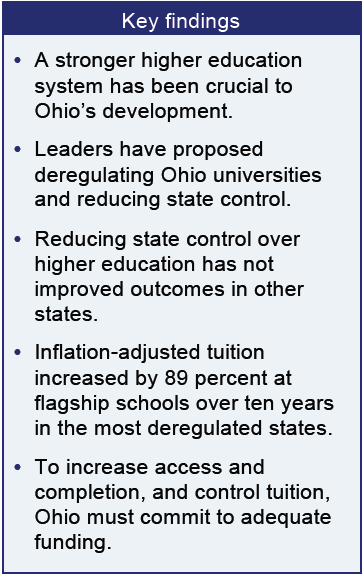
The most deregulated public college and university systems in the U.S. saw a staggering 89 percent tuition growth in flagship schools over the past decade (inflation adjusted), enrolled the lowest percentage of lower-income students, and devoted the lowest amount of state per capita income to higher education when compared to more regulated public education systems, according to a new report from Policy Matters Ohio.

The study, Deregulation and higher education: Potential impact on access, affordability and achievement in Ohio, reviews higher education management structures around the country.

In August 2011, the Kasich administration proposed the Enterprise University Plan,an approach that is likely to form the basis for changes to university management in Ohio. The proposal provides broad exemption from state fiscal and administrative statutes; diminished state oversight of real estate, construction, procurement, and legal settlements; elimination of student enrollment caps; and authority to set differential tuition.

Deregulation in other states has not made tuition more affordable, increased access for low-income students, or increased graduation rates,” said Wendy Patton, senior project director at Policy Matters and report co-author. “Public support for universities and funding for need-based aid, not management structure, are the key factors that lead to lower tuition and more access.”

In the past 20 years, many states have loosened control over aspects of public higher education. Ohio’s proposal goes further than most – it lacks state-mandated performance targets on retention, graduation, affordability and other mechanisms included in the deregulation of other systems.

Policy Matters compared enrollment, graduation, affordability, and low-income student access for the nation as a whole with three smaller groups of states: highly deregulated states like Colorado and Virginia; partially regulated approaches like in Illinois, New Jersey and Texas and coordinated systems as in Kentucky, Maryland and Minnesota.

Ohio’s Enterprise University Plan is most like the highly deregulated model. The most deregulated systems in our study have seen the highest inflation-adjusted tuition growth at flagship schools since deregulation, an 89 percent jump. At non-flagship four-year universities, tuition has spiked most in the partially regulated schools, the second most deregulated category.

Public investment has plunged across all management structures, with highly deregulated systems investing the least by 2011, a paltry $3.79 for every $1,000 in state income, down from $7.55 in 1991. Ohio’s investment also plunged, from $7.03 for every $1,000 in state income in 1991 to just $4.57 in 2011. Low-income enrollment for the highly deregulated group was far behind the control group, just 26.1 percent compared to 37.8 percent.

Public universities and colleges in Ohio helped to dramatically increase higher education levels over the past fifty years. They have given employers skilled professionals, provided a pathway to the middle class, and provided businesses with cutting edge research. However, Ohio college completion levels lag the nation (we rank 34th), tuition is higher than average (tied for third most costly relative to median family income), the state has slashed support for higher education and for need-based aid, and it is difficult in Ohio, as elsewhere, for students from middle-class and low-income families to afford college. Federal aid helps: Ohio enrolls more students who are eligible for and get federal assistance in the form of Pell grants (38.9 percent).

The report concludes that reducing public control over Ohio’s university system could result in higher tuition and lower access for students from middle- and low-income families. The report recommends that, instead of deregulating, Ohio adequately fund higher education, commit to need-based aid, and establish strong performance targets.

Ohio’s future depends on an excellent higher education system capable of preparing Ohioans to participate in the economy and community,” said Michelle Camou, report co-author. “The enterprise plan lost sight of Ohio’s own goals, labor force needs, and understanding of higher education as a pathway to the middle class. Outcomes are likely to be better if citizens maintain control over Ohio’s public university system.”

###

 Policy Matters is a non-profit, non-partisan policy research institute. Michelle Camou, who has a Ph.D. in political science from University of Colorado at Boulder, is a public policy consultant, specializing in urban development, labor, immigration, and higher education policies.

Here are some key findings:

Download report
Download executive summary

The public policy wonks well tell you that it is bad public policy to have tightly dedicated funds for one particular public purpose. But, we are at the time in this society where a dedicated source of funding for K-16 education should be examined. Otherwise, the seeds of growth for the economic future of this state and this country will die before they have a chance to germinate.

Dr. Wilda says this about that ©

Blogs by Dr. Wilda:

COMMENTS FROM AN OLD FART © http://drwildaoldfart.wordpress.com/

Dr. Wilda Reviews ©                        http://drwildareviews.wordpress.com/

Dr. Wilda ©                                                                                    https://drwilda.com/

For-profit colleges: It’s all about the $$$

16 Oct

Moi wrote in Report: For-profit colleges more concerned with executive pay than student achievement:

Michael Stratford reports on the Harkin report in the Chronicle of Higher Education article, Senate Report Paints a Damning Portrait of For-Profit Higher Education:

For-profit colleges can play an important role in educating nontraditional students, but the colleges often operate as aggressive recruiting machines focused on generating shareholder profits at the expense of a quality education for their students.

That’s the unflattering portrait of the for-profit higher-education industry detailed in a voluminous report officially released on Monday by the Senate Health, Education, Labor, and Pensions Committee. The report, which also criticizes the accrediting agencies that evaluate the colleges, concludes a two-year investigation into the operations of 30 for-profit higher-education companies from 2006 to 2010….

Profits Over Students

The report says that more than half of the 1.1 million students who enrolled in the colleges under scrutiny in 2008-9 had withdrawn by mid-2010. Those retention rates varied between publicly traded and privately held for-profit colleges. At the 15 publicly traded companies 55 percent of students withdrew, compared with 46 percent at the 15 privately held companies, many of which are owned by private-equity firms.

While community colleges and two-year for-profit programs have similarly low retention rates, the cost of the for-profit programs makes those programs more risky for students and federal taxpayers,” the report says. Nearly all students attending a for-profit college take out loans to attend, the report says, compared with just 13 percent of community-college students.

Internal company documents examined by the investigation reveal that decisions to increase tuition at for-profit colleges were driven by profit goals rather than increasing costs of instruction. The educational interests of students rarely, if at all, figured into that decision making, the report says. https://drwilda.com/2012/07/31/report-for-profit-colleges-more-concerned-with-executive-pay-than-student-achievement/

For-profit education exists at both higher education and K-12.

Moi wrote in Online K-12 education as a cash cow for ‘Wall Street’: There should be a variety of options and approaches in education. Still, School choice does not mean education on the cheap! K-12 education should not be the next sub-prime mortgage or derivative gambit for large for-profit companies. Lee Fang has written the alarming Nation article, How Online Learning Companies Bought America’s Schools.

While most education reform advocates cloak their goals in the rhetoric of “putting children first,” the conceit was less evident at a conference in Scottsdale, Arizona, earlier this year.

Standing at the lectern of Arizona State University’s SkySong conference center in April, investment banker Michael Moe exuded confidence as he kicked off his second annual confab of education startup companies and venture capitalists. A press packet cited reports that rapid changes in education could unlock “immense potential for entrepreneurs.” “This education issue,” Moe declared, “there’s not a bigger problem or bigger opportunity in my estimation.”

Moe has worked for almost fifteen years at converting the K-12 education system into a cash cow for Wall Street. A veteran of Lehman Brothers and Merrill Lynch, he now leads an investment group that specializes in raising money for businesses looking to tap into more than $1 trillion in taxpayer money spent annually on primary education. His consortium of wealth management and consulting firms, called Global Silicon Valley Partners, helped K12 Inc. go public and has advised a number of other education companies in finding capital.

Moe’s conference marked a watershed moment in school privatization. His first “Education Innovation Summit,” held last year, attracted about 370 people and fifty-five presenting companies. This year, his conference hosted more than 560 people and 100 companies, and featured luminaries like former DC Mayor Adrian Fenty and former New York City schools chancellor Joel Klein, now an education executive at News Corporation, a recent high-powered entrant into the for-profit education field. Klein is just one of many former school officials to cash out. Fenty now consults for Rosetta Stone, a language company seeking to expand into the growing K-12 market.

As Moe ticked through the various reasons education is the next big “undercapitalized” sector of the economy, like healthcare in the 1990s, he also read through a list of notable venture investment firms that recently completed deals relating to the education-technology sector, including Sequoia and Benchmark Capital. Kleiner Perkins, a major venture capital firm and one of the first to back Amazon.com and Google, is now investing in education technology, Moe noted. http://www.thenation.com/article/164651/how-online-learning-companies-bought-americas-schools

Henry M. Levin of Columbia University had some cautionary notes about for-profit K-12 education in 2001.

In the 2001 paper, Thoughts on For-profit Schools, Levin wrote:

The fact is that we know little about how for-profit schools will operate and how they will affect students and other schools. At least three major questions have yet to be answered satisfyingly:

If schools are a potentially profitable endeavor, then why did entrepreneurs wait so long to enter the market? Is there something unique about schooling that makes it difficult to earn a profit?

Now that we do have for-profit schools, how will they achieve cost savings? Will they bring fundamentally different approaches to education through curricular and technological innovations that will “break the mold”?

Even if they are more effective or less costly, or both, will they earn profits that are comparable to the returns on other investments? http://www.ncspe.org/publications_files/7_OP14.pdfhttps://drwilda.com/2011/11/21/online-k-12-education-as-a-cash-cow-for-wall-street/

AP and Seattle Times staff are reporting in the article, University of Phoenix closing some Puget Sound-area learning centers:

Apollo Group, the for-profit education company that operates the University of Phoenix, said it would close 115 of the university’s locations, including several in the Puget Sound region…

Apollo said the closures will affect 13,000 students nationwide, or about 4 percent of the university’s students. The move was spurred by a 60 percent decline in Apollo’s fiscal fourth-quarter profit, which was hurt by higher costs and declining University of Phoenix enrollment.

Shares in the Phoenix-based company tumbled nearly 8 percent in after-hours trading Tuesday.

The closings nationwide include 25 main campuses and 90 smaller satellite learning centers. At least one location in 30 states is slated to be shuttered.

Students affected by the closures will be given the option of transferring to online programs or moving their course work to other sites, said University of Phoenix President Bill Pepicello.

If no other center is nearby, the company will continue courses at other space near the closed facility until students complete their degrees, he added.

The university, which also recently announced a tuition freeze, is in the process of notifying students.

The University of Phoenix currently has about 328,000 students, down from a peak of more than 400,000. Following the closures, it will be left with 112 locations in 36 states, the District of Columbia and Puerto Rico.

The announcement comes as enrollments overall in the for-profit sector are declining after years of rapid growth, even as enrollment in other sectors of higher education rises. Recent federal figures showed enrollment in for-profits fell 2.9 percent in 2011. The sector has faced tighter regulations and more pressure to enroll students who have a better chance of graduating.

Another factor in the closures: students increasingly favor online courses. Others are put off by the shaky economy.

People are simply holding off investing money in education at a time when the costs are escalating and the outcomes are uncertain,” Pepicello said.

In the June-to-August quarter, the number of students enrolled in degreed programs at University of Phoenix fell on an annual basis by 13.8 percent to 328,400. While enrollment of new students in degreed programs declined 13.7 percent.

That decline led to an 11 percent drop in fiscal fourth-quarter revenue for the university’s parent company, which helped weigh down earnings despite some changes in tuition prices and other fees.

Apollo reported net income of $75.4 million, or 66 cents per share, for the three months ended Aug. 31. That compares with net income of $188.6 million, or $1.37 per share, a year earlier.

The latest results included $9.4 million in restructuring costs and other charges. Excluding the special items, Apollo’s earnings amounted to 52 cents per share.

Revenue fell to $996.5 million from $1.12 billion. http://seattletimes.com/html/businesstechnology/2019448516_universityphoenixxml.html

Many critics put the emphasis on “for-profit” and will adamantly argue that any entity which is for-profit is inherently bad for education. Moi would put the emphasis on neighborhood choice and argue that entities without strong ties to the neighborhood they intend to operate in, do not have the loyalty to succeeding in that particular neighborhood and will probably not be successful. Let’s be honest, corporations intend to generate a profit from their education activities as their primary goal. The secondary goal is probably the education of children. Moi is skeptical that a for-profit entity really has the commitment to a neighborhood and thus to a neighborhood’s schools. Still, moi is not like some so called “anti-reform” types who foam at the mouth at the words charter and for-profit. There is no magic bullet or “Holy Grail” in education. There is only what works to produce academic achievement in each population of children. That is why school choice is so important. Still, the welfare of the student must be paramount.

Children are not the new sub-prime mortgage business or the new derivative gambit.People must be afraid, very afraid of the vultures who are now hovering around the education sector. If folks don’t watch them, the results will not be pretty.

Resources:

College accreditation – U.S. Department of Education

http://ope.ed.gov/accreditation/

College Accreditation: Frequently Asked Questions

http://www.back2college.com/library/accreditfaq.htm

Ask questions before deciding on a for-profit college [Video]

http://latimesblogs.latimes.com/money_co/2011/02/questions-deciding-for-profit-college-video.html

For Profit Colleges: Get the Facts

http://www.education.com/magazine/article/for-profit-colleges/

Related:

For-profit colleges: Money buys government, not quality for students                                                                                https://drwilda.com/2011/12/12/for-profit-colleges-money-buys-government-not-quality-for-students/

Dr. Wilda says this about that ©

Blogs by Dr. Wilda:

COMMENTS FROM AN OLD FART © http://drwildaoldfart.wordpress.com/

Dr. Wilda Reviews ©                                      http://drwildareviews.wordpress.com/

Dr. Wilda ©                                                                                   https://drwilda.com/

Study: Bored students may be stressed rather than bored

14 Oct

Moi wrote in Motivation is increasingly researched as a key ingredient in student achievement

Moi wrote in It’s the culture and the values, stupid:

Every week in the Seattle Stranger there is a column I, Anonymous , which gives one reader the chance to rant anonymously about any topic or person that has provoked such a reaction that venting and a good old fashion rant is necessary. Sometimes, the rants are poetic or touching. Most of the time, they are just plain hilarious. This is a recent rant, which is from a teacher, not an educator

I say hello with a big smile every morning as you shuffle in the door, but I secretly seethe with hatred for almost each and every one of you. Your stupidity and willful ignorance know no bounds. I have seen a lot of morons in my 10 years of teaching high school, but you guys take the cake. Your intellectual curiosity is nonexistent, your critical thinking skills are on par with that of a head trauma victim, and for a group of people who have never accomplished anything in their lives, you sure have a magnified sense of entitlement. I often wonder if your parents still wipe your asses for you, because you certainly don’t seem to be able to do anything on your own.
A handful of you are nice, sweet kids. That small group will go on and live a joyful and intellectual life filled with love, adventure, and discovery. The vast majority of you useless fuckwits will waste your life and follow in the footsteps of your equally pathetic parents. Enjoy your future of wage slavery and lower-middle-class banality.
Amazing how teachers are blamed for the state of education in this country. Look what you give us to work with. I am done trying to teach the unteachable.

Moi doesn’t blame most teachers for the state of education in this country, but puts the blame on the culture and the unprepared and disengaged parents that culture has produced. Moi also blames a culture of moral relativism as well which says there really are no preferred options. There are no boundaries, I can do what I feel is right for ME. https://drwilda.com/2011/11/04/its-the-culture-and-the-values-stupid/ https://drwilda.com/2012/10/02/motivation-is-increasingly-researched-as-a-key-ingredient-in-student-achievement/

Sarah D. Sparks reports in the Education Week article, Studies Link Students’ Boredom to Stress:

Boredom is one of the most consistent experiences of school and one that can be frustrating and disheartening for teachers. According to findingsRequires Adobe Acrobat Reader in the High School Survey of Student Engagement, conducted by the Indiana University Bloomington, boredom is nearly universal among American students. Of a representative sample of more than 275,000 high school students surveyed in 27 states from 2006 to 2009, 65 percent reported being bored in class at least once a day.

Lack of Focus

Under Mr. Eastman and his colleagues’ definition, a student who is bored cannot focus attention to engage in the class activity—and blames that inability to focus on the outside environment. A dry lecture style or an uninteresting topic might trigger boredom, Mr. Eastman said, but so can other issues that interfere with a student’s attention and working memory.

Getting to the Roots

When students feel bored, research shows they are aware of their own difficulty paying attention. A student may attribute the experience to not being interested in the material or the lecture style. But new studies show that any stress or distraction that takes up working memory—from emotional trauma to attention deficit hyperactivity disorders—all could be contributing to the problem.

For example, students with attention deficit hyperactivity disorder are more likely to report feeling bored than students with normal attention. Students tackling material that is too difficult for them—and thus taking up more working memory—also are more likely to report it is “boring” rather than simply frustrating, Mr. Eastman and other researchers found.

“When people are in a negative emotional state, discouraged, or down, we know that causes attention problems,” Mr. Eastman said. “We know when people are stressed it makes it harder to focus and pay attention at a very basic, fundamental level.”

Like any type of stress, boredom hampers the prefrontal cortex, the brain area positioned just behind that student’s furrowed brow that allows a student to reason and hold different facts in working memory. http://www.edweek.org/ew/articles/2012/10/10/07boredom_ep.h32.html?tkn=VMPF3anAix33lAsD%2BFnoz1mgquEbELuvXvaO&cmp=clp-edweek

Here is the press release from the American Psychological Association:

PRESS RELEASE

September 26, 2012
For Immediate Release

Contact: Anna Mikulak
Association for Psychological Science
202.293.9300
amikulak@psychologicalscience.org

I’m Bored!” – Research on Attention Sheds Light on the Unengaged Mind

Related Topics: Attention, Cognitive Processes, Cognitive Psychology, Emotions, Perspectives on Psychological Science, Thinking

You’re waiting in the reception area of your doctor’s office. The magazines are uninteresting. The pictures on the wall are dull. The second hand on the wall clock moves so excruciatingly slowly that you’re sure it must be broken. You feel depleted and irritated about being stuck in this seemingly endless moment. You want to be engaged by something—anything—when a thought, so familiar from childhood, comes to mind: “I’m bored!”

Although boredom is often seen as a trivial and temporary discomfort that can be alleviated by a simple change in circumstances, it can also be a chronic and pervasive stressor that can have significant consequences for health and well-being.

Boredom at work may cause serious accidents when safety depends on continuous vigilance, as in medical monitoring or long-haul truck driving. On a behavioral level, boredom has been linked with problems with impulse control, leading to overeating and binge eating, drug and alcohol abuse, and problem gambling. Boredom has even been associated with mortality, lending grim weight to the popular phrase “bored to death.”

Although it’s clear that boredom can be a serious problem, the scientific study of boredom remains an obscure niche of research, and boredom itself is still poorly understood. Even though it’s a common experience, boredom hasn’t been clearly defined within the scientific community.

Psychological scientist John Eastwood of York University (Ontario, Canada) and colleagues at the University of Guelph and the University of Waterloo wanted to understand the mental processes that underlie our feelings of boredom in order to create a precise definition of boredom that can be applied across a variety of theoretical frameworks. Their new article, which brings together existing research on attention and boredom, is published in the September 2012 issue of Perspectives on Psychological Science, a journal of the Association for Psychological Science.

Drawing from research across many areas of psychological science and neuroscience, Eastwood and colleagues define boredom as “an aversive state of wanting, but being unable, to engage in satisfying activity,” which arises from failures in one of the brain’s attention networks.

Specifically, we’re bored when:

  • We have difficulty paying attention to the internal information (e.g., thoughts or feelings) or external information (e.g., environmental stimuli) required for participating in satisfying activity
  • We’re aware of the fact that we’re having difficulty paying attention
  • We believe that the environment is responsible for our aversive state (e.g., “this task is boring,” “there is nothing to do”).

The researchers are confident that integrating the disparate fields of cognitive neuroscience, social psychology, and clinical psychology will produce a more thorough understanding of boredom and attention—phenomena which are ubiquitous and intimately linked.

Armed with a precise and broadly applicable definition of boredom that gets at the underlying mental processes, the authors identify important next steps in research on boredom. Eastwood and his colleagues hope to help in the discovery and development of new strategies that ease the problems of boredom sufferers and address the potential dangers of cognitive errors that are often associated with boredom.

###

For more information about this study, please contact: John D. Eastwood at johneast@yorku.ca.

Perspectives on Psychological Science is ranked among the top 10 general psychology journals for impact by the Institute for Scientific Information. It publishes an eclectic mix of thought-provoking articles on the latest important advances in psychology. For a copy of the article “The Unengaged Mind: Defining Boredom in Terms of Attention” and access to other Perspectives on Psychological Science research findings, please contact Anna Mikulak at 202-293-9300 or amikulak@psychologicalscience.org.

Moi wrote in The ‘whole child’ approach to education

Moi writes this blog around a set of principles which are:

All children have a right to a good basic education.

  1. Education is a partnership between the student, parent(s) or guardian(s), the teacher(s), and the school. All parts of the partnership must be active and involved.

  2. Society should support and foster strong families.

  3. Society should promote the idea that parents are responsible for parenting their children and people who are not prepared to accept that responsibility should not be parenting children.

  4. The sexualization of the culture has had devastating effects on children, particularly young women. For many there has been the lure of the “booty call” rather than focusing on genuine achievement.

    Education is a life long pursuit

Many children do not have a positive education experience in the education system for a variety of reasons. Many educators are advocating for the “whole child” approach to increase the number of children who have a positive experience in the education process.

The National Education Association (NEA) describes the “whole child” approach to learning in the paper, Meeting the Needs of the Whole Child:

Meeting the needs of the whole child requires:

Addressing multiple dimensions, including students’ physical, social and emotional health and well-being.

Ensuring equity, adequacy and sustainability in resources and quality among public schools and districts.

Ensuring that students are actively engaged in a wide variety of experiences and settings within—and outside—the classroom.

Providing students with mentors and counselors as necessary to make them feel safe and secure.

Ensuring that the condition of schools is modern and up-to-date, and that schools provide access to a broad array of resources.

Reducing class size so that students receive the individualized attention they need to succeed.

Encouraging parental and community involvement. http://www.educationvotes.nea.org/wp-content/uploads/2010/04/WholeChildBackgrounder.pdf

ASCD, (formerly the Association for Supervision and Curriculum Development) along with the NEA is leading in the adoption of the “whole child” approach. https://drwilda.com/2012/02/10/the-whole-child-approach-to-education/

Related:

Research papers: Student Motivation: An Overlooked Piece of School Reform                                                                               https://drwilda.com/2012/05/30/research-papers-student-motivation-an-overlooked-piece-of-school-reform/

Dr. Wilda says this about that ©

Blogs by Dr. Wilda:

COMMENTS FROM AN OLD FART © http://drwildaoldfart.wordpress.com/

Dr. Wilda Reviews ©                                 http://drwildareviews.wordpress.com/

Dr. Wilda ©                                                                                   https://drwilda.com/

Is an individualized program more effective in math learning?

10 Oct

Moi wrote in Study: Early mastery of fractions is a predictor of math success:

Math is important for a number of reasons.

Michigan State University’s Office of Supportive Services succinctly states why math is important:

Why is math important?

All four year Universities have a math requirement

Math improves your skills:

  • Critical Thinking Skills

  • Deductive Logic and Reasoning Skills

  • Problem Solving Skills

A good knowledge of math and statistics can expand your career options

Physical Sciences – Chemistry, Engineering, Physics

Life and Health Sciences – Biology, Psychology, Pharmacy, Nursing, Optometry

Social Sciences – Anthropology, Communications, Economics, Linquistics, Education, Geography

Technical Sciences – Computer Science, Networking, Software Development

Business and Commerce

Actuarial Sciences

Medicine

http://oss.msu.edu/academic-assistance/why-is-math-important

In Perhaps the biggest math challenge is how to teach math, moi said:

There will continue to be battles between those who favor a more traditional education and those who are open to the latest education fad. These battles will be fought out in school board meetings, PTSAs, and the courts.

There is one way to, as Susan Powder says, “Stop the Insanity.” Genuine school choice allows parents or guardians to select the best educational setting for their child. Many policy wonks would like to believe that only one type of family seeks genuine school choice, the right wing wacko who makes regular visits on the “tea party” circuit. That is not true. Many parents favor a back-to-the basics traditional approach to education.

A one-size-fits-all approach does not work in education https://drwilda.wordpress.com/2012/02/01/perhaps-the-biggest-math-challenge-is-how-to-teach-math/

https://drwilda.com/2012/06/26/study-early-mastery-of-fractions-is-a-predictor-of-math-success/

Jacob Vigdor wrote the interesting Education Next article, Solving America’s Math Problem:

American public schools have made a clear trade-off over the past few decades. With the twin goals of improving the math performance of the average student and promoting equality, it has made the curriculum more accessible. The drawback to exclusive use of this more accessible curriculum can be observed among the nation’s top-performing students, who are either less willing or less able than their predecessors or their high-achieving global peers to follow the career paths in math, science, and engineering that are the key to innovation and job creation. In the name of preparing more of the workforce to take those jobs, we have harmed the skills of those who might have created them. Although there is some evidence of a payoff from this sacrifice, in the form of marginally better performance among average students, some of the strategies used to help these students have in fact backfired.

To some extent, the nation has reduced the costs of this movement through immigration. Foreign students account for more than half of all doctorate recipients in science and engineering, two-thirds of those in engineering. Many of these degree recipients leave the country when they finish, however, limiting their potential benefit to native-born Americans. Immigration policy reform that emphasizes skills over traditional family reunification criteria, much like the policies in place in Australia, Canada, and other developed nations, could change this pattern.

A second possible policy option would be to implement a curricular reform more radical than tinkering with the timing of already existing courses. Many schools have adopted the so-called “Singapore math” model, which emphasizes in-depth coverage of a limited set of topics. There are concerns, however, regarding whether a curriculum developed in a different cultural and educational context could produce similar results here. Singapore’s public schools, for example, use a year-round calendar, obviating the need to review basic subjects after a summer spent out of the classroom. Evidence also indicates that Singapore’s teachers have a firmer grasp of math than their American counterparts.

The United States need not import its science and engineering innovators, however. It need not borrow a faddish curriculum from a foreign context. And it need not sacrifice the math achievement of the average student in order to cater to superstars. It need only recognize that equalizing the curriculum for all students cannot be accomplished without imposing significant lifelong costs on some and perhaps all students.

Curricular differentiation might, for its part, exacerbate test-score gaps between moderate and high performers, if high performers move ahead more quickly. A narrow-minded focus on the magnitude of the gap, however, can lead to scenarios where the gap is closed primarily by worsening the performance of high-achieving students—bringing the top down—without raising the performance of low-achieving students. Society’s goal should be to improve the status of low-performing students in absolute terms, not just relative to that of their higher-performing peers. A growing body of evidence suggests that this type of improvement is best achieved by sorting students, even at a young age, into relatively homogenous groups, to better enable curricular specialization. Recent results from Chicago, cited above, provide evidence that differentiating the high school mathematics curriculum can have long-run benefits, even for students assigned to remedial coursework.

Not all children are equally prepared to embark on a rigorous math curriculum on the first day of kindergarten, and there are no realistic policy alternatives to change this simple fact. Rather than wish differences among students away, a rational policy for the 21st century will respond to those variations, tailoring lessons to children’s needs. This strategy promises to provide the next generation of prospective scientists and engineers with the training they need to create jobs, and the next generation of workers with the skills they need to qualify for them. http://educationnext.org/solving-america%E2%80%99s-math-problem/#.UG25FCk_6rE.email

One way of looking at Vigdor’s conclusions is to ask whether high performance preschool programs and early intervention can affect student achievement?

Moi wrote in Oregon State University study: Ability to pay attention in preschool may predict college success:

In Early learning standards and the K-12 continuum, moi said:

Preschool is a portal to the continuum of life long learning. A good preschool stimulates the learning process and prompts the child into asking questions about their world and environment. Baby Center offers advice about how to find a good preschool and general advice to expectant parents. At the core of why education is important is the goal of equipping every child with the knowledge and skills to pursue THEIR dream, whatever that dream is. Christine Armario and Dorie Turner are reporting in the AP article, AP News Break: Nearly 1 in 4 Fails Military Exam which appeared in the Seattle Times:

Nearly one-fourth of the students who try to join the U.S. Army fail its entrance exam, painting a grim picture of an education system that produces graduates who can’t answer basic math, science and reading questions, according to a new study released Tuesday.

Many children begin their first day of school behind their more advantaged peers. Early childhood learning is an important tool is bridging the education deficit. https://drwilda.wordpress.com/2012/01/03/early-learning-standards-and-the-k-12-contiuum/

Jonathan Cohn’s study about the value of early learning is described in Jonathan Cohn’s ‘The Two Year Window’:

Jonathan Cohn reports about an unprecedented experiment which occurred in Romanian orphanages in the Nw Republic article, The Two Year Window. There are very few experiments involving humans because of ethical considerations.

Drury, Nelson, and their collaborators are still learning about the orphans. But one upshot of their work is already clear. Childhood adversity can damage the brain as surely as inhaling toxic substances or absorbing a blow to the head can. And after the age of two, much of that damage can be difficult to repair, even for children who go on to receive the nurturing they were denied in their early years. This is a revelation with profound implication—and not just for the Romanian orphans.

APPROXIMATELY SEVEN MILLION American infants, toddlers, and preschoolers get care from somebody other than a relative, whether through organized day care centers or more informal arrangements, according to the Census Bureau. And much of that care is not very good. One widely cited study of child care in four states, by researchers in Colorado, found that only 8 percent of infant care centers were of “good” or “excellent” quality, while 40 percent were “poor.” The National Institute of Child Health and Human Development has found that three in four infant caregivers provide only minimal cognitive and language stimulation—and that more than half of young children in non-maternal care receive “only some” or “hardly any” positive caregiving. http://www.tnr.com/article/economy/magazine/97268/the-two-year-window?page=0,0&passthru=YzBlNDJmMmRkZTliNDgwZDY4MDhhYmIwMjYyYzhlMjg

Because the ranks of poor children are growing in the U.S., this study portends some grave challenges not only for particular children, but this society and this country. Adequate early learning opportunities and adequate early parenting is essential for proper development in children. https://drwilda.wordpress.com/2011/12/18/jonathan-cohns-the-two-year-window/

https://drwilda.com/2012/08/08/oregon-state-university-study-ability-to-pay-attention-in-preschool-may-predict-college-success/

Dr. Wilda says this about that ©

Blogs by Dr. Wilda:

COMMENTS FROM AN OLD FART© http://drwildaoldfart.wordpress.com/

Dr. Wilda Reviews ©                                     http://drwildareviews.wordpress.com/

Dr. Wilda ©                                                                                                 https://drwilda.com/

Is a gap year a good option for some students?

8 Oct

One Tennessee Study found that quite often kids are encouraged to choose college over vocational or trade options.  The societal push the last few years has been to have more kids go to college. Quite often schools are ranked on the percentage of kids that go directly to college from high school. So, counselors are following cultural cues they have received from administrators, parents, and the media.

Pros and Cons of Going to A Four Year College

A.     Five Reasons to Go to College

Chris Stout lists Top Five Reasons to Go to College

1.The undergraduate degree is the new high school diploma

There was once a time when college was entirely optional. Even today, smart, hard working people can develop  excellent careers and stable

lives without the aid of a university education. College is by no means

mandatory,  but when you’re ready to start building a career for

yourself, you will increasingly discover that a college degree is a

prerequisite  for many entry-level employment opportunities…. 

2.College will satisfy and expand your curiosity

If you possess a general curiosity about how and why the world works the way it does, then you owe it to yourself to attend college. Education is a personal project. If you want to develop your mental faculties and increase your knowledge base, then you have to college. If you feel that you’ve learned all you possibly can in high school, if you think that there’s nothing else that you need to absorb, then don’t go to college. If you have a passion for improved understanding, then college is mandatory.

3.College is a process of continual maturation

College is freedom. When you attend college, you are free to live on your own, according to your own priorities. As you carve out your own custom tailored living and learning experience, you can’t help but grow as a person. College is a time for self-improvement and development, so if you want to grow and mature as an individual, college is the perfect playground for self-progress.

4.College is all about networking

In college, you have the unique ability to create life-long associations in a structured environment. Networking is important, but it can also be difficult. If you want to build relations with students and faculty members, you have to put forth effort. Unlike the real world, in college, it’s easy to combine your individual interests with supportive allies who subscribe to those same interests. Take advantage of this environment and build up relationships that will help you in the future.

5.College exposes you to things you would not normally experience

When you set about choosing your path through life, it’s important to remember that finding yourself is as much a process of elimination as it is a process of discovery. Just as you seek out interests and identities, you need to rule out certain life-options and mental frameworks that you do not agree with. College exposes you to new risks, rewards, people, places, ideas, lifestyles, eating habits and career choices. Exposure is critical. You can’t form a genuine opinion on something if you’ve never been exposed to it.  

  College is a place for you to improve yourself, to satiate your curiosities,   to mature, to network, and to be  exposed to new things. College is an   important, irreplaceable experience in life. Going  to college is highly   recommended.

Stout places the emphasis on the college experience and the fact that college is not just a place for possible career training.

B.    Five Reasons Not to Go to College

Forbes. Com published Five Reasons Not to Go to College

1. You’ll be losing four working years.

There’s an opportunity cost associated with going to college: Not only will you lose the money you’ll have spent on tuition, you’ll also be out the amount of money that you could have made if you’d worked during those four years. And if your family isn’t wealthy enough to pay for your education on their own, you’ll also owe a hefty amount in interest payments for your student loans. Perhaps more importantly, with four years of experience on your resume, you’ll be far better off when looking for work than the average 22-year-old college graduate.

2. You won’t necessarily earn less money.

College grads earn an average 62% more over the course of their careers than high school grads. But economist Robert Reischauer of the Brookings Institution in Washington, D.C., argues that those numbers are skewed by the fact that smarter kids are more likely to go to college in the first place. In other words, the profitability of higher education is a self-fulfilling prophecy.

3. In fact, you could probably make more money if you invested your tuition.

Put $160,000–the approximate cost of a Harvard education–into municipal bonds that pay a conservative 5%, and you’ll have saved more than $500,000 in 30 years. That’s far more than the average college grad will accumulate in the same amount of time.

4. You don’t need to be in a classroom in order to learn something.

Truly motivated learners can teach themselves almost anything with a couple of books and an Internet connection. Want to learn a hands-on skill or trade? Consider an apprenticeship.

5. Plenty of other people did fine

Bill Gates, Larry Ellison, Quentin Tarantino, David Geffen, and Thomas Edison, among others, never graduated from college. Peter Jennings and John D. Rockefeller never finished high school. 

Some people discover their passion earlier in life than others. Forbes.Com addresses its comments at those folks. The calculation is that if one already knows what they want to do, college could be an unnecessary detour.

Economic Value of A College Degree

A US News and World Report article estimated the value of a college degree

As the price of a college degree continues to rise, there’s growing evidence that the monetary payoff isn’t quite as big as often advertised. The best estimate now is that a college degree is worth about $300,000 in today’s dollars—nowhere near the $1 million figure that is often quoted. “That $1 million number has driven me crazy!” says Sandy Baum, a Skidmore economist who studied the value of a college degree for the College Board last year. Baum’s research showed that college graduates earn, on average, about $20,000 a year more than those who finished their educations at high school. Add that up over a 40-year working life and the total differential is about $800,000, she figures. But since much of that bonus is earned many years from now, subtracting out the impact of inflation means that $800,000 in future dollars is worth only about $450,000 in today’s dollars. Then, if you subtract out the cost of a college degree—about $30,000 in tuition and books for students who get no aid and attend public in-state universities—and the money a student could have earned at a job instead of attending school, the real net value in today’s dollars is somewhere in the $300,000 range, a number confirmed by other studies. But, especially these days, that still makes a college degree one of the most lucrative investments a person can make, Baum notes.

Better yet, college graduates can go on to earn advanced degrees, which return even bigger payoffs. The average holder of a bachelor’s degree earns about $51,000 a year, Baum calculates. But those who’ve gone on to earn MBAs, law degrees, or other professional degrees earn about $100,000 a year.

As the price of a college degree continues to rise, there’s growing evidence that the monetary payoff isn’t quite as big as often advertised. The best estimate now is that a college degree is worth about $300,000 in today’s dollars—nowhere near the $1 million figure that is often quoted. 

The article also mentions some of the non-monetary rewards of attending a four year college. The Wall Street Journal in a 2008 article at published at the beginning of the economic downtown describes declining value of a college degree

A variety of economic forces are at work here. Globalization and technology have altered the types of skills that earn workers a premium wage; in many cases, those skills aren’t learned in college classrooms. And compared with previous generations, today’s college graduates are far more likely to be competing against educated immigrants and educated workers employed overseas.

The issue isn’t a lack of economic growth, which was solid for most of the 2000s. Rather, it’s that the fruits of growth are flowing largely to “a relatively small group of people who have a particular set of skills and assets that lots of other people don’t,” says Mr. Bernstein. And that “doesn’t necessarily have that much to do with your education.” In short, a college degree is often necessary, but not sufficient, to get a paycheck that beats inflation.

A college degree is no guarantee of either employment or continued employment.

Alternatives to a Four Year College Degree

Great Schools has a concise overview of various options should a child decide they do not want to go from high school to a four year college. What if Your Teen Wants to Skip College There are several options. Options include a gap year, trade school, vocational school, community college, and for some the military. The only option that should be off the table is to do nothing.

Victor Lukerson has written the excellent Time article, Gap Year: The Growing Appeal of Not Going Right to College:

About 1.2% of first-time college freshmen choose to defer enrollment for a year, according to the Higher Education Research Institute at UCLA. What these students choose to do with their time varies widely, from expensive study abroad programs, to volunteer programs like City Year, to staying at home and saving up for college.

In 1980, no one was talking gap year,” says Holly Bull, the president of The Center for Interim Programs, a company that offers parents and students consulting in choosing the appropriate gap year program. “I’ve watched this whole concept go basically from its inception to present day. I wouldn’t call it mainstream, but there’s way more awareness and support and colleges are now beginning to endorse it as a really positive thing.”http://moneyland.time.com/2012/10/05/gap-year-the-growing-appeal-of-not-going-right-to-college/#ixzz28eFKj1Ce

Whether a person chooses to attend a four year college after high school is a very personal decision and there is no one right answer. One thing the current economic climate has taught many is there are no guarantees in life, even with a college degree. The trades may offer some a means to earn a living and a fulfilling life.

A one-size-fits-all approach does not work.

Resources:

A publication by the government Why Attend College? Is a good overview

Article in USA Today about gap year

gap year articles

Dr. Wilda says this about that

Blogs by Dr. Wilda:

COMMENTS FROM AN OLD FART©  http://drwildaoldfart.wordpress.com/

Dr. Wilda Reviews ©          http://drwildareviews.wordpress.com/

Dr. Wilda © https://drwilda.com/

Many NOT ready for higher education

6 Oct

Moi wrote in Remedial education in college:                                                           Whether or not students choose college or vocational training at the end of their high school career, our goal as a society should be that children should be “college ready.” David T. Conley writes in the ASCD article, What Makes a Student College Ready?

The Big Four

A comprehensive college preparation program must address four distinct dimensions of college readiness: cognitive strategies, content knowledge, self-management skills, and knowledge about postsecondary education.

Key Cognitive Strategies

Colleges expect their students to think about what they learn. Students entering college are more likely to succeed if they can formulate, investigate, and propose solutions to nonroutine problems; understand and analyze conflicting explanations of phenomena or events; evaluate the credibility and utility of source material and then integrate sources into a paper or project appropriately; think analytically and logically, comparing and contrasting differing philosophies, methods, and positions to understand an issue or concept; and exercise precision and accuracy as they apply their methods and develop their products.

Key Content Knowledge

Several independently conducted research and development efforts help us identify the key knowledge and skills students should master to take full advantage of college. Standards for Success (Conley, 2003) systematically polled university faculty members and analyzed their course documents to determine what these teachers expected of students in entry-level courses. The American Diploma Project (2004) consulted representatives of the business community and postsecondary faculty to define standards in math and English. More recently, both ACT (2008) and the College Board (2006) have released college readiness standards in English and math. Finally, the Texas Higher Education Coordinating Board (2008), under mandate of state law, developed one of the first and most comprehensive sets of state-level college readiness standards….

Key Self-Management Skills

In college, students must keep track of massive amounts of information and organize themselves to meet competing deadlines and priorities. They must plan their time carefully to complete these tasks. They must be able to study independently and in informal and formal study groups. They must know when to seek help from academic support services and when to cut their losses and drop a course. These tasks require self-management, a skill that individuals must develop over time, with considerable practice and trial-and-error.

Key Knowledge About Postsecondary Education

Choosing a college, applying, securing financial aid, and then adjusting to college life require a tremendous amount of specialized knowledge. This knowledge includes matching personal interests with college majors and programs; understanding federal and individual college financial aid programs and how and when to complete appropriate forms; registering for, preparing for, and taking required admissions exams; applying to college on time and submitting all necessary information; and, perhaps most important, understanding how the culture of college is different from that of high school….

Students who would be the first in their family to attend college, students from immigrant families, students who are members of racial and ethnic minority groups traditionally underrepresented in college, and students from low-income families are much more easily thrown off the path to college if they have deficiencies in any of the four dimensions. http://www.ascd.org/publications/educational-leadership/oct08/vol66/num02/What-Makes-a-Student-College-Ready%C2%A2.aspx

The difficult question is whether current testing accurately measures whether students are prepared for college.  https://drwilda.com/2012/03/04/remedial-education-in-college/

Shelby McIntosh has written a report about “college readiness” standards.

Here is the press release for State High School Exit Exams: A Policy in Transition:

CONTACT: Megan Cotten at 301-656-0348 or megan@thehatchergroup.com

As States Embrace Higher Standards on Exit Exams, Schools and Students Will Feel the Impact

More rigorous standards will pose challenges

WASHINGTON, D.C. — September 19, 2012— After more than a decade of growing reliance on high school exit exams, states are rethinking how they use these popular assessments, a new Center on Education Policy (CEP) report finds.

New data released today show that eight of the 26 states with exit exam policies have aligned these exams to the Common Core State Standards (CCSS) or other college- and career-readiness standards, and 10 more states plan to do so in the near future, according to “State High School Exit Exams: A Policy in Transition,” the 11th annual report on high school exit exams by CEP at George Washington University.

“CEP has been studying high school exit exams for 11 years and this year’s report shows that the national move towards more rigorous college and career ready standards has definitely placed these exams at a crossroads,” said Maria Ferguson, CEP’s executive director. “While exit exams remain an influential force in education, state policies will likely continue to evolve as both schools and students adjust to more rigorous standards.”

Aligning exit exam policies to more rigorous standards will almost certainly impact the performance of students taking the exams, the report notes. Passing rates on exit exams already vary among states, and these rates tend to be lower for minority and poor students, students with disabilities, and English language learners.

“Students who are already struggling with the current state standards will soon be expected to pass exit exams aligned to more rigorous standards, and there’s a good chance many will fail to do so,” said Shelby McIntosh, CEP research associate and author of the report. “While high schools should prepare all students for college or careers, policymakers must consider whether all students have had the opportunity to learn the content of these new, more rigorous standards before attaching such high stakes to the exams.”

The report also notes that despite potential concerns regarding the impact of more rigorous high school exit exams on student performance, very few postsecondary education institutions pay attention to exit exam results when making decisions about student admissions, course placement, or awarding scholarships, according to the report.

Currently, 25 states require their high school students to pass an exam to graduate, and a 26th state, Rhode Island, is phasing in an exit requirement for the class of 2014. Twenty-two of these exit exam states have adopted the CCSS in English language arts and math. But the move to the types of college- and career-readiness standards embodied by the CCSS does not mean an end to exit exams, according to CEP’s research. At least 14 CCSS-adopting states intend to maintain a requirement for high school students to pass an exam to graduate.

Reductions in education budgets have also affected state high school exit exams, according to the report. Three states have responded to budget cuts by dropping exit exams in certain subjects, and two states have reduced the number of retake opportunities for students who fail the exams.

End-of-course exams—which assess students’ mastery of the content learned in a particular course rather than the content learned in multiple subjects as of a particular grade level—have grown in popularity throughout the past decade. Nine states currently require students to pass end-of-course exams to graduate, compared with two states in 2002. Three additional states are phasing in requirements for end-of-course exit exams, and six more states currently require or will soon require students to take, but not necessarily pass, end-of-course exams to graduate. Thus, 18 states altogether have policies requiring some type of end-of-course exams.

The report also reviews lessons learned from states’ experience implementing exit exams. For example, the report notes, successful implementation of a new or revised exit exam policy often depends on states’ willingness to phase in policies over several years, provide alternate routes to graduation for students who fail exit exams, adapt policies to meet changing needs, and make a sufficient financial commitment, among other actions.

The report, as well as individual profiles of states with exit exams, can be accessed free of charge at http://www.cep-dc.org.

###

Based in Washington, D.C., and founded in 1995 by Jack Jennings, the Center on Education Policy at The George Washington University is a national advocate for public education and for more effective public schools. The Center works to help Americans better understand the role of public education in a democracy and the need to improve the academic quality of public schools. The Center does not represent special interests. Instead, it helps citizens make sense of conflicting opinions and perceptions about public education and create conditions that will lead to better public schools.

Citation:

State High School Exit Exams: A Policy in Transition

Author(s): Shelby McIntosh
Published: September 19, 2012

CEP’s 11th annual report on state high school exit exams finds that states are embracing higher standards on their exit exams, which means schools and students will feel the impact. The report, based on data collected from state education department personnel in 45 states, discusses the present status of state exit exam policies, the future of these policies as states implement the Common Core State Standards and common assessments, and lessons that can be learned from states’ past experiences with implementing new exit exam policies.

State Profiles for Exit Exam Policies Through 2011-12

Download files:

Annual Report (PDF format, 764 KB) * Direct link: http://us.mg6.mail.yahoo.com/neo/cfcontent_file.cfm?Attachment=McIntosh%5FReport%5FHSEE2012%5F9%2E19%2E12%2Epdf
Appendix (PDF format, 66.4 KB) * Direct link: http://us.mg6.mail.yahoo.com/neo/cfcontent_file.cfm?Attachment=Appendix%5FHSEE2012%5F9%2E19%2E12%2Epdf
Press Release (PDF format, 122 KB) * Direct link: http://us.mg6.mail.yahoo.com/neo/cfcontent_file.cfm?Attachment=PressRelease%5FHSEE2012%5F9%2E19%2E12%2Epdf

See, Report Finds States Tightening College Readiness Metrics         http://www.educationnews.org/higher-education/report-finds-states-tightening-college-readiness-metrics/

K-12 education must not only prepare students by teaching basic skills, but they must prepare students for training after high school, either college or vocational. There should not only be a solid education foundation established in K-12, but there must be more accurate evaluation of whether individual students are “college ready.”

Related:

What the ACT college readiness assessment means                                             https://drwilda.com/2012/08/25/what-the-act-college-readiness-assessment-means/

Study: What skills are needed for ’21st-century learning?’                                       https://drwilda.com/2012/07/11/study-what-skills-are-needed-for-21st-century-learning/

ACT to assess college readiness for 3rd-10th Grades                                                    https://drwilda.com/2012/07/04/act-to-assess-college-readiness-for-3rd-10th-grades/

Dr. Wilda says this about that ©

Blogs by Dr. Wilda:

COMMENTS FROM AN OLD FART©                                         http://drwildaoldfart.wordpress.com/

Dr. Wilda Reviews ©                                                                                                  http://drwildareviews.wordpress.com/

Dr. Wilda ©                                                                                                                  https://drwilda.com/

Is classroom practice the missing ingredient in teacher training?

4 Oct

Moi wrote in Teacher credentials: ‘Teacher Performance Assessment’:

Because teacher training programs will be evaluated by the National Council on Teacher Quality, there is interest in examining how teachers are prepared. See, Building Better Teachers http://www.nctq.org/p/edschools/home.jsp Amy Hetzner and Becky Vevea of the Milwaukee Journal Sentinel have written the article, How Best to Educate Future Teachers which is part of a series

Alverno College, the small women’s college on Milwaukee’s south side, has been widely cited as a national model for training teachers, thanks to its combination of clinical and classroom experience and use of video and other tools to evaluate whether graduates are meeting the standards for what makes a good teacher….

Key elements of an excellent teacher education program:

  • Strong content knowledge, teaching skills. Future teachers gain a solid grounding in the content to be taught as well as how to teach it.

  • Flexible methods. Emphasis is placed on teaching diverse learners – knowing how to differentiate teaching to reach a broad range of students.

  • Fieldwork. Coursework clearly is connected to fieldwork. The clinical experience, like in medical school, consists of intensive student-teaching, preferably for a semester or entire year, under the supervision of an experienced mentor.

  • Professional mentors. Mentors observe future teachers in the classroom – sometimes videotaping for later analysis – and work with them on everything from lesson-planning and creating assignments to monitoring student progress and grading.

  • Designated “learning schools.” Mentors and school sites for student-teaching are well-chosen. There are close relationships and a sense of joint responsibility among the school sites at which future teachers train, the local district and the teacher-education program.

  • Escalating teaching responsibilities. Future teachers gradually take over a full classroom, first teaching short segments on a single topic with a small group of students, then co-teaching with the mentor before assuming full responsibility for a class.

  • Feedback. Feedback from multiple sources (mentors, professors, peers) is routine.

  • Selective admission standards. Admission to the program is selective; not everyone has the necessary skills or demeanor to be an effective teacher.

Sources: National Council for Accreditation of Teacher Education; faculty at Columbia University Teachers College, Stanford and Harvard Universities. Compiled by Justin Snider of The Hechinger Report

These are the elements that have made the graduates of Alverno College successful. https://drwilda.com/2012/07/31/teacher-credentials-teacher-performance-assessment/

Jay Mathews has written an interesting Washington Post article, Why teacher training fails our teachers:

American public elementary and secondary schools spend about $20 billion a year on what is called professional development — helping teachers do their jobs better. Many teachers will tell you much of that is a waste of time and money.

Now, three former teachers involved in training have discovered an important reason. Teachers are rarely given time and opportunity to practice what they have learned.

Practice Perfect: 42 Rules for Getting Better at Getting Better,” is the new book by Doug Lemov, Erica Woolway and Katie Yezzi exposing this flaw in teacher training and the way most of us learn any complex skill. Professional athletes know the value of repeating moves again and again before the game starts. Michael Jordan was famous for how much time he spent practicing in the gym, even after he became a superstar…

For teachers, the authors of “Practice Perfect” say, pre-game repetition is crucial. “If a teacher’s performance during a given class is less than what she wanted, she cannot get it back,” they say. “She cannot as, say, a lawyer working on a contract might do, stop in the middle of her work and call someone to ask for advice. She can’t give it her best shot and then, as we are doing as we write this book, go back and tinker and revise and have the luxury of being held accountable for a final product that reflects actions taken and reconsidered over an extended period….”

They learned this only recently after analyzing the results of a study of great teachers in high-poverty public schools, reported in Lemov’s previous best-selling book, “Teach Like a Champion.” The teachers with the best results “were often the most likely to focus on small and seemingly mundane aspects of their daily work.” The authors liken this to legendary basketball coach John Wooden, who went so far as to teach players how to put their socks on correctly. But the insight did not immediately illumine the importance of practice….

The authors realized that their trainees hadn’t practiced. It was the equivalent of trying to learn a new backhand in the middle of a match at center court Wimbledon.

They added repetitive exercises to their training workshops. Teachers played students so the situation would resemble a real classroom. Teachers still had trouble getting it right. The real world situation was too distracting, The authors dialed down the student disruption so their trainees had a chance to do the technique correctly several times. Once it became automatic, they could handle unpredictable moments….

In the future, schools will still often spend big money on training teachers in ineffective ways. Learning to practice, this book vividly illustrates, takes time and effort, trial and error. It won’t happen tomorrow. But even a small movement in the direction of more practice will reap benefits, in teaching and many other things we do. http://www.washingtonpost.com/blogs/class-struggle/post/why-teacher-training-fails-our-teachers/2012/10/03/f88d470a-0c56-11e2-bb5e-492c0d30bff6_blog.html

Every child has a right to a good basic education. In order to ensure that every child has a good basic education, there must be a quality teacher in every classroom.

Resources:

National Council on Teacher Quality

How I was evaluated as a first-year teacher – 10/04/2012

A first year teacher, ripe for feedback and improvement, gets none.

What’s the Latest on Teacher Evaluation? – 10/02/2012

We’ve got the skinny on what states are doing to evaluate their teachers and award them tenure. Read more

2011 State Teacher Policy Yearbook

January 2012

State of the States: Trends and Early Lessons on Teacher Evaluation and Effectiveness Policies

October 2011

State of the States 2012: Teacher Effectiveness Policies

October 2012

Center for Teaching Quality http://www.teachingquality.org/

The National Comprehensive Center for Teacher Quality http://www.tqsource.org/

Related:

Linda Darling-Hammond on teacher evaluation https://drwilda.wordpress.com/2012/05/09/linda-darling-hammond-on-teacher-evaluation/

Report: Measuring teacher effectiveness https://drwilda.wordpress.com/2012/06/13/report-measuring-teacher-effectiveness/

Dr. Wilda says this about that ©

Blogs by Dr. Wilda:

COMMENTS FROM AN OLD FART© http://drwildaoldfart.wordpress.com/

Dr. Wilda Reviews ©                                       http://drwildareviews.wordpress.com/

Dr. Wilda ©                                                                                  https://drwilda.com/

Study:School reform, like politics is local

3 Oct

Moi wrote in The love affair with the Finnish education system:

In U.S. education failure: Running out of excuses, moi said:

Education tends to be populated by idealists and dreamers who are true believers and who think of what is possible. Otherwise, why would one look at children in second grade and think one of those children could win the Nobel Prize or be president? Maybe, that is why education as a discipline is so prone to fads and the constant quest for the “Holy Grail” or the next, next magic bullet. There is no one answer, there is what works for a particular population of kids. https://drwilda.wordpress.com/2011/12/13/u-s-education-failure-running-out-of-excuses/

Many educators around the world have a love affair with the Finnish education system. The question is what if anything which is successful about the Finnish system can be transported to other cultures?

The Pearson Foundation lists some key facts about Finland in their video series,Strong Performers and Successful Reformers in Education

Key facts

Finland’s society is relatively homogeneous. Out of a population of 5.3 million, only 3.8% are foreign-born, against an OECD average of 12.9%. Finland spends 5.9% of its gross domestic product on education, slightly above the OECD average of 5.2%.

  • Finland recruits its teachers from the top 10% of graduates. From primary through upper secondary level, all teachers are required to have a Master’s degree.

  • Finnish teachers spend 592 hours per year teaching in class, less than the OECD average of 703 hours. This allows more time for supporting students with learning difficulties.

  • At least two out of five Finnish school students benefit from some type of special intervention during their secondary schooling.

Outcomes

Finland was the top performer in the PISA 2000 tests and it has consistently featured among the top performers since then. In 2009, the number of Finnish students reaching the top level of performance in science was three times the OECD average.

  • Upper secondary students are expected to design their own individual learning programs within a modular structure.

  • In 2008, Finland’s upper secondary graduation rate was 93%, against an OECD average of 80%.

  • In 2008, more than 40% of Finns between 20 and 29 were enrolled at university, well above the OECD average of 25%. http://www.pearsonfoundation.org/oecd/finland.html

Pasi Sahlberg urges a measured analysis in his Washington Post article.

Pasi Sahlberg, author of “ Finnish Lessons: What Can the World Learn About Educational Change in Finland? writes in the Washington Post article, What the U.S. can’t learn from Finland about ed reform:

What I have to say, however, is not always what they want to hear. While it is true that we can certainly learn from foreign systems and use them as backdrops for better understanding of our own, we cannot simply replicate them. What, then, can’t the United States learn from Finland? https://drwilda.com/2012/04/17/the-love-affair-with-the-finnish-education-system/

There are probably some lessons which can be learned from the Finnish experience, but we shouldn’t be looking through rose colored glasses. Just a Tip O’Neil famously commented, “All politics is local.” All school reform is local as well. Dr. Tina Trujillo and Dr. Michelle Renee have written the study, Current School Turnaround Policies ‘More Likely to Cause Upheaval Than to Help.’ 

The National Education Policy Center has released the Trujillo and Renee study about school reform:

Study: Current School Turnaround Policies ‘More Likely to Cause Upheaval Than to Help’ 

Collaboration, investment can improve public schooling in disadvantaged communities 

Contact

Jamie Horwitz
jhdcpr@starpower.net
202-549-4921

URL for this press release: http://tinyurl.com/95t48jr

BOULDER, CO (October 1, 2012) — A new report, “Democratic School Turnarounds: Pursuing Equity and Learning from Evidence,” by Tina Trujillo at the University of California, Berkeley and Michelle Renée of the Annenberg Institute for School Reform at Brown University, suggests that government agencies and policy-makers, including the U.S. Department of Education, would be wise to look at educational research as they guide school turnarounds. Evidence shows that top-down, punitive efforts that are currently in vogue are ineffective and counterproductive. A collaborative, community-driven approach combined with significant, sustained financial investment and a focus on teaching and learning has been proven to be the better path to school improvement.

“We appreciate the Obama Administration’s efforts to try to improve troubled public schools,” Trujillo stated. “But good intentions are not enough. We need to move past old reform strategies that research shows destabilize public schools and instead increase our investment in these schools and in the people.”

In 2009, the administration announced its intention to turn around 5,000 of the nation’s lowest-performing schools over five years. It created the federal School Improvement Grant program (SIG) to temporarily channel increased federal dollars into states and struggling schools.

In exchange for up to $2 million per year for up to three years, the federal program mandates that SIG-funded schools implement one of four reforms: turnaround, transformation, restart or closure. The report explains how these four approaches are really “old wine in new bottles” because they promote change strategies that research shows do not work and that actually recreate the conditions that cause school failure.

The report explains that the four SIG approaches are largely grounded in the firing and replacement of school staff – a process also known as churn.  Because the nation’s lowest-performing schools are also the hardest to staff, these approaches have an inherent logistical problem: finding the better-qualified personnel to refill vacant slots in turnaround schools. In New York, for example, under the new turnaround policy some districts found themselves swapping principals from one low-performing school to another. In Louisville, over 40 percent of the teachers hired to work in turnaround schools were completely new to teaching. And in another region, hiring difficulties forced many schools to begin the school year with high numbers of substitutes.

“Low-performing schools are placed in a terrible situation,” Renée explains. “In order to get the needed federal resources in the middle of this fiscal crisis, they must implement strategies that are more likely to cause upheaval than to help. When a school is in crisis, it is damaging to remove the people who are committed to helping children learn.”

Renée further explains that because of this and other problems, “the current approaches to school turnaround are almost always ineffective, weakening school systems, causing staff upheaval, crushing morale, and leaving the schools with poor student performance.”

The new report also points out what is missing. While many experts consider community engagement critical for turnarounds to succeed, federal and state policymakers have rarely involved the public in the turnaround decision-making process.

“It is extremely important to engage those most impacted by turnaround: families, community members and teachers in targeted schools, usually in racially and socio-economically segregated areas,” said Renée.  “These groups are our biggest assets in improving education.  They can help plan and implement turnaround strategies that are tailored to each school and community and they have roots in the community to ensure a reform lasts overtime.”

Recent research links community organizing with more effective teacher recruitment and retention, improved curricula, increased equity in school funding systems, and higher student performance.

“Though these kinds of initiatives are relatively new, they offer examples of the ways in which communities might play leading roles in designing, planning and implementing more equitable, democratic turnarounds under the current federal policy structure,” Trujillo explained.

Trujillo and Renée conclude with a series of recommendations for federal and state policymakers. First among the recommendations is increasing current federal and state spending for public education, particularly as it is allocated for turnaround-style reforms. “Real change requires real investment in teaching and learning,” Trujillo states. “Though closing a school and firing teachers make great headlines, the real work of educating our students is about providing all young people with engaging and supported learning environments, high-quality teachers and rich opportunities to learn and succeed.”

A companion document, released along with the policy brief, takes the brief’s recommendations and offers legislative language that would translate those recommendations into law. This legislative brief is written by Tara Kini, a senior staff attorney at Public Advocates, a California-based nonprofit law firm and advocacy organization that challenges the systemic causes of poverty and racial discrimination by strengthening community voices in public policy.

The policy brief and the legislative brief were both produced by the National Education Policy Center (NEPC) at the University of Colorado Boulder, with funding from the Great Lakes Center for Education Research and Practice (greatlakescenter.org). In addition, the Ford Foundation provided funding for the policy brief.

Both the policy brief and the legislative brief can be found on the NECP website here:
http://nepc.colorado.edu/publication/democratic-school-turnarounds

About the Authors
Tina Trujillo is an Assistant Professor at UC Berkeley’s Graduate School of Education. She studies the politics of urban district reforms, the unintended consequences of policies and reforms for students of color and English Learners, and trends in urban educational leadership. She is a former urban public school teacher, school reform coach, and educational evaluator. She holds a Ph.D. in education from UCLA.

Michelle Renée of the Annenberg Institute for School Reform at Brown University studies community organizing and works to make research relevant and available to community organizers, to support the development and implementation of equitable education policies. She is a core staff member of the new Center for Education Organizing, and is co-leader of a Ford Foundation project designed to document the implementation and results of the Foundation’s More and Better Learning Time (MBLT) initiative. She is a former legislative assistant in the United States Congress, and she holds a Ph.D. in education from UCLA.

The Annenberg Institute for School Reform at Brown University is a national policy research and reform-support organization that works with urban districts and communities to improve the conditions and outcomes of schools, especially in urban communities and in those attended by traditionally underserved children. Its work focuses on three crucial issues in education reform today: school transformation, college and career readiness, and expanded learning time.

The National Education Policy Center produces and disseminates high-quality, peer-reviewed research to inform education policy discussions. We are guided by the belief that the democratic governance of public education is strengthened when policies are based on sound evidence.  For more information on NEPC, please visit http://nepc.colorado.edu/. For more information of the Ford Foundation-funded project, called the Initiative on Diversity, Equity, and Learning (IDEAL), please visit http://nepc.colorado.edu/ideal.

The point is, there is no magic bullet or “Holy Grail” in education. There is what works to produce academic achievement in a given population of children.There must be a way to introduce variation into the education system. The testing straightjacket is strangling innovation and corrupting the system. Yes, there should be a way to measure results and people must be held accountable, but relying solely on tests, especially when not taking into consideration where different populations of children are when they arrive at school is lunacy.

The words of truth are always paradoxical.

Lao Tzu

Related:

Center for American Progress report: Disparity in education spending for education of children of color https://drwilda.com/2012/08/22/center-for-american-progress-report-disparity-in-education-spending-for-education-of-children-of-color/

What exactly are the education practices of top-performing nations?                                                          https://drwilda.com/2012/05/28/what-exactly-are-the-education-practices-of-top-performing-nations/

Dr. Wilda says this about that ©

Blogs by Dr. Wilda:

COMMENTS FROM AN OLD FART©  http://drwildaoldfart.wordpress.com/

Dr. Wilda Reviews ©                               http://drwildareviews.wordpress.com/

Dr. Wilda ©                                                                              https://drwilda.com/