Tag Archives: politics

Embracing parents as education leaders

28 Nov

Moi wrote about the importance of parental involvement in Missouri program: Parent home visits:

One of the mantras of this blog is that education is a partnership between the student, parent(s) or guardian(s), teacher(s), and the school. All parts of the partnership must be involved.  Many educators have long recognized that the impact of social class affects both education achievement and life chances after completion of education. There are two impacts from diversity, one is to broaden the life experience of the privileged and to raise the expectations of the disadvantaged. Social class matters in not only other societies, but this one as well. A few years back, the New York Times did a series about social class in America. That series is still relevant. Janny Scott and David Leonhardt’s overview, Shadowy Lines That Still Divide describes the challenges faced by schools trying to overcome the disparity in education. The complete series can be found at Class Matters

Teachers and administrators as well as many politicians if they are honest know that children arrive at school at various points on the ready to learn continuum. Teachers have to teach children at whatever point on the continuum the children are. Jay Matthews reports in the Washington Post article, Try parent visits, not parent takeovers of schools. http://www.washingtonpost.com/local/education/try-parent-visits-not-parent-takeovers-of-schools/2012/05/30/gJQAlDDz2U_story.html

The key ingredient is parental involvement. The Wisconsin Council on Children and Families (Council) has a great policy brief on parental involvement.http://www.wccf.org/pdf/parentsaspartners_ece-series.pd

https://drwilda.com/2012/05/30/missouri-program-parent-home-visits/

Julia Lawrence of Education News reports in the article, Kentucky Venture Aims to Train Parents to Become Ed Leaders:

When the Governor’s Commonwealth Institute for Parent Leadership opens its doors in Kentucky, it will do so with the goal of getting parents more involved in their children’s academic lives. The Institute’s mission will be to empower parents to take a more active role in determining the future direction of their local education system, which includes greater participation in parent-teacher groups, local school boards and school councils.

Kentucky residents who wish to get involved will have an opportunity to enroll in a 24-month mentoring program offered by the Institute, which will introduce them to the ins and outs of the state’s academic system. Institute leaders say that parents will graduate from the course having learned “the business of education,” leaving them more able to understand the problems confronting state schools today.

Their attempts at involvement will no longer be thwarted by unfamiliar jargon and impenetrable quantitative reports. The goal at graduation will be to have parents not only fully cognizant of the current issues facing K-12 education in the state but also ready to provide solutions for those issues as well….

The CIPL will be building on top of the work done by the existing Commonwealth Institute for Parent Leadership, which has been working for more than 15 years on ways to keep parents in the loop on education. Over 1,600 Kentucky parents have gone through the programs offered by the CIPL, with many going on to take leadership positions in their schools, districts and even at state level. According to KYForward.com, CIPL boasts recruiting two people who have served on the Kentucky Board of Education.

Furthermore, as CIPL expanded its reach, it created a self-perpetuating network among the state’s parents. Those who go through CIPL later go on to recruit and mentor up to 20 other parents each – all in service of giving parents a greater voice in their children’s education…..

In the end, the aim of the Institute is to convince parents that with the right preparation they can have a real, positive impact on student achievement statewide.  http://www.educationnews.org/parenting/kys-new-venture-aims-to-train-parents-to-become-ed-leaders/

Here is the press release:

Wednesday, November 21, 2012

Leadership institute encourages parents to get more involved to boost student success

An new initiative to engage and educate parents to be strong and effective leaders in Kentucky schools was recently announced. The Governor’s Commonwealth Institute for Parent Leadership (GCIPL) will be an independent nonprofit organization, building on the 16-year record of the Commonwealth Institute for Parent Leadership, developed by the Prichard Committee for Academic Excellence.

The Institute’s mission is preparing parents to take leadership roles in parent-teacher organizations, school councils and committees, local school boards and in other roles that can positively influence student achievement.

We know how important it is to invest in education for the future of Kentucky, and we can’t overlook parents as a critical resource,” said Gov. Steve Beshear said. “Engaging families in improving schools has benefits that extend far beyond the students whose parents participate in the training. We have parents in our communities who want to help our schools and our students achieve excellence. The Governor’s Commonwealth Institute for Parent Leadership will help them do that.”

The Insitute teaches and mentors parents over a 24-month period to understand what Institute leaders call “the business of education” – such as how to read aggregated test scores to understand trends, then recommend steps to help struggling students based on that data. The Institute unlocks educational jargon and technical language so that teachers, administrators and parents can speak with a common understanding of tools and goals.

Parents will also learn to understand how a school’s budget works and how to maximize resources. The goal is to train parents specifically in partnering with educators and administrators to enhance student achievement. Institute administrators estimate that every CIPL graduate mentors another 20 parents, which exponentially enhances the program’s impact on Kentucky students.

The existing Commonwealth Institute for Parent Leadership (CIPL), which has garnered national attention and served as a model for other states, has engaged about 1,600 Kentucky parents, teaching them how to have a positive impact on student achievement.

Many have gone on to serve in key leadership positions: At least 750 have served on local site-based councils, 47 have served on local school boards and two have served on the state Board of Education.

Begun in 1997, the impact of CIPL fellows, parent leaders with information, skills, and data that prepares them to partner with schools to improve student achievement, is being felt across the state,” said Bev Raimondo, director of the Governor’s Commonwealth Institute for Parent Leadership. “We are excited that Gov. Beshear sees this and is supporting it by making CIPL the Governor’s Commonwealth Institute for Parent Leadership.”

In this era of high quality reform taking place in our nation, it is more important now than ever to have parent leaders deeply involved with our schools,” said Stu Silberman, executive director, Prichard Committee for Academic Excellence. “The Governor’s Institute will be a gold standard for this leadership training for our parents. Once again, Kentucky steps up and takes the lead.”

In its most recent sessions, the Institute this past year held three regional classes for parents – in Hazard, Florence and Henderson. Those parents then share their knowledge with others, as peers and mentors.

My participation in the Commonwealth Institute for Parent Leadership has refined me as a person, a parent and a citizen. I am so proud of the achievements, the successes and the advocacy opportunities I’ve been given because of confidence gained while educating myself and others,” said Teresa Dawes, a parent and 2001 participant in the Commonwealth Institute for Parent Leadership. “Being an advocate for change is true empowerment. GCIPL’s support will reinforce the mission of the Prichard Committee by providing a public voice advocating for continually improved education for all Kentuckians. CIPL fellows past, present and future welcome the collaboration with open arms.”

The new program extends the reach of the Commonwealth Institute for Parent Leadership, taking the program statewide and formally recognizing its efforts. The program will remain a private, independent, nonprofit corporation funded by donations.

While it is not a state agency, the new name demonstrates the Governor’s commitment to the program. Since there is no state funding available, the program is seeking private support from individuals, corporations and foundations.

Additionally, University of Pikeville President Paul Patton and Morehead State University President Wayne Andrews announced a collaboration that will conduct the first Governor’s Commonwealth Institute for Parent Leadership session, to be held in Eastern Kentucky next fall.

The new program’s goal is to fund and schedule at least two more institutes in 2013, and eventually offer five to six per year throughout Kentucky. Each program is three sets of two-day sessions, with follow-up coaching.

For more information or to get involved in the Institute for Parent Leadership, visit kygovcipl.org.

It is going to take coordination between not only education institutions, but a strong social support system to get many of children through school. This does not mean a large program directed from Washington. But, more resources at the local school level which allow discretion with accountability. For example, if I child is not coming to school because they have no shoes or winter coat, then the child gets new shoes and/or a coat. School breakfast and lunch programs must be supported and if necessary, expanded. Unfortunately, schools are now the early warning system for many families in crisis.

Related:

Tips for parent and teacher conferences                          https://drwilda.com/2012/11/07/tips-for-parent-and-teacher-conferences/

Common Sense Media report: Media choices at home affect school performance                                                              https://drwilda.com/2012/11/01/common-sense-media-report-media-choices-at-home-affect-school-performance/

Parents can use tax deductions to pay for special education needs                                                                           https://drwilda.com/2012/10/24/parents-can-use-tax-deductions-to-pay-for-special-education-needs/

Intervening in the lives of truant children by jailing parents https://drwilda.com/2012/10/07/intervening-in-the-lives-of-truant-children-by-jailing-parents/

Making time for family dinner                                                     https://drwilda.com/2012/09/10/making-time-for-family-dinner/

Where information leads to Hope.Dr. Wilda.com

Dr. Wilda says this about that ©

Blogs by Dr. Wilda:

COMMENTS FROM AN OLD FART©                 http://drwildaoldfart.wordpress.com/

Dr. Wilda Reviews ©                                    http://drwildareviews.wordpress.com/

Dr. Wilda ©                                                                                         https://drwilda.com/

Many young people don’t know they are infected with HIV

27 Nov

Moi wrote about HIV in the article, People MUST talk: AIDS epidemic in Black community:

Aside from the devastation that a poor economy has wrecked upon the Black community, a scourge that few are talking about is the AIDS epidemic in the Black community. NPR reports in the story, AIDS In Black America: A Public Health Crisis:

Of the more than 1 million people in the U.S. infected with HIV, nearly half are black men, women and children — even though blacks make up about 13 percent of the population. AIDS is the primary killer of African-Americans ages 19 to 44, and the mortality rate is 10 times higher for black Americans than for whites.

A new Frontline documentary, Endgame: AIDS in Black America, explores why the HIV epidemic is so much more prevalent in the African-American community than among whites. The film is produced, written and directed by Renata Simone, whose series The Age of AIDS appeared on Frontline in 2006.

On Thursday’s Fresh Air, Simone is joined by Robert Fullilove, a professor of clinical sociomedical studies at Columbia University’s Mailman School of Public Health, and chairman of the HIV/AIDS advisory committee at the Centers for Disease Control and Prevention.

When I started doing this work in 1986, roughly 20 percent of all of the people in the United States who were living with AIDS were African-American,” Fullilove tells Fresh Air‘s Terry Gross. “The most recent statistics from the Centers for Disease Control indicate that 45 percent of all the new cases of HIV infection are amongst African-Americans. … If we continue on the current trend, in the year 2015, especially in the South, it will probably be the case that 5 to 6 percent of all African-American adults who are sexually active will be infected with the virus.”

Endgame explores how politics, social factors and cultural factors allowed the AIDS epidemic to spread rapidly in the African-American community over the past three decades. The film — shot in churches, harm-reduction clinics, prisons, nightclubs and high school classrooms — tells personal stories from children who were born with the virus, public health officials and educators who run HIV clinics, and clergy members around the country, many of whom have been divided on their response to the epidemic.

The film also explores how the war on drugs in the 1980s and 1990s affected the spread of HIV in communities where large percentages of African-American men were incarcerated. http://www.npr.org/2012/07/05/156292172/aids-in-black-america-a-public-health-crisis

The Centers for Disease Control (CDC) and Preventions studies a variety of diseases. https://drwilda.com/2012/08/02/people-must-talk-aids-epidemic-in-black-community/

Nirvi Shah is reporting in the Education Week article, Disproportionate Numbers of Young People Have HIV, Don’t Know It:

About 1 in 15 people living in the United States who has HIV is 13 to 24 years old—and more than half of these young people don’t know they have the disease, new estimates from the Centers for Disease Control and Prevention show, and the agency says schools must work harder to prevent HIV’s spread.

These estimates, shared today by the CDC, are from 2009. In all, about 1.1 million people in the United States have HIV, the agency reported.

The CDC estimates that about 70 out of 100,000 teenagers and young adults have HIV and they accounted for 12,000 cases—about 26 percent—diagnosed in 2010. Meanwhile, 13- to 24-year-olds represent only about 21 percent of the total population. The majority of the new cases, about 60 percent, were among black teens and young adults. Another 20 percent of the new cases were among Latinos of the same age.

The infection rate among young people is disproportionately high, the CDC said, while the percentage of people in the same age group tested was disproportionately low.

In 2009, people ages 13 to 24 comprised 6.7 percent of persons living with HIV, but more than half, nearly 60 percent, didn’t know they were infected, the CDC said, the highest rate for any age group. http://blogs.edweek.org/edweek/rulesforengagement/2012/11/disproportionate_numbers_of_yo.html

Here is a portion of press release from the Centers for Disease Control:

Vital Signs: HIV Infection, Testing, and Risk Behaviors Among Youths — United States

Early Release

November 27, 2012 / 61(Early Release);1-6

Abstract

Background: In 2009, 6.7% of the estimated 1.1 million persons living with human immunodeficiency virus (HIV) infection in the United States were youths (defined in this report as persons aged 13–24 years); more than half of youths with HIV (59.5%) were unaware of their infection.

Methods: CDC used National HIV Surveillance System data to estimate, among youths, prevalence rates of diagnosed HIV infection in 2009 and the number of new infections (incidence) in 2010. To assess the prevalence of risk factors and HIV testing among youths, CDC used the 2009 and 2011 Youth Risk Behavior Surveillance System for 9th–12th grade students and the 2010 National Health Interview Survey (NHIS) for persons 18–24 years.

Results: Prevalence of diagnosed HIV was 69.5 per 100,000 youths at the end of 2009. Youths accounted for 12,200 (25.7%) new HIV infections in 2010. Of these, 7,000 (57.4%) were among blacks/African Americans, 2,390 (19.6%) among Hispanics/Latinos, and 2,380 (19.5%) among whites; 8,800 (72.1%) were attributed to male-to-male sexual contact. The percentage of youths tested for HIV overall was 12.9% among high school students and 34.5% among those aged 18–24 years; it was lower among males than females, and lower among whites and Hispanics/Latinos than blacks/African Americans.

Conclusions: A disproportionate number of new HIV infections occurs among youths, especially blacks/African Americans, Hispanics/Latinos, and men who have sex with men (MSM). The percentage of youths tested for HIV, however, was low, particularly among males.

Implications for Public Health: More effort is needed to provide effective school- and community-based interventions to ensure all youths, particularly MSM, have the knowledge, skills, resources, and support necessary to avoid HIV infection. Health-care providers and public health agencies should ensure that youths are tested for HIV and have access to sexual health services, and that HIV-positive youths receive ongoing health-care and prevention services.

Introduction

The risk for acquiring human immunodeficiency virus (HIV) infection during adolescence and early adulthood starts with initiation of sexual behavior or injection drug use, and initiation of contributing behaviors such as use of alcohol and other drugs. The prevalence of HIV in potential sex partners, the percentage of HIV-infected persons unaware of their status, and the frequency of risky sexual behaviors and injection drug use contribute to the level of risk. In 2009, youths (defined in this report as persons aged 13–24 years), who represented 21% of the U.S. population, comprised 6.7% of persons living with HIV. More than half (59.5%) were unaware of their infection, the highest for any age group (1). All persons need to understand the threat of HIV and how to prevent it (2). Youths, particularly those at highest risk, need effective school-based, school-linked, and community-based interventions (3) that make them aware of their risk for HIV and help delay initiation of sexual activity, increase condom use for those who are sexually active, and decrease other behaviors, such as alcohol and drug use, that contribute to HIV risk. This report describes, among youths, 1) rates of those living with a diagnosis of HIV infection at the end of 2009, 2) the estimated number of new HIV infections in 2010, 3) the percentage that have been tested for HIV, and 4) the percentage that engage in selected risk behaviors.

Conclusions and Comment

Based on the most recent data available from 2009 and 2010, youths represent 6.7% of persons living with HIV in the United States and account for 25.7% of new HIV infections. Of new HIV infections among youths, 45.9% were among black/African American males, the majority of which were attributed to male-to-male sexual contact. Nationwide, the percentage of youths who had ever been tested for HIV was low compared with other age groups (1): 12.9% among high school students (22.2% among those who ever had sexual intercourse) and 34.5% among persons aged 18–24 years.

The higher HIV prevalence among blacks/African Americans overall (nearly three times higher than among Hispanics/Latinos and nearly eight times higher than among whites [1]) and MSM overall (nearly 40 times higher than other men [5]) contributes to the disproportionate number of new HIV infections among black/African American youths and young MSM. Because of this disparity, black/African American youths are at higher risk for infection even with similar levels of risk behaviors (6). Other research has found that among young MSM, other factors such as stigma, discrimination (7), less condom use, more alcohol and drug use, and having sex with older partners (8) contribute to even higher risk for HIV acquisition. This analysis also found that young MSM were significantly less likely to use condoms during last sexual intercourse, more likely to drink alcohol or use drugs before last sexual intercourse, and more likely to have four or more partners during their lifetime compared with young men who had sexual intercourse only with females. These behaviors are associated with substantial risk for infection. In one study among MSM, the attributable risk for new HIV infection was 29% for using alcohol or drugs before sex and 32% for having four to nine sex partners (9). Further, in a study of primarily young MSM, 75% of those with acute HIV infection reported sex under the influence of drugs or alcohol compared with 31% of HIV-uninfected MSM. Moreover, the risk for HIV infection doubled for MSM with a sex partner 5 years older and quadrupled with a sex partner 10 years older (8).

More than half (59.5%) of youths with HIV are unaware of their infection (1). Although the number of new HIV infections is highest among males, fewer males have been tested for HIV than females. Routine HIV testing as part of regular medical care is recommended by CDC for all persons aged 13–64 years (10) and by the American Academy of Pediatrics for all youths by age 16–18 years and all sexually active youths regardless of age (11). Better adherence to these guidelines, especially for males, is needed to increase early HIV diagnosis and facilitate treatment that improves health and reduces transmission.

Interventions for youths have been proven effective for delaying initiation of sexual activity, increasing condom use, and reducing other risk behaviors, such as drug and alcohol use.¶¶ The Community Preventive Services Task Force recommends risk reduction interventions in school and community settings to prevent HIV among adolescents (3). Individual- and group-level HIV prevention interventions provide knowledge, skill building, and increased motivation to adopt behaviors that protect against HIV infection, and some are designed specifically for youths at high risk for HIV.

For young MSM (those aged 18–29 years), “Mpowerment” is an effective community-level intervention that has been shown to reduce unprotected anal intercourse, the sexual behavior that carries the greatest risk for HIV transmission (12). However, additional individual- and group-level interventions specifically designed for young MSM, and young black/African American MSM in particular, are needed. Evidence-based behavioral HIV interventions for high risk youths can be adapted to address the unique needs of young MSM and to communicate the substantial risks associated with having sex with partners who are more likely to be infected, particularly those who are older.

Multicomponent school-based interventions, including classroom-based curricula and school-wide environmental changes, have been shown to decrease unprotected sex and increase condom use among youths (3). Policies can support these efforts by promoting in schools an inclusive environment for sexual minorities that reduces stigma and discrimination (13) and requiring evidence-based HIV prevention education (3) for all students. In addition, community organizations, schools, and health-care providers can establish procedures that reduce barriers and protect confidentiality (i.e., procedures that do not disclose information to unauthorized persons unless required under state law) for youths seeking sexual health services (14) and facilitate access to education and other HIV prevention services.

Early diagnosis and treatment can reduce HIV progression and prevent transmission, but youths are less likely to be tested, access care, remain in care, and achieve viral suppression (15). Youth-friendly, culturally competent, confidential, and convenient health services facilitate access to and retention in care.*** Comprehensive health services, including HIV/sexually transmitted infection screening, treatment, and prevention services, and adjunct services, such as mental health, drug and alcohol treatment, and housing assistance, are necessary for youths at highest risk of acquiring or transmitting HIV. Because young MSM often acquire HIV from older, HIV-positive partners (8), regular testing, care, and treatment for adult MSM also are essential to prevent HIV infections among youths.

Limitations of the estimates of new HIV infections have been described previously (15). In addition, the findings in this report are subject to at least three more limitations. First, YRBS data apply only to youths who attend school and therefore are not representative of all persons in this age group. Nationwide, in 2009, of persons aged 16–17 years, approximately 4% were not enrolled in a high school program and had not completed high school (4). Second, NHIS excludes active military personnel and those who live outside of households (e.g., persons who are incarcerated, in long-term–care institutions, or homeless), who might be at greater risk for HIV infection than persons in households. Finally, data from YRBS and NHIS are self-reported and subject to recall bias and potential underreporting of sensitive information, such as HIV risk factors and HIV testing.

To achieve the goals of the National HIV/AIDS Strategy for the United States (i.e., to reduce the number of persons who become infected with HIV and reduce disparities), public health agencies, in conjunction with families, educators, and health-care practitioners, must educate youths about HIV before they begin engaging in risk behaviors, especially young gay and bisexual males, particularly blacks/African Americans, who face a disproportionately higher risk (2). To delay the onset of sexual activity, increase condom use among those who are sexually active, and decrease injection drug use, multicomponent school- and community-based approaches that provide access to condoms, HIV testing and treatment, and behavioral interventions for those at highest risk are needed.

Reported by

Suzanne K. Whitmore, DrPH, Laura Kann, PhD, Joseph Prejean, PhD, Linda J Koenig, PhD, Bernard M. Branson, MD, H. Irene Hall, PhD, Amy M. Fasula, PhD, Angie Tracey, Jonathan Mermin, MD, Linda A. Valleroy, PhD, Div of HIV/AIDS Prevention, Div of Adolescent and School Health, National Center for HIV/AIDS, Viral Hepatitis, STD, and TB Prevention, CDC. Corresponding contributor: Suzanne K. Whitmore, swhitmore@cdc.gov, 404-639-1556. http://www.cdc.gov/mmwr/preview/mmwrhtml/mm61e1127a1.htm?s_cid=mm61e1127a1_e

The Centers for Disease Control has many resources about HIV testing:

Positive? Negative? Not sure?

What You Need to Know About HIV:

Frequently Asked Questions About HIV and STD Testing

There is nothing more frightful than ignorance in action.”
Johann Wolfgang von Goethe,
Collected Works

Dr. Wilda says this about that ©

Blogs by Dr. Wilda:

COMMENTS FROM AN OLD FART © http://drwildaoldfart.wordpress.com/

Dr. Wilda Reviews ©                           http://drwildareviews.wordpress.com/

Dr. Wilda ©                                                                                   https://drwilda.com/

The ‘school-to-prison pipeline’

27 Nov

Moi wrote about the “school-to-prison pipeline” in Inappropriate discipline: The first step on the road to education failure:

Joan Gausted of the University of Oregon has an excellent article in Eric Digest 78, School Discipline

School discipline has two main goals: (1) ensure the safety of staff and students, and (2) create an environment conducive to learning. Serious student misconduct involving violent or criminal behavior defeats these goals and often makes headlines in the process. However, the commonest discipline problems involve noncriminal student behavior (Moles 1989).

The issue for schools is how to maintain order, yet deal with noncriminal student behavior and keep children in school.

Alan Schwartz has a provocative article in the New York Times about a longitudinal study of discipline conducted in Texas. In School Discipline Study Raises Fresh Questions  Schwartz reports:

Raising new questions about the effectiveness of school discipline, a report scheduled for release on Tuesday found that 31 percent of Texas students were suspended off campus or expelled at least once during their years in middle and high school — at an average of almost four times apiece.

Donna St. George has written a Washington Post article which elaborates on the Texas study.

In the article, Study shows wide varieties in discipline methods among very similar schools, St. George reports:

The report, released Tuesday, challenges a common misperception that the only way schools can manage behavior is through suspension, said Michael D. Thompson, a co-author of the report, done by the Council of State Governments Justice Center and Texas A&M University’s Public Policy Research Institute. “The bottom line is that schools can get different outcomes with very similar student bodies,” he said. “School administrators and school superintendents and teachers can have a dramatic impact….”

The results showed that suspension or expulsion greatly increased a student’s risk of being held back a grade, dropping out or landing in the juvenile justice system. Such ideas have been probed in other research, but not with such a large population and across a lengthy period, experts said. http://www.washingtonpost.com/local/education/study-exposes-some-some-myths-about-school-discipline/2011/07/18/gIQAV0sZMI_story.html?wpisrc=emailtoafriend

Family First Aid has a good discussion about the types of behavior problems that result in suspension or expulsion.  Dore Francis has a guide, which lists what parents should do if their child is suspended. The guide gives detailed instructions to these steps and other steps. Francis also lists what questions to ask after meeting with school officials. https://drwilda.wordpress.com/2011/12/13/inappropriate-discipline-the-first-step-on-the-road-to-education-failure/

Sarah D. Sparks reports in the Education Week article, Study: Student Arrest Leads to Push Out, Low College Attendance:

A minor student’s arrest record may be wiped clean at 18, but it may already have permanently blemished her chances of graduating high school and going on to college and funneled her into the school-to-prison pipeline, according to a new study at the University of Texas at Austin.

“Students may drop out of school or opt not to enter college following arrest because they assess, perhaps correctly, that the touted benefits of education are not likely to materialize given the stigma of a criminal record,” said David S. Kirk, an associate sociology professor and co-author of the study, in a statement. “Though they might not even be conscious of it, teachers and advisers tend to think of arrested teens as ‘problem students,’ and focus more of their time on the students with promising futures while alienating problem students.”

Kirk and co-author Robert J. Sampson, a social sciences professor at Harvard university in Cambridge, Mass., disentangled students’ arrest history from the load of other dropout risk factors—poverty, a minority background, school disengagement, and so on. Using individual student longitudinal data from local and national education and criminal databases in Chicago, the researchers tracked cohorts of 12-year-olds and 15-year-olds from 1990 to 2005, cross-referencing enrollment and dropout data with student arrests between 1995 and 2001. (About 12 percent of students studied were arrested at least once.)

The study, to be published in the January 2013 issue of Sociology of Education, finds that school discipline policies that heavily favor out-of-school suspensions and expulsions disproportionately “push out” students after an arrest. Although in Chicago as in the rest of the country, a teenager’s arrest is supposed to be under seal, school staff and administrators often find out about them—first and foremost because a quarter of the arrests of students in Chicago happened on campus. District rules also allow a student to be expelled from school for serious behavior problems off-campus, including arrests.

While 64 percent of Chicago students who were never arrested eventually earned a high school diploma, the graduation rate for students who had been arrested was only 26 percent. Similarly, only 16 percent of students with an arrest record eventually enrolled in a four-year colleges, compared with 35 percent of students with a diploma or GED who avoided the legal system. Arrested students were also more likely to have missed school, failed a grade, or been identified for special education, even though the researchers found little difference in the IQ of students arrested and not. In subsequent analyses, the researchers found that after arrest, students come back to campus with significantly worse support from friends, though they still felt attached to school.

Other characteristics being equal, a student who had been arrested was 22 percent more likely to drop out of school than his peers. For a frustrating look at how quickly things can spiral downhill, check out the American Civil Liberty Union’s school-to-prison game.

These results add fuel to a growing push-back against exclusionary discipline in schools. Civil rights advocates charge that “zero tolerance” discipline policies more frequently lead to police involvement, particularly for students of color. For more on how schools are finding alternatives to these practices, check out my colleague Nirvi Shah’s series Rethinking Discipline.

http://blogs.edweek.org/edweek/inside-school-research/2012/11/study_student_arrest_leads_to_.html

Citation:

Juvenile Arrest and Collateral Educational Damage in the Transition to Adulthood

  1. David S. Kirk dkirk@prc.utexas.edu
  2. Robert J. Sampson

Abstract

Official sanctioning of students by the criminal justice system is a long−hypothesized source of educational disadvantage, but its explanatory status remains unresolved. Few studies of the educational consequences of a criminal record account for alternative explanations such as low self−control, lack of parental supervision, deviant peers, and neighborhood disadvantage. Moreover, virtually no research on the effect of a criminal record has examined the “black box” of mediating mechanisms or the consequence of arrest for postsecondary educational attainment. Analyzing longitudinal data with multiple and independent assessments of theoretically relevant domains, the authors estimate the direct effect of arrest on later high school dropout and college enrollment for adolescents with otherwise equivalent neighborhood, school, family, peer, and individual characteristics as well as similar frequency of criminal offending. The authors present evidence that arrest has a substantively large and robust impact on dropping out of high school among Chicago public school students. They also find a significant gap in four-year college enrollment between arrested and otherwise similar youth without a criminal record. The authors also assess intervening mechanisms hypothesized to explain the process by which arrest disrupts the schooling process and, in turn, produces collateral educational damage. The results imply that institutional responses and disruptions in students’ educational trajectories, rather than social− psychological factors, are responsible for the arrest–education link.

This Article

  1. Published online before print May 22, 2012, doi: 10.1177/0038040712448862 Sociology of Education May 22, 2012 0038040712448862
  1. » AbstractFree
  2. Full Text (PDF)                                                                                                      http://soe.sagepub.com/content/early/2012/05/22/0038040712448862.abstract

In Who says Black children can’t learn? Some schools get it, moi said:

People want an education for a variety of reasons. Some have a love of learning. Others want to attend a good college or vocational school. Still others, see an education as a ticket to a good job. Increasingly for schools, the goal is to prepare kids with the skills to attend and succeed at college. In order to give children the skills to succeed, schools need teachers who are effective at educating their population of kids. There are many themes in the attempt to answer the question, what will prepare kids for what comes after high school. What will prepare kids for what comes after high school is a good basic education. The schools that provide a good basic education are relentless about the basics. https://drwilda.wordpress.com/2012/03/22/who-says-black-children-cant-learn-some-schools-gets-it/

See:

Education Law Center

Discipline In Schools: What Works and What Doesn’t?

Justice for Children and Youth has a pamphlet                                        I’m being expelled from school – what are my rights?

Related:

A strategy to reduce school suspensions: ‘School Wide Positive Behavior Support’                                                                 https://drwilda.wordpress.com/2012/07/01/a-strategy-to-reduce-school-suspensions-school-wide-positive-behavior-support/

Single-sex classrooms should be allowed in public schools https://drwilda.wordpress.com/2012/07/22/single-sex-classrooms-should-be-allowed-in-public-schools/

Boys of color: Resources from the Boys Initiative https://drwilda.wordpress.com/2012/07/06/boys-of-color-resources-from-the-boys-initiative/

U.S. Education Dept. Civil Rights Office releases report on racial disparity in school retention                                                https://drwilda.wordpress.com/2012/03/07/u-s-education-dept-civil-rights-office-releases-report-on-racial-disparity-in-school-retention/

Dr. Wilda says this about that ©

Blogs by Dr. Wilda:

COMMENTS FROM AN OLD FART © http://drwildaoldfart.wordpress.com/

Dr. Wilda Reviews ©                            http://drwildareviews.wordpress.com/

Dr. Wilda ©                                                                                  https://drwilda.com/

Policy brief: The fiscal and educational benefits of universal universal preschool

25 Nov

In Early learning standards and the K-12 continuum, moi said:

Preschool is a portal to the continuum of life long learning. A good preschool stimulates the learning process and prompts the child into asking questions about their world and environment. Baby Center offers advice about how to find a good preschool and general advice to expectant parents. At the core of why education is important is the goal of equipping every child with the knowledge and skills to pursue THEIR dream, whatever that dream is. Christine Armario and Dorie Turner are reporting in the AP article, AP News Break: Nearly 1 in 4 Fails Military Exam which appeared in the Seattle Times:

Nearly one-fourth of the students who try to join the U.S. Army fail its entrance exam, painting a grim picture of an education system that produces graduates who can’t answer basic math, science and reading questions, according to a new study released Tuesday.

Many children begin their first day of school behind their more advantaged peers. Early childhood learning is an important tool is bridging the education deficit. https://drwilda.wordpress.com/2012/01/03/early-learning-standards-and-the-k-12-contiuum/

Huffington Post reports in the article, Preschool Education Deserves Expansion, Investment: National Education Policy Center Brief:

In a brief released Tueday, National Education Policy Center managing director Dr. William Mathis urges policymakers to invest in high-quality preschool education, citing its universally acknowledged economic and social benefits.

According to Mathis, in inflation-adjusted dollars, overall funding per child is lower than a decade ago, despite the fact that high-quality, intensive preschool education for at least two years has been found to close as much as half the achievement gap.

Involvement in preschool programs can also yield more positive adult outcomes, such as fewer arrests, less drug use, fewer grade retentions, higher college attendance rates, higher employment and earnings, greater social mobility and less welfare dependency.

Mathis goes on to explain the key elements of a quality preschool program, which include small class sizes and ratios — 20 or fewer children, with two adults. He also says programs should boast well-trained, adequately compensated teachers and include strong links to social and health services. The author highlights the importance of featuring a mix of child-initiated and teacher directed activities, with adequate time for individualized and small group interactions.

According to Mathis’ brief, economically deprived children benefit most from preschool, but all children experience some advantage from participation in such programs. Branching off that, children from middle-income families tend to struggle with access because they are not eligible for programs like Head Start, which enrolls fewer students than state or district programs. Results indicate Head Start is a cost-effective program with lesser but nonetheless positive results, suggesting it should be retained but also strengthened

Besides broad investment in preschool, Mathis recommends states develop and monitor early education standards in order to ensure quality programs. Furthermore, programs should be expanded to include three-year-olds, with an emphasis on needy children and promoting the well-being of the “whole child.”

The results of a Chicago-based study released last June bolstered the findings from similar, smaller studies showing that high-quality preschool “gives you your biggest bang for the buck,” according to Dr. Pamela High, chair of an American Academy of Pediatrics committee that deals with early childhood issues. The study tracked more than 1,000 low-income, mostly black Chicago children for up to 25 years, including nearly 900 who attended the city’s intensive Child-Parent Center Education Program in the early 1980s. Overall, those who attended the program fared much better in life than their peers who did not attend preschool, recording fewer arrest and securing better jobs. http://www.huffingtonpost.com/2012/11/13/national-education-policy_n_2122594.html

Here is the press release from The National Education Policy Center:

Contact 

William J. Mathis, (802) 383-0058, wmathis@sover.net

URL for this press release: http://tinyurl.com/a3kh6ps

BOULDER, CO (November 13, 2012) –Policymakers should heed the sound research evidence supporting the expansion of high-quality preschool opportunities, according to the third in a series of two- and three-page briefs summarizing key  findings in education policy research.
The brief is authored by Dr. William Mathis, managing director of the National Education Policy Center, housed at the University of Colorado Bo ulder School of Education.
There is near-universal agreement among researchers “that high-quality preschool programs more than pay for themselves in economic and social benefits,” Mathis writes. Indeed, high-quality preschool for at least two years has been found to close as much as half the achievement gap. Such preschool participation is also associated with a wide range of more positive adult outcomes, including less drug use, less welfare dependency, higher graduation rates, higher college attendance, and higher employment.
Despite these demonstrated outcomes and the increase in children attending pre-school, “in inflation adjusted dollars, overall funding per child served is lower than a decade ago,” Mathis writes. For preschool to reap its proven substantial benefits, lawmakers must assure that the programs are of high quality and are adequately supported.
The brief explains the key elements of a quality pre-school program. It also discusses research findings concerning basic issues such as the entrance age for preschool, comparisons of center-based and home-based programs, and whether preschool should be universal or targeted by socioeconomic group.
The three-page brief is part of
Research-Based Options for Education Policymaking, a multipart brief that takes up a number of important policy issues and identifies policies supported by research. Each section focuses on a different issue, and its recommendations to policymakers are based on the latest scholarship.
The brief is made possible in part by support provided by the Great Lakes Center for Education Research and Practice.
Find William Mathis’s brief on the NEPC website at:
http://nepc.colorado.edu/publication/options
The mission of the National Education Policy Center is to produce and disseminate high-quality, peer-reviewed research to inform education policy discussions. We are guided by the belief that the democratic governance of public education is strengthened when policies are based on sound evidence.  For more information on the NEPC, please visit
http://nepc.colorado.edu/.
This brief is also found on the GLC website at
http://www.greatlakescenter.org/

Here is more information from Dr. Mathias:

William J. Mathis

November 13, 2012

Press Release →

Media Citations →

Research-Based Options for Education Policymaking is a 10-part brief that takes up important policy issues and identifies policies supported by research. Each section focuses on a different issue, and its recommendations for policymakers are based on the latest scholarship. 

Introduction

Section 1:  Teacher Evaluation.  After reviewing different types of evaluative methods, Mathis points out the importance of using a combination of methods, of including all stakeholders in decision-making about evaluation systems, and of investing in the evaluation system.

Section 2:  Common Core State Standards.  Mathis explains how the actual effect of the widespread adoption of the Common Core State Standards will depend less on the standards themselves than on how they are used.

Section 3:  Preschool Education.  Investment in high-quality preschool education is one of the most effective reform strategies. Bill Mathis details the key elements of such a program, and the supporting research.

Section 4:  Effective School Expenditures

Section 5:  Funding Formulas and Choice

Section 6:  English Language Learners Parent Involvement

Section 7:  Dropout Strategies

Section 8:  21st Century College and Career Ready

Section 9:  LGBT Safety Policies

Section 10:  Detracking

Moi wrote in OECD study: U.S. lags behind in preschool enrollment:


Lesli A. Maxwell reports in the Education Week article, Study Finds U.S. Trailing in Preschool Enrollment a new study by the Organization for Economic Cooperation and Development (OECD):

According to the Paris-based OECD’s “Education at a Glance 2012,” a report released today, the United States ranks 28th out of 38 countries for the share of 4-year-olds enrolled in pre-primary education programs, at 69 percent. That’s compared with more than 95 percent enrollment rates in France, the Netherlands, Spain, and Mexico, which lead the world in early-childhood participation rates for 4-year-olds. Ireland, Poland, Finland, and Brazil are among the nations that trail the United States.

The United States also invests significantly less public money in early-childhood programs than its counterparts in the Group of Twenty, or G-20, economies, which include 19 countries and the European Union. On average, across the countries that are compared in the OECD report, 84 percent of early-childhood students were enrolled in public programs or in private settings that receive major government resources in 2010. In this country, just 55 percent of early-childhood students were enrolled in publicly supported programs in 2010, while 45 percent attended independent private programs….. http://www.edweek.org/ew/articles/2012/09/11/04oecd.h32.html?tkn=YZXFRtH3UunPt9e%2B5ZodvlLULKTdt47aFyK8&cmp=clp-edweek

https://drwilda.com/2012/09/11/oecd-study-u-s-lags-behind-in-preschool-enrollment/

Citation:

Education at a Glance 2012: OECD Indicators

Our goals should be: A healthy child in a healthy family who attends a healthy school in a healthy neighborhood. ©

Think small, Not small minded ©

Money spent on early childhood programs is akin to yeast for bread. The whole society will rise.

Related:

What is the Educare preschool model?                                https://drwilda.com/2012/11/09/what-is-the-educare-preschool-model/

Dr. Wilda says this about that ©

Blogs by Dr. Wilda:

COMMENTS FROM AN OLD FART © http://drwildaoldfart.wordpress.com/

Dr. Wilda Reviews ©                           http://drwildareviews.wordpress.com/

Dr. Wilda ©                                                                                   https://drwilda.com/

‘Big Brother’ and the schools

24 Nov

Moi wrote about that Texas “Big Brother” in Texas digital school ID: ‘Big brother’ or the ‘mark of the beast’?

There was of course no way of knowing whether you were being watched at any given moment. How often, or on what system, the Thought Police plugged in on any individual wire was guesswork. It was even conceivable that they watched everybody all the time. But at any rate they could plug in your wire whenever they wanted to. You had to live—did live, from habit that became instinct—in the assumption that every sound you made was overheard, and, except in darkness, every movement scrutinized.”

George Orwell, 1984

Huffington Post is reporting in the article, Texas School District Reportedly Threatening Students Who Refuse Tracking ID, Can’t Vote For Homecoming:

Weeks after Northside Independent School District in San Antonio rolled out its new “smart” IDs that tracks students’ geographic locations, the community is still at odds with the program.

The “Student Locator Project,” which is slated to eventually reach 112 Texas schools and close to 100,000 students, is in trial stages in two Northside district schools. In an effort to reduce truancy, the district has issued new student IDs with an embedded radio-frequency identification (RFID) chip that tracks the location of a student at all times.

The program officially launched October 1 at John Jay High School and Anson Jones Middle School. Without the badges — required to be worn around the neck — students cannot access common areas like the cafeteria or library, and cannot purchase tickets to extracurricular activities. WND reports that the district has threatened to suspend, fine or involuntarily transfer students who fail to comply and officials have noted that “there will be consequences for refusal to wear an ID card as we begin to move forward with full implementation.”

Parents and students from the schools spoke out against the project last month. But now, WND is reporting that schools are taking the restrictions one step further.

John Jay High School sophomore Andrea Hernandez refuses to use the new IDs, citing religious beliefs and instead sticking with her old badge from previous years, calling the tracking devices the “mark of the beast.” She tells Salon that the new badges make her uncomfortable and are an invasion of her privacy.

But to add to her restricted school grounds access, the teen says she was barred from voting for homecoming king and queen.

I had a teacher tell me I would not be allowed to vote because I did not have the proper voter ID,” she told WND. “I had my old student ID card which they originally told us would be good for the entire four years we were in school. He said I needed the new ID with the chip in order to vote.”

If successful, the tracking program could save the district as much as $175,000 lost daily to low attendance figures, which in part determine school funding. Higher attendance could lead to more state funding in the neighborhood of $1.7 million. A statement on the school district’s website lays out the program’s goals: to increase student safety and security, increase attendance and offer a multi-purpose “smart” student ID card that streamlines grounds access and purchasing power.

While uncommon, RFID chips are not new to school IDs, according to Wired. Schools in Houston launched a monitoring program as early as 2004, and a federally funded preschool in California started placing RFID chips in children’s clothes two years ago. Numerous districts have also considered similar programs, but without making them mandatory. http://www.huffingtonpost.com/2012/10/08/texas-school-district-rep_n_1949415.html?utm_hp_ref=email_share

What one might ask would cause a school district to do that ‘big brother’ thing. It’s the money, stupid. According to the Texas Tribune’s Maurice Chammah and Nick Swartsell writing in the article, Student IDs That Track the Students which was published in the New York Times:

In Texas, school finance is a numbers game: schools receive money based on the number of students counted in their homeroom classes each morning. At Anson Jones, as at other schools, many students were in school but not in homeroom, so they were not counted and the district lost money, said Pascual Gonzalez, a spokesman for the district.

We were leaving money on the table,” he said, adding that the district expects a $2 million return on an initial investment of $261,000 in the technology at two pilot schools. [Emphasis Added] http://www.nytimes.com/2012/10/07/us/in-texas-schools-use-ids-to-track-students.html?emc=eta1&_r=0 http://drwildaoldfart.wordpress.com/2012/10/09/texas-digital-school-id-big-brother-or-the-mark-of-the-beast/

Students who refuse to be monitored are being expelled.

Aaron Dykes writes at Infowars.Com in the article, Student Expelled for Refusing Location Tracking RFID Badge:

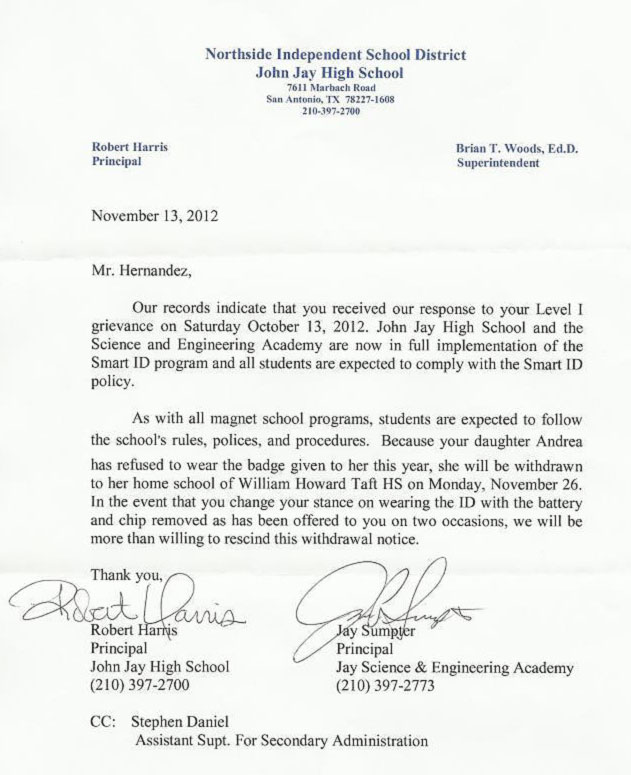
After months of protesting a policy requiring high school students to wear an RFID-enabled ID badge around their necks at all times, Andrea Hernandez is being involuntarily withdrawn from John Jay High School in San Antonio effective November 26th, according to a letter sent by the district that has now been made public.

The letter, sent on November 13, informs her father that the Smart ID program, which was phased in with the new school year, is now in “full implementation” and requires all students to comply by wearing the location-tracking badges.

Since Andrea Hernandez has refused to wear the badge, she is being withdrawn from the magnet school and her program at the Science and Engineering Academy, and instead will have to attend William Howard Taft HS, which is not currently involved in the ID scheme, unless she changes her position.

Civil liberties lawyers at the Rutherford Institute told Infowars.com that they are in the process of filing a temporary restraining order petition to prevent the school from kicking Hernandez out until further appeals can be made to resolve the matter. Representatives for John Jay did not return calls for comment by the time of publishing.

Andrea, backed by her family, has claimed the policy violates her religious beliefs and unduly infringes on her privacy. The controversial ID badge includes the photo and name of each student, a barcode tied to the student’s social security number, as well as an RFID chip which pinpoints the exact location of the individual student, including after hours and when the student leaves campus.

The battle over the IDs has been an ongoing saga. The Hernandez family has previously attended several school board meetings, organized protests and filed formal grievances with the district over the matter, and has been backed by numerous civil rights advocates.

Infowars reporters covered a protest that took place in early October, following up with appearances by the Hernandez family on the Alex Jones Show and the Infowars Nightly News programs.

Letter from John Jay High School withdrawing Andrea Hernandez for not submitting to the RFID tracking ID badges.


http://www.infowars.com/student-expelled-for-refusing-location-tracking-rfid-badge/

For money, you would sell your soul.
 Sophocles

Resources:

Big Brother invades our classrooms                                     http://www.salon.com/2012/10/08/big_brother_invades_our_classrooms/

ACLU documents show increasing phone and internet surveillance by Department of Justice                                                       http://www.theverge.com/2012/9/27/3418420/department-of-justice-surveillance-increase-aclu

Related:

Who has access to student records?                               https://drwilda.com/tag/student-privacy-laws-complicate-schools-ability-to-prevent-attacks/

Dr. Wilda says this about that ©

Blogs by Dr. Wilda:

COMMENTS FROM AN OLD FART © http://drwildaoldfart.wordpress.com/

Dr. Wilda Reviews ©                           http://drwildareviews.wordpress.com/

Dr. Wilda ©                                                                                 https://drwilda.com/

Studies: Lack of support and early parenthood cause kids to dropout

19 Nov

In Is mandating 18 as the dropout age the answer? Moi wrote:

The Alliance for Excellent Education has information about Graduation Rates at their site:

Yet every year, approximately 1.3 million students—that’s over 7,000 every school day—do not graduate from high school on time. Nationwide, only 69 percent of students earn their high school diplomas. Among minority students, only 56 percent of Hispanic, 54 percent of African American, and 51 percent of American Indian and Alaska Native students in the U.S. graduate with a regular diploma, compared to 77 percent of white students and 81 percent of Asian Americans….

High school dropouts face a lifetime of reduced earnings and a diminished quality of life. For example, a high school dropout’s lifetime earnings are, on average, about $260,000 less than a high school graduate’s. Local communities, states, and the American economy suffer from the dropout crisis as well – from lost wages, taxes, and productivity to higher costs for health care, welfare, and crime, as shown in the potential economic impacts nationally and by state.

Census projections show that the minority populations with the lowest graduation rates are poised to become half of the U.S. population by 2050. According to Demography as Destiny: How America Can Build a Better Future, an Alliance issue brief, if minority students continue to receive inferior educations and leave high school without diplomas and adequate preparation for the twenty-first-century economy, the nation’s graduation rate and economic strength will both decrease further.

To learn more, access the Alliance’s publications on high school graduation and dropout rates. http://www.all4ed.org/about_the_crisis/students/grad_rates

The question that educators, politicians, and business leaders are asking is how to decrease the dropout rates.

Passing a law is not going to be effective, but intervention for at-risk students and early childhood education are proven strategies. Those strategies cost money. The question is whether the political elite are paying lip service to dropout prevention while being penny wise and pound foolish. Rapoport is correct that raising the age to dropout must be accompanied by proven education strategies. https://drwilda.com/2012/01/26/is-mandating-18-as-the-dropout-age-the-answer/

Caralee Adams writes in the Education Week article, Why High School Students Drop Out and Efforts to Re-Engage:

Parenthood—either being a parent or missing out on parental support—is the leading reason cited by dropouts for leaving school, according to a new survey.

The 2012 High School Dropouts in America survey was released today by Harris/Decima, a division of Harris Interactive, on behalf of Everest College, a part of the for-profit Corinthian College Inc.

The poll was commissioned to help policymakers and educators understand why students drop out of high school and find effective ways to re-engage them in the hope of improving graduation rates.

The survey asked 513 adults, ages 19 to 35: “Which, if any, of the following reasons prevented you from finishing high school?” Here are the responses:

  1. Absence of parental support or encouragement (23 percent)
  2. Becoming a parent (21 percent)
  3. Lacking the credits needed to graduate (17 percent)
  4. Missing too many days of school (17 percent)
  5. Failing classes (15 percent)
  6. Uninteresting classes (15 percent)
  7. Experiencing a mental illness, such as depression (15 percent)
  8. Having to work to support by family (12 percent)
  9. Was bullied and didn’t want to return (12 percent)

In the survey, conducted online in October, 55 percent of the dropouts looked into, but had not started the process of getting their high school equivalency or GED. The likelihood of doing so is higher for those who are married (67 percent). The reasons for not getting a GED: “not having enough time” (34 percent) and “it costs too much” (26 percent).

One-third of high school dropouts say they are employed either full time, part time, or are self‐employed. Another 38 percent of the men and 26 percent of the women were unemployed.

Attracting young adults who have dropped out back for more education is a challenge.

Often students don’t want to return to the same school they left and are looking for flexible options. One approach that is showing promise is the Boston Public Re-Engagement Center. There, students can retake up to two courses they previously failed; try online credit recovery, or attend night school or summer school. Coming into the program, out-of-school youths are connected with an adult to discuss goals, finances, and enrollment options. http://blogs.edweek.org/edweek/college_bound/2012/11/examining_reasons_for_dropping_out_of_high_school_and_ways_to_re-engage_students.html

See, High School Dropouts Worsened By Lack Of Support, Becoming A Parent: Survey http://www.huffingtonpost.com/2012/11/15/lack-of-support-becoming-_n_2137961.html?utm_hp_ref=email_share

Here is the Executive Summary of Rennie Center’s report about Massachusetts:

Forgotten Youth: Re-Engaging Students Through Dropout Recovery [PDF]

Voices From the Field [PDF]

Executive Summary: Forgotten Youth: Re-Engaging Students Through Dropout Recovery [PDF]

PRESENTATIONS

Presentation: Forgotten Youth [PDF]

EVENTS

Recovering Out-of-School Youth: Using Re-Engagement as a Dropout Reduction Strategy [Web Page]  

Forgotten Youth

Re-Engaging Students Through Dropout Recovery Issue

Each year, thousands of Massachusetts students drop out of school. The path forward for these students is difficult, and failing to educate the next generation of workers and leaders has substantial long-term consequences for our shared economic and social well-being. Policymakers recently have devoted significant attention to dropout reduction; however, this agenda lacks focus on dropout recovery, the act of re-engaging and re-enrolling students who leave school before graduating. Without a more systemic approach to connect with these youth, educators will struggle to fulfill a commitment to educate all students.

Strategy

Boston’s Re-Engagement Center is a dropout recovery program that strives to re-enroll out-of-school youth through outreach, personal connections, and needs-based educational options.

Research

The Rennie Center conducted a case study of the Re-Engagement Center (REC) in Spring 2012, the findings of which are highlighted in the policy brief Forgotten Youth: Re-Engaging Students Through Dropout Recovery.

Findings

Promising practices A robust public-private partnership provides resources & support critical to the REC’s success. By pooling their assets, two partners pushed the work beyond what either could accomplish individually.
 The REC is a welcoming and supportive environment that encourages out-of-school youth to re-enroll in school. Staff encourage & assist youth who may not know what re-enrollment options are available.


Out-of-school youth who decide to return to school require appropriate educational options. A range of options, some immediately accessible, is essential for keeping these youth interested in education.


The REC is a driver of reform for serving students at-risk for leaving school. Information about out-of-school youth has pushed BPS to re-evaluate support provided to students at-risk for dropping out.

Continuing Challenges Information and data tracking is needed to demonstrate the impact of dropout recovery. There is no formal information tracking to explain the REC’s impact on graduation rates and district practices.
 

More systematic approaches are needed to evaluate out-of-school youth before re-enrollment. Re-engagement procedures would benefit from entry assessments to better address student needs.


There is limited capacity in the school district to re-enroll youth. Re-engaging youth often prefer to re-enroll in alternative education programs over traditional high schools, but seats are limited.


Formalization of the REC’s work is needed to strengthen organizational capacity and sustainability. Additional funding from diverse sources is needed to maintain and expand current operations.

 The inflexibility of some policies disengages many students who are close to graduation. Rigid credit hour requirements and MCAS administration dates create challenges to graduating with a diploma.
Considerations For school and district leaders Shape re-engagement around out-of-school youth needs by including multiple, flexible re-enrollment options. Develop partnerships with experienced organizations working to support at-risk youth. Create a supportive and welcoming environment for returning youth by finding the right staff and location.

Nurture open dialogue between re-engagement staff and district leadership to shape systematic change.


For community partners

Use an existing understanding of out-of-school youth to partner with districts to address unmet needs.

Address financial stability at the outset to ensure maintenance of the program.


For state policymakers

Support school districts in making re-engaging out-of-school youth a priority.

Encourage districts to develop or expand existing education options based on student needs.

Create opportunities for out-of-school youth to graduate by bein

Moi wrote about childcare in A baby changes everything: Helping parents finish school https://drwilda.com/tag/childcare-on-colleges/

Dr. Wilda says this about that ©

Blogs by Dr. Wilda:

COMMENTS FROM AN OLD FART © http://drwildaoldfart.wordpress.com/

Dr. Wilda Reviews ©                        http://drwildareviews.wordpress.com/

Dr. Wilda ©                                                                              https://drwilda.com/

Translating digital learning into K-12 education

18 Nov

Moi wrote in The digital divide in classrooms:

One of the major contributors to poverty in third world nations is limited access to education opportunities. The Asian Development Bank has the best concise synopsis of the link between Education and Poverty For a good article about education and poverty which has agood bibliography, go toPoverty and Education, Overview As technology becomes more prevalent in society and increasingly is used in schools, there is talk of a “digital divide” between the haves and have-nots. Laurence Wolff and Soledad MacKinnon define the “digital divide” in their article, What is the Digital Divide?

The “digital divide,” inequalities in access to and utilization of information and communication technologies (ICT), is immense.

http://info.worldbank.org/etools/docs/library/57449/digitaldivide.pdf

Access to information technology varies within societies and it varies between countries. The focus of this article is the digital divide in education. https://drwilda.com/2012/01/25/the-digital-divide-in-classrooms/

Huffington Post reports in the article, Education Technology, Digital Learning Not As Easy As It Seems: Alliance For Excellent Education Report:

A report from the Alliance for Excellent Education identifies four key challenges that public school district leaders must address in the next two years in order to successfully bring digital learning and education technology into K-12 classrooms.

The driving force behind the nationwide effort to adopt a comprehensive digital learning strategy is the move by all states to raise academic expectations by requiring students to graduate from high school college- and career-ready. Additionally, the Common Core State Standards adopted by 46 states and the District of Columbia necessitates using technology to prepare students for computer-administered assessments in the 2014-15 school year.

If you’re a school or district leader who is considering using education technology and digital learning in your schools, STOP — and go no further — until you have a comprehensive plan that addresses your district’s specific challenges and learning goals for all students,” Bob Wise, president of the Alliance for Excellent Education and former governor of West Virginia, said in a statement.

One challenge facing district leaders is ensuring that all students are adequately prepared for college and career following graduation. The report states that schools must adapt accordingly and provide students with learning opportunities that are more hands on, experiential, project-based and aligned with their interests. Doing so will enable students to produce content, analyze information and develop a deeper knowledge of complex topics.

Districts must also manage shrinking budgets and rethink how resources are allocated in support of teachers. The report recommends streamlining expenses, offering online professional development, elevating media specialists as instructional leaders and analyzing budget expenses.

When it comes to training and supporting teachers, the Alliance for Excellent Education encourages a transition from a teacher-centric culture to learner-centered instruction, so as to combat the widely uneven and inequitably distributed access to teachers. http://www.huffingtonpost.com/2012/11/15/alliance-for-excellent-ed_n_2140129.html?utm_hp_ref=email_share

The digital learning report is part of an initiative launched by the Alliance:

Alliance Launches Major Effort to Inform School District Leaders About Decisions Affecting the Future of Education

Every school, district, and state leader must make critical decisions in the next two years involving digital learning that will shape education for decades, according to a new report from the Alliance.

The report, The Nation’s Schools Are Stepping Up to Higher Standards, identifies four key challenges that public school district leaders must systemically address in the next two years and outlines the essential elements for developing a comprehensive digital strategy. (Click on the infographic to the left for a larger image).

The report, plus the Nov. 15 webinar and new digital learning web portal accompanying its release, are the first steps in a major effort by the Alliance to help district leaders make smart, far-reaching decisions about implementing education technology that support teachers and improve student outcomes in K–12 public schools.

If you’re a school or district leader who is considering using education technology and digital learning in your schools, STOP—and go no further—until you have a comprehensive plan that addresses your district’s specific challenges and learning goals for all students,” said Alliance President Bob Wise.

Read the press release , download the report, or access the digital learning portal.

All children have a right to a good basic education. See, Rural schools and the digital divide https://drwilda.com/2012/06/21/rural-schools-and-the-digital-divide/

Related:

Schools Must Bridge the Digital Divide                                          http://www.abpc21.org/digitaldivide.html

Dr. Wilda says this about that ©

Blogs by Dr. Wilda:

COMMENTS FROM AN OLD FART © http://drwildaoldfart.wordpress.com/

Dr. Wilda Reviews ©                            http://drwildareviews.wordpress.com/

Dr. Wilda ©                                                                                       https://drwilda.com/

Will ‘massive open online courses’ (MOOCS) begin to offer credit?

14 Nov

Moi discussed online college courses in Do online badges give a more realistic appraisal than grades?

The New York Times reported about the online education trend in the article, Online Enterprises Gain Foothold as Path to a College Degree http://www.nytimes.com/2011/08/25/education/25future.html?_r=1&emc=eta1

Often these online ventures will offer a certificate or badge to show completion of a course of study. Education Portal defines the difference between a certificate and diploma:

Certificate Overview

A certificate is earned by a student after taking a series of courses relating to a subject. Students often earn certificates to get a step ahead in the professional field of their interest and certificates may be offered in similar programs as degrees. For instance, there are certificates in business, literature and technical programs. In some technical programs, a certificate may be required.

There are also graduate certificates, often taken either alone or alongside a graduate degree program. In some programs, the student may use his or her electives to fulfill a certificate in order to make him or herself more desirable to a potential employer.

Certificate programs taken alone are similar to associate’s degree programs. However, they take less time because core academic programs are not required.

Diploma Overview

Diplomas are similar to certificates but often earned at clinical schools. For instance, a diploma of nursing is offered as an option besides an associate’s degree or bachelor’s degree. This diploma program is only offered at hospitals with specialty programs that provide training. A diploma often takes two years and involves as much clinical work as classroom.

Degree Overview

An academic degree can be earned at many levels, including associate’s, which takes two years, bachelor’s, which takes four years, master’s, which is two years beyond a bachelor’s degree, and doctoral, which is several years beyond a master’s degree.

A degree program differs from certificates and diploma programs in that it often requires the student to take core courses to support a more rounded education. For instance, at many universities, those earning their bachelor’s degree are required to take English, math, science, philosophy and history. Earning a degree also opens up many more potential doors to the student than would a certificate or diploma. Many careers require that the student has earned at least a bachelor’s degree; several career options require more than this. http://education-portal.com/articles/What_is_the_Difference_Between_a_Certificate_Diploma_and_Degree.html

Some online universities are awarding badges. Lynn O’Shaughnessy reports in the U.S. News article, Digital Badges Could Significantly Impact Higher Education. http://www.usnews.com/education/blogs/the-college-solution/2011/10/04/digital-badges-could-significantly-impact-higher-education https://drwilda.com/2012/01/23/can-free-online-universities-change-the-higher-education-model/

https://drwilda.com/2012/10/21/do-online-badges-give-a-more-realistic-appraisal-than-grades/

Nick Anderson reports in the Washington Post article, Exploring credits for free online courses:

The American Council on Education, which represents university presidents, said Tuesday it is teaming with the Bill & Melinda Gates Foundation and the free online education provider Coursera on an initiative to seek answers to those questions.

The announcement is the latest sign of the emerging influence of what are known as mass­ive open online courses, or MOOCs. Millions of people this year have tried out MOOCs on Web sites such as Coursera, edX, Udacity and others.

MOOCs are an intriguing, innovative new approach that hold much promise for engaging students across the country and around the world, as well as for helping colleges and universities broaden their reach,” Molly Corbett Broad, president of the council, said in a statement. She said the council is eager to help answer questions such as whether the free online courses can “increase learning productivity.”

Under the initiative, Coursera will pay the council a to-be-determined fee to evaluate the credit-worthiness of a selection of its courses. Coursera, a for-profit company, hosts about 200 courses from 33 prominent institutions. Among local participants are the universities of Virginia and Maryland and Johns Hopkins University.

Broad said the council also is in discussions with edX, a nonprofit MOOC venture led by MIT and Harvard University, about possible analysis of its courses.

The universities that offer MOOCs have not said that they intend to award credits for them. But a recommendation from the council that the courses are worthy of credit would be a key step toward helping students obtain transfer credit from other schools. Another key step would be to arrange proctored exams to verify student work….

Some university presidents are skeptical.

C.L. Max Nikias, president of the University of Southern California, said his school will not offer free online courses. He said he worries about how much students learn through MOOCs and whether their achievement can be verified. http://www.washingtonpost.com/local/education/exploring-credits-for-free-online-courses/2012/11/13/ccdcbac8-2d8f-11e2-89d4-040c9330702a_story.html?wpisrc=emailtoafriend

See, College Credit Eyed for Online Courses http://www.nytimes.com/2012/11/14/education/moocs-to-be-evaluated-for-possible-college-credit.html?emc=eta1&_r=0

Jeffrey R. Young reports in the Chronicle of Higher Education article, American Council on Education May Recommend Some Coursera Offerings for College Credit:

ACE also announced on Tuesday that it will set up a Presidential Innovation Lab that will bring together college leaders to discuss the potential of MOOC’s and new business models for higher education. The lab is supported by an $895,453 grant from the Bill & Melinda Gates Foundation, as part of about $3-million in new MOOC-related grants announced Tuesday.

The review process by the council will be “similar to the way regional accreditation works,” said Molly Corbett Broad, president of ACE. Professors will look at the content, teaching methods, “evidence of student engagement,” and other elements of MOOC’s to see if they appear equivalent to that taught by an accredited college, she added.

To pass the council’s test, Coursera will make a few changes in the courses for which it seeks certification. For instance, ACE requires an “authentication of identity,” said Ms. Broad, meaning that Coursera must have some kind of proctored examination or other way to prove that students are who they say they are.

For the courses in the pilot project, Coursera will form partnerships with online proctoring companies that use Webcams and special software to monitor tests remotely, said Daphne Koller, co-founder of Coursera. Students hold up their ID’s to a Webcam during an appointed exam time, and an employee from the proctoring company checks them to verify identity, and then watches students take the test to make sure they aren’t cheating.

Meanwhile, the proctoring company uses software to monitor the students’ activity to make sure they aren’t just Googling the answers. Ms. Koller expects the cost of the proctoring to be less than $30 per exam.

The remote-proctoring strategy differs from an identity-verification system used by other providers of MOOC’s, including edX, a nonprofit started by Harvard University and the Massachusetts Institute of Technology, and Udacity, a start-up company competing with Coursera. Both of those organizations say they will use a series of testing centers run by Pearson, which will require students to travel to a test center to take final exams in person, if they want a certificate of completion.

Related Content

http://chronicle.com/article/American-Council-on-Education/135750/?cid=pm&utm_source=pm&utm_medium=en

With any education opportunity the prospective student and their family must do their homework and weigh the pros and cons of the institution with with the student’s goals and objectives. In answer to the question of whether online college is a threat to traditional bricks and mortar universities, it depends. The market will answer that question because many students do not attend college to receive a liberal arts education, but to increase employment opportunities. If the market accepts badges and certificates, then colleges may be forced to look at the costs associated with a traditional college degree.

Related:

Verifying identity for online courses                                            https://drwilda.com/2012/04/15/verifying-identity-for-online-courses/

Is online higher ed a threat to bricks and mortar colleges? https://drwilda.com/2012/09/17/is-online-higher-ed-a-threat-to-bricks-and-mortar-colleges/

Dr. Wilda says this about that ©

Blogs by Dr. Wilda:

COMMENTS FROM AN OLD FART © http://drwildaoldfart.wordpress.com/

Dr. Wilda Reviews ©                            http://drwildareviews.wordpress.com/

Dr. Wilda ©                                                                                https://drwilda.com/

The military mirrors society

13 Nov

Here’s today’s COMMENT FROM AN OLD FART: Despite the fact that those in high places are routinely outed for lapses in judgment and behavior unbecoming the office or position they have been entrusted with, many continue to feign surprise at the lapse. Really, many are feigning the surprise at the stupidity of the seemingly bright and often brilliant folk who now have to explain to those close and the public about the stupidity which brought their lives to ruin. Some how the “devil made me do it” does not quite fully explain the hubris. The hubris comes from a society and culture where ME is all that counts and there are no eternals. There is only what exists in this moment.

Thom Shanker writes in the New York Times article, Concern Grows Over Top Military Officers’ Ethics:

Along with a steady diet of books on leadership and management, the reading list at military “charm schools” that groom officers for ascending to general or admiral includes an essay, “The Bathsheba Syndrome: The Ethical Failure of Successful Leaders,” that recalls the moral failure of the Old Testament’s King David, who ordered a soldier on a mission of certain death — solely for the chance to take his wife, Bathsheba.

The not-so-subtle message: Be careful out there, and act better.

Despite the warnings, a worrisomely large number of senior officers have been investigated and even fired for poor judgment, malfeasance and sexual improprieties or sexual violence — and that is just in the last year.

Despite the warnings, a worrisomely large number of senior officers have been investigated and even fired for poor judgment, malfeasance and sexual improprieties or sexual violence — and that is just in the last year….http://www.nytimes.com/2012/11/13/us/petraeuss-resignation-highlights-concern-over-military-officers-ethics.html?hp

The Petreaus Mess is simply this month’s scandal de jour. There will be others to follow.

Moi wrote in Cheating at Harvard:

Minnesota State University Mankato has an excellent newsletter article about academic dishonesty. Richard C. Schimming writes in Academic Dishonesty

A recent survey found that 1/3 of all students admitted to cheating on an examination, 1/2 admitted to cheating on a class assignment, 2/3 admitted to cheating at least once during their college career, and 2/3 have seen classmates cheat on exams or assignments. Paradoxically, 3/4 of those in that survey believe that cheating is not justified under any circumstances. Finally, 1/2 of the students surveyed believe that the faculty of their university do not try to catch cheaters….

The various reasons that students give for cheating can also be instructive in obtaining a picture of academic dishonesty. Gleaned from a variety of sources, the list of student reasons for cheating given below is meant to be illustrative rather than exhaustive:

  1. Today’s generation of student has less of an attachment to the institution so that cheating is more impersonal and seen as less painful because of this detachment.

  2. The difficult job market places a premium on a high grade point average so that any means necessary will be employed to achieve and maintain good grades.

  3. Some students believe that professors are cheating them in the classroom by shirking their teaching responsibilities. Therefore, students come to believe that turnabout is fair play.

  4. New entering students find themselves in courses beyond their capability so they resort to cheating to succeed in the course.

The metaphors and social constructs provided by students in surveys can also provide insight into the rationale for academic dishonesty. In one recent study, students used the following metaphors for cheating:

  1. Cheating is just a game, so that it is not important how you win but what is important is that you win.

  2. Cheating is an addiction. Once a student has successfully cheated in some academic context, the urge to continue can become addicting.

  3. Cheating is an easy out. Rather than working hard to master the material, a student can be tempted to use the shortcut of academic dishonesty.

  4. Cheating is a personal dilemma. Students do not begin to cheat because they are ignorant of the potential consequences. Rather the decision to cheat is a difficult decision for most students.

  5. Cheating is theft. The act of cheating robs the institution, the professor, the cheating student, and the other students.

  6. Cheating is a team effort. Cheating does not occur in a vacuum. Where there is a culture that condones cheating and where a student sees other students cheating, academic dishonesty is more likely to flourish.

For some students, cheating starts early. By the time some kids reach college they have already established a pattern of cheating. ABC News has a good report, A Cheating Crisis in America’s Schools http://drwilda.wordpress.com/2011/12/21/cheating-in-schools-goes-high-tech/ https://drwilda.com/2012/09/02/cheating-at-harvard/

Today’s college students become tomorrow’s generals and captains of industry.

Too many families lack a moral compass or a compass of any type. In fact, too many children are growing up in shells of what a family should be. Moi wrote about the culture in It’s the culture and the values, stupid. https://drwilda.com/2011/11/04/its-the-culture-and-the-values-stupid/

Petreaus too shall pass. The next unnamed scandal is be formulated like a hurricane forms over the ocean. After all, it’s really all about ME.

Blogs by Dr. Wilda:

COMMENTS FROM AN OLD FART © http://drwildaoldfart.wordpress.com/

Dr. Wilda Reviews ©                              http://drwildareviews.wordpress.com/

Dr. Wilda ©                                                                                   https://drwilda.com/

Alternative discipline: Helping disruptive children stay in school

12 Nov

Moi wrote in Inappropriate discipline: The first step on the road to education failure:

Joan Gausted of the University of Oregon has an excellent article in Eric Digest 78, School Discipline

School discipline has two main goals: (1) ensure the safety of staff and students, and (2) create an environment conducive to learning. Serious student misconduct involving violent or criminal behavior defeats these goals and often makes headlines in the process. However, the commonest discipline problems involve noncriminal student behavior (Moles 1989).

The issue for schools is how to maintain order, yet deal with noncriminal student behavior and keep children in school.

Alan Schwartz has a provocative article in the New York Times about a longitudinal study of discipline conducted in Texas. In School Discipline Study Raises Fresh Questions  Schwartz reports:

Raising new questions about the effectiveness of school discipline, a report scheduled for release on Tuesday found that 31 percent of Texas students were suspended off campus or expelled at least once during their years in middle and high school — at an average of almost four times apiece.

Donna St. George has written a Washington Post article which elaborates on the Texas study.

In the article, Study shows wide varieties in discipline methods among very similar schools, St. George reports:

The report, released Tuesday, challenges a common misperception that the only way schools can manage behavior is through suspension, said Michael D. Thompson, a co-author of the report, done by the Council of State Governments Justice Center and Texas A&M University’s Public Policy Research Institute. “The bottom line is that schools can get different outcomes with very similar student bodies,” he said. “School administrators and school superintendents and teachers can have a dramatic impact….”

The results showed that suspension or expulsion greatly increased a student’s risk of being held back a grade, dropping out or landing in the juvenile justice system. Such ideas have been probed in other research, but not with such a large population and across a lengthy period, experts said. http://www.washingtonpost.com/local/education/study-exposes-some-some-myths-about-school-discipline/2011/07/18/gIQAV0sZMI_story.html?wpisrc=emailtoafriend

Family First Aid has a good discussion about the types of behavior problems that result in suspension or expulsion.  Dore Francis has a guide, which lists what parents should do if their child is suspended. The guide gives detailed instructions to these steps and other steps. Francis also lists what questions to ask after meeting with school officials. https://drwilda.com/2011/12/13/inappropriate-discipline-the-first-step-on-the-road-to-education-failure/

Nirvi Shah has written the interesting Education Week report, Suspended in School: Punished But Still Learning about alternative discipline methods:

Some of the students at Success Academy here are doing International Baccalaureate-level work. Most of the classes have just five or six students. And every nine weeks, groups of students are required to make major presentations to their classmates and hand in thick binders full of even more- detailed reports.

But this Baltimore public high school isn’t for elite students. Admission depends on whether students have done something so serious a regular district school won’t have them anymore: assaulting classmates or staff members, possessing or distributing drugs, or wielding weapons.

The school, serving as many as 100 students at a time, costs more than $1.2 million a year to run, but the district, which houses the program at its headquarters, says keeping students learning and in school—somewhere—while they are serving out a suspension or have been kicked out of their own schools is far less expensive than the alternative.

“The idea of children being out of school makes no sense,” said Karen Webber-Ndour, Baltimore’s executive director of the office of student support and safety. But at the same time, the district acknowledges that students may have to leave their home school for some offenses.

School-based discipline options like this one are being tried in schools nationwide as a substitute for punishments that force students out of school, which have been shown to disproportionately affect black, Latino, and male students and those with disabilities.

While in-school suspension may be an old standby, schools seem to be putting their own stamp on it. Whether those spaces are staffed by certified teachers or aides varies, and some schools don’t have classroom space to spare for something that might be heavily used one day and not at all the next. Other disciplinary configurations include Saturday classes, evening programs, and lunchtime interventions. In some cases, behavioral-health specialists are available on demand to work with students, keeping them in school rather than suspending them. http://www.edweek.org/ew/articles/2012/11/07/11inschool_ep.h32.html?tkn=OQXF4T7wRzd%2BfDTAENRdHmICQyIk7%2FNisjS1&cmp=clp-edweek&intc=es

The whole child approach is useful in keeping many children in school.

Moi wrote in The ‘whole child’ approach to education: Many children do not have a positive education experience in the education system for a variety of reasons. Many educators are advocating for the “whole child” approach to increase the number of children who have a positive experience in the education process. https://drwilda.com/2012/02/10/the-whole-child-approach-to-education/

In order to ensure that ALL children have a basic education, we must take a comprehensive approach to learning.

A healthy child in a healthy family who attends a healthy school in a healthy neighborhood ©

See:

Education Law Center

Discipline In Schools: What Works and What Doesn’t?

Justice for Children and Youth has a pamphlet I’m being expelled from school – what are my rights?

Related:

Report: Black students more likely to be suspended https://drwilda.com/2012/08/07/report-black-students-more-likely-to-be-suspended/

Johns Hopkins study finds ‘Positive Behavior Intervention’ improves student behavior                                                   https://drwilda.com/2012/10/22/johns-hopkins-study-finds-positive-behavior-intervention-improves-student-behavior/

Pre-kindergarten programs help at-risk students prepare for school                                                                                    http://drwilda.com/2012/07/16/pre-kindergarten-programs-help-at-risk-students-prepare-for-school/

A strategy to reduce school suspensions: ‘School Wide Positive Behavior Support’                                                     https://drwilda.com/2012/07/01/a-strategy-to-reduce-school-suspensions-school-wide-positive-behavior-support/

Dr. Wilda says this about that ©

Blogs by Dr. Wilda:

COMMENTS FROM AN OLD FART © http://drwildaoldfart.wordpress.com/

Dr. Wilda Reviews ©                                  http://drwildareviews.wordpress.com/

Dr. Wilda ©                                                                                 https://drwilda.com/