Tag Archives: At Public Universities Warnings of Privatization

American Association of State Colleges and Universities report: Proposal to slow privatization of public universities

18 Jan

Moi really don’t know what to make of the idea of privatizing state universities. In the recent past, government had the goal of raising the standard of living and producing the economic conditions that fostered livable wage jobs. The goal of most politicians was to create the conditions that promoted and fostered a strong middle class. Particularly, after WWII and the Korean War, with the G.I Bill, one part of that equation was the wide availability of a college education. This push produced an educated workforce and a college education was within reach, no matter one’s class or social status. This educated workforce helped drive this country’s prosperity. Now, have we lost the goal of providing educational opportunity the widest number of people possible, no matter their class or social status? This question causes me to wonder about privatizing state universities.

A couple of questions. First, has anyone ever looked at how efficient the academic world is in spending current resources? Second, is the current institutional model one that works? Should there be changes in the institutional model?

Sam Dillion was writing about the prospect of privatizing public universities in the New York Times in 2005. See, At Public Universities, Warnings of Privatization http://www.nytimes.com/2005/10/16/education/16college.html In 2004, William Symonds wrote an opinion piece in Business Week about the role of public universities:

To date, no major public university has been fully privatized. But as the states foot a smaller share of their budgets, the flagships have become more dependent on tuition and other sources of funds. They may still be publicly owned, but increasingly they’re privately financed. So a number of the flagships are seeking more freedom from state control. In July, University of Colorado President Elizabeth Hoffman won “enterprise status” for her school, which means it’s no longer governed by the same rules as state agencies. Miami University of Ohio recently became the first major public campus to adopt the high-price, high-financial-aid tuition model used by elite private colleges. That means all students across the board are now charged $19,642, although Ohio residents receive scholarships of at least $10,000. “We are becoming more like our private counterparts,” says Penn State President Graham B. Spanier.”
This is a powerful yet troubling trend. On the one hand, the flagships are being forced to rely more on fund-raising, research grants, and other private or nonstate money. Given this reality, it makes sense to free them up from state rules that could impede their ability to become efficient and competitive. Such moves could help to insulate them from meddling politicians, as well.
Squeezing the Poor
At the same time, creeping privatization accelerates a broader movement by the top 100 or so flagships to hike their tuitions at a double-digit rate. The result is that a public good designed to give all Americans access to higher ed is turning into something more like a private one, open primarily to those whose families can afford it. Already, the student body at some flagship campuses is more affluent than at elite private schools: At Ohio’s Miami, for one, the median family income tops $100,000 a year.
Moreover, as flagships break free, support could erode for less prestigious state schools that remain more dependent on public funds. Privatization “will accelerate the social stratification of higher education, in which the elite [public colleges] are primarily filled with kids from privileged backgrounds, and the kids from poorer families are concentrated in less prestigious schools,” says David W. Breneman, dean of the Curry School of Education at UVA. At the nation’s 146 most selective colleges — including the top flagships — just 3% of entering freshman come from the bottom socioeconomic quarter, while a staggering 74% come from the top quarter…. http://www.businessweek.com/stories/2004-11-14/commentary-should-public-universities-behave-like-private-colleges

The privatization issue arises whenever there is a lack of leadership or vision

Recently, Kim Clark at the US News site asked Would Privatization Help Public Universities Excel? http://www.usnews.com/education/articles/2009/08/19/would-privatization-help-public-universities-excel Michael Hiltzak addressed the question of privatizing the University of California in an LA Times article, Why Privatizing the University of California Won’t Work http://articles.latimes.com/2009/dec/10/business/la-fi-hiltzik10-2009dec10

Eric Kelderman reported in the Chronicle of Higher Education article, Report Proposes Federal Matching Grants for State Higher Education:

As Congress begins debating the reauthorization of the Higher Education Act, proposals to change how public colleges get their federal money are starting to pop up.
On Wednesday, the American Association of State Colleges and Universities released a report recommending a new federal block grant to the states for higher education. The goal of the proposed program is to give states some incentive to preserve and even raise the amount they spend on colleges, which has been in decline, and also to strengthen the federal commitment to affordable higher education.
The formula for the additional federal money would be based on a comparison of a state’s per-student appropriation and the maximum Pell Grant.
To qualify for the bonus money, the state would have to provide a per-student appropriation equal to half of the maximum Pell Grant. At that level, the federal government would give the state another 25 cents for each dollar of state money.
“The more fiscal support states provide per … student, the higher the federal match rate, with the peak match reaching $0.60 for each dollar of state investment,” the report proposes. Based on figures for the 2012 fiscal year, Colorado, for example, would receive a block grant of about $1.7-million, while California would get about $1.2-billion.
While the formula would serve as a sort of de facto maintenance-of-effort provision, the additional federal dollars should come largely without strings attached, the report recommends.
http://chronicle.com/blogs/bottomline/new-report-proposes-federal-matching-grants-for-state-higher-ed/

The question lawmakers should be asking themselves is why society developed public universities and do those reasons still exist. In the rush to get past this moment in time lawmakers may be destroying the very economic engine, which would drive this state out of the economic famine that currently exists. Of course, if the current public universities were privatized, we wouldn’t have to worry about pigs still at the trough, like university presidents with million dollar salaries or would we?

Here is the press release from AASCU:

News Release from AASCU
FOR IMMEDIATE RELEASE 2014-01-15
Contact: Jennifer Walpole (202) 478-4665
STOPPING THE PRIVATIZATION OF PUBLIC HIGHER EDUCATION
AASCU Proposes Federal Incentive Program to Address College Affordability Crisis
Washington, D.C.—The American Association of State Colleges and Universities (AASCU) released a proposal today aimed at combatting escalating tuition hikes at public colleges and universities. AASCU’s plan calls for leveraging up to $15 billion in federal matching funds to incentivize state lawmakers to invest in public higher education. The erosion of state funding remains the primary driver of tuition increases at public colleges and universities.
The proposed Federal-State College Affordability Partnershipwould reward states whose higher education funding practices align with the federal government’s longstanding commitment to making college more affordable for all Americans. It would compare each state’s per-student subsidy at public institutions to the Pell Grant maximum award—the federal government’s level of support for low-income students—and provide progressively greater federal matching funds to states that better fund their students.
“Providing an annual block grant to states that includes a scaled federal award is an efficient, effective and equitable method to keep college affordable,” says Daniel J. Hurley, associate vice president for government relations and state policy at AASCU.
“The program offers a unique mechanism to counter the privatization trend by ensuring that federal and state funding practices work in tandem to reduce costs for students” says Barmak Nassirian, director of federal relations and policy analysis at AASCU.
Given the vital importance of a highly educated workforce, AASCU calls on Congress to give serious consideration to the Federal-State College Affordability Partnership.
The proposal is the result of the Reimagining Aid Design and Delivery (RADD) initiative—Phase Two; Grants and Work-Study Consortia, led by the Education Trust, and funded by the Bill and Melinda Gates Foundation.It was authored by Daniel J. Hurley, Thomas L. Harnisch and Barmak Nassirian of the AASCU division of government relations and policy analysis.
View AASCU’s report on the proposal here:
A Proposed Federal Matching Grant Program to Stop the Privatization of Public Higher Education

Click to access federalmatchingprogram.pdf

###
AASCU is a Washington-based higher education association of more than 400 public colleges, universities and systems whose members share a learning- and teaching-centered culture, a historic commitment to underserved student populations and a dedication to research and creativity that advances their regions’ economic progress and cultural development.
http://www.aascu.org/policy/publications/policy-matters/federalmatchingprogram.pdf

Where information leads to Hope. © Dr. Wilda.com

Dr. Wilda says this about that ©

Blogs by Dr. Wilda:

COMMENTS FROM AN OLD FART©
http://drwildaoldfart.wordpress.com/

Dr. Wilda Reviews ©
http://drwildareviews.wordpress.com/

Dr. Wilda ©
https://drwilda.com/
Ohio study: Deregulation in college education equals less access to modest and lower-income students

19 Oct

Moi really doesn’t know what to make of the idea of privatizing state universities. In the recent past, government had the goal of raising the standard of living and producing the economic conditions that fostered livable wage jobs. The goal of most politicians was to create the conditions that promoted and fostered a strong middle class. Particularly, after WWII and the Korean War, with the G.I Bill, one part of that equation was the wide availability of a college education. This push produced an educated workforce and a college education was within reach, no matter one’s class or social status. This educated workforce helped drive this country’s prosperity. Now, have we lost the goal of providing educational opportunity the widest number of people possible, no matter their class or social status? This question causes moi to wonder about privatizing state universities.

A couple of questions. First, has anyone ever looked at how efficient the academic world is in spending current resources? Second, is the current institutional model one that works? Should there be changes in the institutional model? Finally, is this proposal the first step toward privatization of universities?  Sam Dillion was writing about the prospect of privatizing public universities in the New York Times in 2005. See, At Public Universities, Warnings of Privatization In 2004, William Symonds wrote an opinion piece in Business Week about the role of public universities

Tamar Lewin wrote an excellent 2011 article in the New York Times about the greater percentage that tuition is making up of must public university budgets. In, Public Universities Relying More on Tuition Than State Money Lewin writes:

According to the Delta Cost Project, most of the nation’s public research universities had more than half their costs paid by tuition in 2008, and other four-year public institutions were hovering near the 50 percent mark. With three more years of tuition increases, they, too, have probably passed it, said Jane V. Wellman, executive director of the project, leaving only community colleges as mostly state-financed.

And the increasing dependence on tuition has disturbing implications for access to higher education, she said.

In the next three or four years, we’re going to have more students who are spilling out the bottom, priced out of the expensive institutions,” Ms. Wellman said. “We’re going to be rationing opportunity. We’re moving in that direction fairly rapidly.”

Given that states still provide some $80 billion for higher education, some education policy experts say it is wrong to think of public universities as privatized. But they acknowledge that a fundamental reordering is under way — and that the era of affordable four-year public universities, heavily subsidized by the state, may be over.

Something important is happening here,” said Pat Callan, president of the National Center for Public Policy and Higher Education. “I wouldn’t call it privatization, a word often used by presidents of public institutions who want a blank check on raising tuition. But with the shift toward more student funding, you have to wonder who owns these places — the students, because they’re paying the majority, or the state, which has invested hundreds of years in the physical plant and the brand?”

The burden on students is likely to keep growing. According to the Center on Budget and Policy Priorities, 30 states face shortfalls of at least 10 percent of their budgets next year. And given the difficulties of cutting costs for Medicaid or K-12 schools, which get the biggest chunk of state budgets, appropriations for higher education are likely to shrivel further, leaving public universities ever more dependent on tuition money.

The University of South Carolina has lost almost half of its state appropriations in the last three years, gets only about a quarter of its education budget from the state and is expecting another round of deep cuts next year.

We still have our public mission, but at this point, we have more of a private funding model,” said Michael Amiridis, the provost.

More states may soon find themselves in a similar position. In California, where tuition has been raised by 30 percent in the last two years — and where out-of-state tuition now tops $50,000, about the same as an elite private university — the governor has proposed cutting state support for the University of California by $500 million for the next fiscal year.

If approved, this budget will mean that for the first time in our long history, tuition paid by University of California students and their families will exceed the state’s contribution to the core fund,” Mark Yudof, the president of the University of California system, told the Board of Regents. “For those who believe what we provide is a public good, not a private one, this is a sad threshold to cross.”

In Texas, legislators have proposed closing four community colleges and ending financial aid for freshmen. In Georgia, the popular Hope scholarships are likely to be slashed. In Arizona, the governor has proposed cutting financing for community colleges by half, and for four-year universities by 20 percent.

In state after state, tuition and class size are rising, jobs are being eliminated, maintenance is being deferred and the number of nonresident students, who pay higher tuition, is increasing.

Policy Matters Ohio studied deregulation efforts in the Ohio higher education system. See, Lack of Success in Experiments Deregulating Public Higher Ed http://www.educationnews.org/higher-education/lack-of-success-in-experiments-deregulating-public-higher-ed/

Here is the press release from Policy Matters Ohio:

Deregulated higher education shows troubling results

by Policy Matters Ohio on October 17th, 2012

October 17th, 2012     
   
For immediate release
Contact: Wendy Patton, 614.221.4505
Download press release
Go to full report

Higher tuition, less access for modest-income students at systems with less public control, study finds

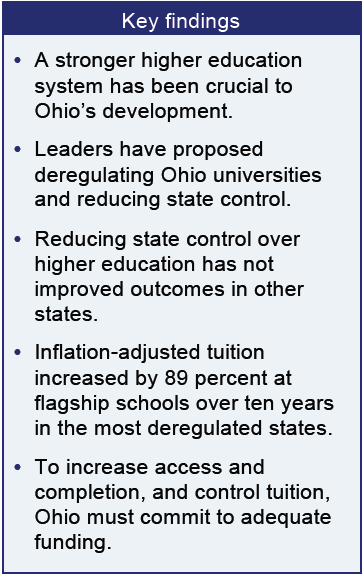
The most deregulated public college and university systems in the U.S. saw a staggering 89 percent tuition growth in flagship schools over the past decade (inflation adjusted), enrolled the lowest percentage of lower-income students, and devoted the lowest amount of state per capita income to higher education when compared to more regulated public education systems, according to a new report from Policy Matters Ohio.

The study, Deregulation and higher education: Potential impact on access, affordability and achievement in Ohio, reviews higher education management structures around the country.

In August 2011, the Kasich administration proposed the Enterprise University Plan,an approach that is likely to form the basis for changes to university management in Ohio. The proposal provides broad exemption from state fiscal and administrative statutes; diminished state oversight of real estate, construction, procurement, and legal settlements; elimination of student enrollment caps; and authority to set differential tuition.

Deregulation in other states has not made tuition more affordable, increased access for low-income students, or increased graduation rates,” said Wendy Patton, senior project director at Policy Matters and report co-author. “Public support for universities and funding for need-based aid, not management structure, are the key factors that lead to lower tuition and more access.”

In the past 20 years, many states have loosened control over aspects of public higher education. Ohio’s proposal goes further than most – it lacks state-mandated performance targets on retention, graduation, affordability and other mechanisms included in the deregulation of other systems.

Policy Matters compared enrollment, graduation, affordability, and low-income student access for the nation as a whole with three smaller groups of states: highly deregulated states like Colorado and Virginia; partially regulated approaches like in Illinois, New Jersey and Texas and coordinated systems as in Kentucky, Maryland and Minnesota.

Ohio’s Enterprise University Plan is most like the highly deregulated model. The most deregulated systems in our study have seen the highest inflation-adjusted tuition growth at flagship schools since deregulation, an 89 percent jump. At non-flagship four-year universities, tuition has spiked most in the partially regulated schools, the second most deregulated category.

Public investment has plunged across all management structures, with highly deregulated systems investing the least by 2011, a paltry $3.79 for every $1,000 in state income, down from $7.55 in 1991. Ohio’s investment also plunged, from $7.03 for every $1,000 in state income in 1991 to just $4.57 in 2011. Low-income enrollment for the highly deregulated group was far behind the control group, just 26.1 percent compared to 37.8 percent.

Public universities and colleges in Ohio helped to dramatically increase higher education levels over the past fifty years. They have given employers skilled professionals, provided a pathway to the middle class, and provided businesses with cutting edge research. However, Ohio college completion levels lag the nation (we rank 34th), tuition is higher than average (tied for third most costly relative to median family income), the state has slashed support for higher education and for need-based aid, and it is difficult in Ohio, as elsewhere, for students from middle-class and low-income families to afford college. Federal aid helps: Ohio enrolls more students who are eligible for and get federal assistance in the form of Pell grants (38.9 percent).

The report concludes that reducing public control over Ohio’s university system could result in higher tuition and lower access for students from middle- and low-income families. The report recommends that, instead of deregulating, Ohio adequately fund higher education, commit to need-based aid, and establish strong performance targets.

Ohio’s future depends on an excellent higher education system capable of preparing Ohioans to participate in the economy and community,” said Michelle Camou, report co-author. “The enterprise plan lost sight of Ohio’s own goals, labor force needs, and understanding of higher education as a pathway to the middle class. Outcomes are likely to be better if citizens maintain control over Ohio’s public university system.”

###

 Policy Matters is a non-profit, non-partisan policy research institute. Michelle Camou, who has a Ph.D. in political science from University of Colorado at Boulder, is a public policy consultant, specializing in urban development, labor, immigration, and higher education policies.

Here are some key findings:

Download report
Download executive summary

The public policy wonks well tell you that it is bad public policy to have tightly dedicated funds for one particular public purpose. But, we are at the time in this society where a dedicated source of funding for K-16 education should be examined. Otherwise, the seeds of growth for the economic future of this state and this country will die before they have a chance to germinate.

Dr. Wilda says this about that ©

Blogs by Dr. Wilda:

COMMENTS FROM AN OLD FART © http://drwildaoldfart.wordpress.com/

Dr. Wilda Reviews ©                        http://drwildareviews.wordpress.com/

Dr. Wilda ©                                                                                    https://drwilda.com/

Will a three year B.A. help more students afford college?

24 Jun

In 3rd world America: College increasingly out of reach, moi said:

Moi really doesn’t know what to make of the idea of privatizing state universities.  In the recent past, government had the goal of raising the standard of living and producing the economic conditions that fostered livable wage jobs. The goal of most politicians was to create the conditions that promoted and fostered a strong middle class. Particularly, after WWII and the Korean War, with the G.I Bill, one part of that equation was the wide availability of a college education. This push produced an educated workforce and a college education was within reach, no matter one’s class or social status. This educated workforce helped drive this country’s prosperity. Now, have we lost the goal of providing educational opportunity the widest number of people possible, no matter their class or social status? This question causes moi to wonder about privatizing state universities.

Sam Dillion was writing about the prospect of privatizing public universities in the New York Times in 2005. See, At Public Universities, Warnings of Privatization In 2004, William Symonds wrote an opinion piece in Business Week about the role of public universities

Justin Pope, AP Education Writer details just how fast college costs are rising all over the country in the article, College prices up again as states slash budgets:

Average in-state tuition and fees at four-year public colleges rose an additional $631 this fall, or 8.3 percent, compared with a year ago.

Nationally, the cost of a full credit load has passed $8,000, an all-time high. Throw in room and board, and the average list price for a state school now runs more than $17,000 a year, according to the twin annual reports on college costs and student aid published Wednesday by the College Board.

http://www.time.com/time/nation/article/0,8599,2097835,00.html

Prospective students and families will not only have to worry about getting into college, but finding a way to pay for college. So, it comes as no surprise that reducing the time it takes to get a B.A.  is an idea that is being floated.  https://drwilda.wordpress.com/2011/10/27/3rd-world-america-college-increasingly-out-of-reach/

Mary Beth Marklein writes in the USA TODAY article, Cut college tuition by getting 4-year degree in 3 years:

Yet for all its pocketbook appeal, the three-year concept hasn’t taken off, particularly at public universities. Legislation in Rhode Island in 2009 and Washington last year encourages public universities to develop three-year options, but no programs have been proposed to date, officials in both states say. State budget challenges have pushed a University of California committee’s recommendation to a back burner, says system spokesman Steve Montiel.

At Ohio State University, which must phase in three-year degrees beginning this fall, provost Joe Alutto says a three-year degree may be “misdirected for an institution such as ours.” He told legislators last year that students who earned college credit in high school tend to add a minor or second major rather than graduate early.

Some skeptics worry about quality. “It’s as if they put students on a conveyer belt and just speed them up and spray them with a fire hose and the students catch what they can,” Southern New Hampshire University professor Marty Bradley says of models that compress four years into three. He pioneered a three-year degree on his campus in 1997 that required an overhaul of the curriculum.

Some education groups argue that resources, particularly at public institutions, should focus on students who are most at risk of dropping out. A study of 33 states by the non-profit Complete College America found that just 26% of students enrolled at public institutions earn a bachelor’s in four years; 54.3% take six years. About 2% of students earning a bachelor’s in 2007-08 did so in three years, federal data show. Hartwick’s four-year graduation rate in recent years averages about 46%.  http://www.usatoday.com/money/perfi/college/story/2012-06-18/three-year-college-degrees/55746696/1#.T-U7ubWwBmE.email

For many students, a three year program will result in a huge savings, but there are risks for other students.

Mandee Heller Adler, Founder and Principal of International College Counselors writes in the article, 3-Year college degrees can save time and money, but is it worth it?

Some of the pros and the cons of the 3-year plan include:

PROS

• Three years give a boost for ambitious students who know what they want to study.

• It will be easier for families to afford college

• Students enter the workforce quicker and/or go on sooner for graduate study.

CONS

•  An undergraduate’s social experience could be compromised.

•  College would tilt more toward job training and away from the broad-based education that many U.S. schools offer.

• Employers may then insist on a master’s before they employ anyone and this will increase the cost to students of the future.

• Parents will pressure their students to enter a 3 year program and then students will have a miserable time, taking an overload of courses, and missing the experience of college.

•  Students should enjoy these four years of freedom.  They have the rest of their lives to work.

From my experience as a college advisor, my thought is, if you’re smart and dedicated enough to graduate in 3 years, you can figure out how to do it on your own.   AP credits, summer courses, and college credits gained during high school can be used to reach this goal.  I work with a few high school freshmen now who are accumulating college credit. Their life goals may change in the next two years but the college credit can work favorable for them no matter what college or major they enter. I know more than a few students, including my sister, who graduated in three years or less without their colleges having to create a special program.

If you have any other college admissions questions for a college counselor, I’d be happy to answer them.  Please write me here or at my personal email which can be found on my International College Counselors college counseling website.

http://internationalcollegecounselors.com/blog/?page_id=81

For the article that served as a basis for these college counselor thoughts, see:                                                   http://www.washingtonpost.com/wp-dyn/content/article/2009/05/22/AR2009052203681_Comments.html#

There are also concerns that a three year program might not be appropriate for at-risk students.

Christina Couch  writes at Bankrate.com in the article, Pros and cons of accelerated degree programs:

Greater risk to the at-risk

The economic reasons for shortening college tenure are strong. Not only knocking out a year of tuition, room and board — a value of anywhere from $10,000 to $50,000 — they also reduce student loan interest and help students get a jump on paying their student loans back. The problem, says Karen Gross, president of Southern Vermont College in Bennington, Vt., is that the students most economically motivated to reduce their college costs are frequently the ones who need a four-year program the most.

“Many students come into college with certain academic deficiencies. There’s a fair amount of work that has to be done just to catch them up,” she says. “There are a subgroup of students from elite high schools for whom a three-year degree would be just fine. But that’s a very small percentage.”

Certain populations of students are more at-risk than others. Students from low-income, English as a second language and first-generation college backgrounds are less likely to complete a bachelor’s degree than other students.

“If you fit into any of these vulnerable populations, it doesn’t mean that you can’t graduate,” says Gross. “It just means that you are statistically at greater risk. You need to consider that.”
Trend on campus: three-year college degrees http://www.bankrate.com/finance/college-finance/pros-and-cons-of-accelerated-degree-programs-1.aspx#ixzz1yaNmMMdQ

Increasingly, the question is whether colleges are using the resources available to them effectively.

A principal reason for the rush toward three year programs is the cost of college. Robin Wilson wrote in the Chronicle of Higher Education article, Colleges Spend Far Less on Educating Students Than They Claim, Report Says:

While universities routinely maintain that it costs them more to educate students than what students pay, a new report says exactly the opposite is true.

The report was released today by the Center for College Affordability and Productivity, which is directed by Richard K. Vedder, an economist who is also an adjunct scholar at the American Enterprise Institute and a Chronicle blogger. It says student tuition payments actually subsidize university spending on things that are unrelated to classroom instruction, like research, and that universities unfairly inflate the stated cost of providing an education by counting unrelated spending into the mix of what it costs them to educate students.

“The authors find that many colleges and universities are paid more to provide an education than they spend providing one,” says a news release on the report, “Who Subsidizes Whom?”

The report’s authors used data from the U.S. Education Department’s Integrated Postsecondary Education Data System, or Ipeds, to conclude that more than half of students attend institutions that take in more per student in tuition payments than what it actually costs them to deliver an education.

The chief reason universities inflate the figures on what they spend to educate students, says the report, is that institutions include all of their spending—whether it is directly related to instruction or not—when calculating what it costs them to provide an education. In reality, says the report, depending on the type of institution, it can cost universities much less to educate students than what the institutions bring in through tuition charges.

“This study finds that education and related spending is only a portion of many institutions’ budgets,” says a news release on the study, “and that many schools spend large amounts on things unrelated to educating students.”      http://chronicle.com/article/Colleges-Spend-Far-Less-on/127040/

The question lawmakers should be asking themselves is why society developed public universities and do those reasons still exist? In the rush to get past this moment in time lawmakers may be destroying the very economic engine, which would drive this country out of the economic famine that currently exists. While tuition is increased for students, the pay of college administrators remains hefty. Administrators are in effect pigs at the trough and should come under some scrutiny. Of course, if the current public universities were privatized, we wouldn’t have to worry about pigs still at the trough or would we? In a totally privatized university environment, administrators could be paid what the market will allow or the regents can go wink, wink at. Wait, wasn’t unfettered pay one element in the U.S. financial meltdown?

Related:

Choosing the right college for you                                                                  https://drwilda.wordpress.com/tag/the-college-affordability-and-transparency-center/

Many U.S. colleges use the ‘Common Application’                                        https://drwilda.wordpress.com/2012/05/15/many-u-s-colleges-use-the-common-application/

Dr. Wilda says this about that ©